Oki People’s Pyuika Breeding Program
The Deer KingThe Oki People’s Pyuika Breeding Program begins as a practical rescue for Ohma’s family, whose attempt to replace taxed reindeer with flying deer has failed through lack of knowledge. Van draws on the husbandry he learned in the Toga Mountains to show that pyuika cannot simply be confined and bred like ordinary livestock. By teaching their keepers to work with the animals’ migrations, attachments, and breeding cycle, he helps turn a precarious experiment into a source of new calves, food, and mutual aid—while revealing how vulnerable local livelihoods remain to Zolian rule.
Need and Early Setbacks
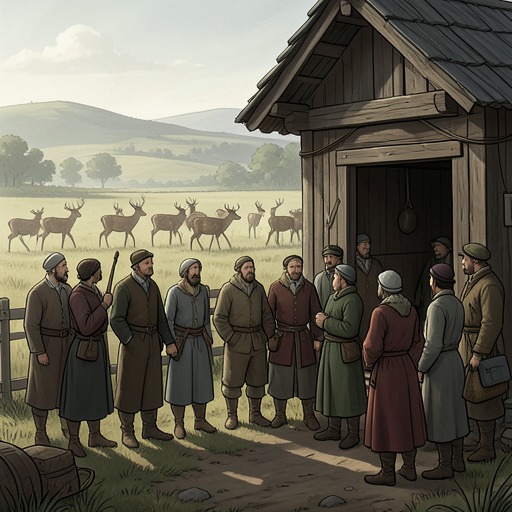
Ohma’s family is close to disaster when Van arrives. They earn little, yet pay a head tax on every reindeer. Taxes are lighter for Kiya and Tohma because of their Zolian ancestry, but that relief is not enough. Ohma has sold some reindeer and tried raising pyuika, which are taxed less, but unsuccessful breeding has left the family’s future uncertain. Their first attempt also imposes avoidable hardship on the animals: stakes inside the corral tether each one, and even Tsupi, who had drawn a cart willingly, resists being tied. Yoki explains that the pyuika jump fences and eat heavily, treating the restraints and expense as unavoidable.
Van recognizes that the problem is not simply the animals’ temperament. The pyuika sellers from Okuba had not told the family about mohoki, a lichen that pyuika avoid. Braided into ropes and hung around a fence, dried mohoki can keep the animals within it; without it, they either escape or decline if penned behind a fence too high to clear. Yet even an effective corral is not the best basis for raising them. Pyuika are grazers, and confinement is unsuitable except at night, when wolves are a threat. Their care requires knowledge of behavior and movement rather than tighter restraint.
Husbandry and Local Knowledge
Van explains that the pyuika’s herds are broad and loosely organized, with the doe and her fawns forming their clearest social unit. They are independent, but also loyal and susceptible to loneliness. A fawn bonded with a person will remember that keeper and come to his whistle. Because the animals migrate seasonally while following habitual routes, their movement can be guided by placing mohoki at strategic points. These observations turn the lichen from a simple corral aid into part of a wider method for managing the herd while allowing it to roam.
That method depends on familiarity acquired over time. In the Toga Mountains, children spend their days with adults in the forest, learning the animals’ habits and watching how selected fawns are trained and bonded to people. Pyuika that reach maturity without such exposure do not become accustomed to humans; early, sustained contact creates a bond that endures. In spring, Van persuades Ohma’s men to let their pyuika range freely, despite their fear that the animals will not return. The approach rests not on domestication by force but on building the animals’ comfort with people and learning the relatively narrow range they travel.
Breeding and training must also be balanced. Pyuika usually bear twins, and the fawn separated from its mother for human bonding is the larger, stronger one, which drinks more milk. Van recalls his father’s instruction, “The weak one to the mother, the strong one to me.” Both sexes can be trained to ride, but bucks must be gelded before maturity if they are to be manageable during mating season. Selecting too many of the strongest males would weaken future generations, so decisions about training have to account for the condition of the herd. Geldings retain their antlers in spring, have less muscular strength but greater stamina, and are more obedient. These requirements make pyuika breeding slower and more deliberate than the Zolians’ apparent assumption that the animals could be bred like horses.
Seasons, Cooperation, and Results
The breeding program has to fit the family’s other work. Reindeer need to move to summer pastures where sea winds keep horseflies and other pests away, while pyuika give birth in the same season. The previous year, the pyuika had been tied and led along after the migrating reindeer; Van suspects that this unnatural routine contributed to their failure to breed. Leaving reindeer in their winter pasture is not a workable solution, because summer insects swarm there and the grasses are thin. Reindeer also eat a varied diet, including mice and insects, but still need the summer pastures.
After several days of discussion, Tohma proposes asking neighboring families for help. The family approaches Kiya’s immediate and distant relatives, Zolian immigrants who have also struggled to breed pyuika and are eager to learn from Van. They agree on a division of labor: three of Kiya’s nephews, Mino, Chida, and Moki, stay to learn pyuika husbandry, while the others take the reindeer to their usual summer pasture. Kiya remains to care for Yuna. At first, the nephews follow Van through the forest in silence, but the arrangement gives them direct experience instead of leaving either household to manage both seasonal tasks alone.
The results arrive in stages. That fall, four of Ohma’s pyuika are impregnated, and word comes that three does in the nephews’ herd will also bear young. The family hides in the forest when the tax officer visits; encouraged by the animals’ breeding and the tax reduction, they are able to keep the relief and spend the surplus on winter supplies. Van’s hunting yields more furs, which the nephews take to Kazan along with dried meat. They return with carts loaded with provisions and clothes, and the two settlements share a feast. The program has not merely produced calves: it has helped households coordinate labor, trade, and preparations for winter.
The next year confirms the gains. After a rainy spring, the pyuika bear healthy young by early summer, and Tohma becomes capable at handling them, riding a fawn born to Tsupi the year before. When Kiya’s nephews report births in their herd and ask for help, Van visits their settlement to guide the bonding process. The fawns initially attach more strongly to Van, making the young men anxious, but their persistence allows the animals to grow affectionate toward their own keepers. Van leaves once they are absorbed in the work, confident they can continue learning without relying on him. His guidance has helped establish knowledge that can be carried between households, rather than a practice dependent on his permanent presence.
Limits and Significance
The program succeeds within a political system that makes the family’s livelihood precarious. The Oki clans were not recognized as Aquafaese under Zolian rule, despite speaking the language and having defended the kingdom’s borders; Zolian policy could therefore relocate them as lower-caste subjects. The empire also managed frontier populations through records of where people lived and their ages, information gathered by tax officers even from outlying communities. For Ohma’s family, the immediate consequence is visible in the head tax and the value of raising less-taxed pyuika. The same tax relief that makes the experiment worthwhile may not last: Van expects the Zolians could abolish it once they recognize how difficult pyuika are to breed for their purposes.
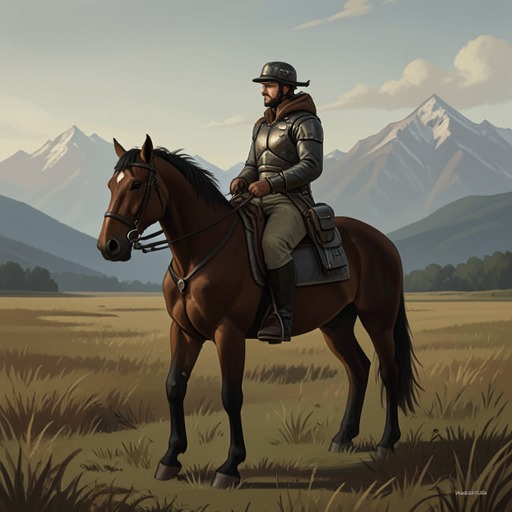
Van sees another danger in the animals’ distinctive bonds. Since pyuika respond to those who raised them, he fears that the empire might conscript young men from Oki as Pyuika Riders to guard its frontier. This is a possibility he does not share with Ohma while the breeding effort is still uncertain. The program therefore carries a double meaning: a locally grounded way to protect a family from immediate want, and a skill that imperial authorities might turn toward military use. Its promise lies in cooperation and close knowledge of the animals; its limits lie in the power of others to tax, relocate, or recruit the people who sustain them.