Oki laputa
The Deer KingOki laputa, a cheese made from reindeer milk, carries the taste of a northern pastoral world into scenes shaped by migration, religious discipline, and military expansion. In Aquafa it is both a prized delicacy and a vanishing one: a food whose changing availability makes political and economic transformation visible at the table.
Identity and Place
Oki laputa is described as a rich cheese made from reindeer milk. Its name points toward Oki, the northern land where herders followed reindeer, rather than toward the southern Sacred Territory of Otawalle, where such products were less familiar. When Hohsalle tastes it at a gathering, its creamy richness surprises him; he explains that merchants from Oki rarely travel as far south as Otawalle, so reindeer-milk cheese is not part of the food he knows.
The cheese’s northern origin matters beyond its flavor. Makokan recognizes it as a product of the valley where reindeer herders lived, a reminder that food travels along routes linking distinct regions and ways of life. In the Aquafa gathering, lapateh made with Oki laputa is served among the king’s family, while the governor’s table features delicacies containing no milk. The contrast places the cheese within a social world where diet reflects not only availability, but also custom and restraint.
A Delicacy Kept in Secret
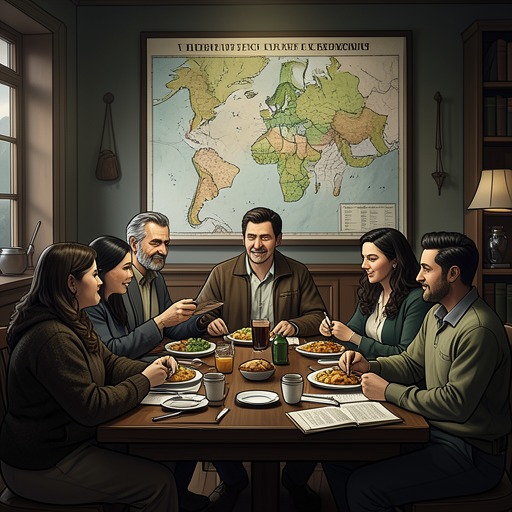
Sulumina serves Hohsalle a small plate of lapateh and explains that she loves Oki laputa, asking the household nurse to obtain it when the season comes around. Her pleasure is not simply public hospitality: her husband, Yotalu, will not eat food made with milk and does not wish to see her eating it either. Sulumina therefore enjoys reindeer-milk products when he is not looking, and her sons share her preference, especially for soft lachu made with reindeer milk. In front of their father, the boys act as though they would never touch such food.
Hohsalle responds with amused approval, noting that yogurt is good for health and encouraging Sulumina to continue eating it out of Yotalu’s sight. The exchange gives Oki laputa a place in a small domestic negotiation: a delicacy enjoyed in private against a household prohibition. It also distinguishes the king’s niece and her sons from Yotalu’s strict abstention, while showing that the custom does not prevent their appetite from persisting.
Scarcity and Changing Markets
Sulumina says that Aquafaese prefer lapateh and lachu made from reindeer milk, but that these have recently become difficult to obtain. Most available products are now made from sheep’s or cow’s milk. Her family can still secure reindeer products because their nurse has relatives connected to the reindeer market, who set some aside; without those connections, she says, obtaining them would be impossible. Even within a privileged household, access depends on a narrow chain of personal ties.
Makokan’s recollection broadens this scarcity into a market change. Reindeer- and mare-milk cheeses and yogurts had once been the norm in Aquafa, but since settlers from Zol arrived, cheaper and more readily available cow- and sheep-milk products have flooded the markets and become popular. The shift does not erase older tastes: Sulumina and her sons continue to favor reindeer products, while her brother’s children insist that cow-milk lapateh is better and refuse the reindeer version. The disagreement registers a changing preference across generations and households, alongside the practical advantage of cheaper supply.
Reindeer, Military Pressure, and Cultural Change
Makokan suspects that the decline in Oki laputa may also reflect a falling number of reindeer. He connects that possibility to the Zolian army’s recent push to breed pyuika, driven by its view of the Kingdom of Mukonia to the west as a threat and its desire to strengthen defenses along the mountainous border. The narrative presents this as Makokan’s conjecture, not a confirmed explanation, but it links the cheese’s scarcity to military policy as well as to market competition.
Oki laputa thus gathers several changes into one familiar food: northern herding, Aquafaese taste, southern distance, household religious restraint, commercial displacement, and possible pressure on reindeer populations. Its significance rests on that convergence. A small plate offered at a formal gathering can disclose how far a regional product has traveled, who can still obtain it, what a family eats behind closed doors, and how the expanding presence of Zolian settlers and military priorities may alter the material conditions of everyday life.