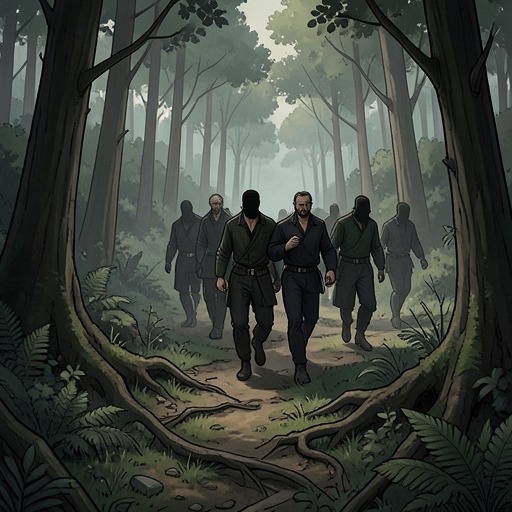
Otawalle Sacred Territory
The Deer KingOtawalle Sacred Territory is both a place of medical learning and a territory under Zolian imperial rule. Its physicians offer treatments rejected by the Pure Heart Creed, making the territory’s knowledge a source of hope for patients and a challenge to the religious and political order. Its importance also reaches inward: research in the Academy of Deeper Learning is tied to a hereditary memory disorder among descendants of the ancient ruling line.
Territory and Imperial Rule
The Sacred Territory and the Kingdom of Aquafa are both ruled by the Zolian Empire, but the territory’s history and status are distinct. Its ruling houses trace descent from the ancient ruler of Otawalle. The Three Sacrosanct Houses are regarded as direct descendants of the divine ruler, while the Eight Hallowed Houses are indirect descendants; this hierarchy carries social weight, though Hohsalle’s stepmother has forgotten the distinctions that once defined her family’s standing.
Zolian authority also extends into the frontier through administration and settlement. Imperial records classify people in remote areas, including the Oki Valley and the Toga Mountains, and count their residents and ages. Elsewhere in the empire, poor farmers and herders are moved to conquered frontiers to establish Zolian-style settlements, grow preferred crops and livestock, and mingle with local populations. Lower taxes and land of their own can benefit these settlers, but forced distance from home brings lasting grief. The territory’s position within this political system means that medical cooperation and the handling of disease cannot be separated from imperial interests.
Medicine and Religious Authority
Otawalle physicians, including Limuelle and Hohsalle, practice a medical science that conflicts at its foundations with the Pure Heart Creed. Zolian priest-doctors regard medicine as a religious duty and, when they judge an illness incurable, accept death rather than pursue treatment they consider improper. Hohsalle comes to understand that this is not merely a dispute over professional authority: the two systems begin from incompatible beliefs about whether disease should be actively resisted.
The conflict became visible when Emperor Natalu summoned Limuelle and Hohsalle to treat his gravely ill wife despite opposition from his advisers. They cured her. Natalu asked them to remain as palace physicians and teach the priest-doctors, but the association of priest-doctors reacted furiously. Limuelle and Hohsalle declined the appointment, yet the episode had already exposed the imperial elite to Otawalle medicine. Over the following decade, nobles secretly sought its physicians after being told their illnesses were incurable; nonetheless, Otawalle treatment remained officially branded heresy, because the Pure Heart Creed was understood as essential to holding the empire together.
The division has practical consequences during an outbreak. When Hohsalle seeks permission to inform the territory and ask for advice, Yotalu supports involving Otawalle rather than concealing the danger from those able to help. Hohsalle later recognizes that the priest-doctors would not agree to inoculation, since prevention itself conflicts with their understanding of treatment. Limuelle argues that bringing them into cooperation could release Otawalle medicine from institutional constraints, opening access to greater funds, personnel, and patients across Zolian society.
The Academy and the Memory Disorder
The Academy of Deeper Learning is a center of research in the Sacred Territory, but some knowledge is kept within its walls. Descendants of the divine founder of the ancient kingdom experience unusually frequent memory loss, sometimes while still in their prime. The condition, known privately as the Divine Ruler’s Curse, is especially common among the Three Sacrosanct Houses, whose members are revered as the Most Sacred of the Sacred. Discussion of it is forbidden outside the Academy.
Some interpret the disorder as punishment for seeking knowledge that brings humanity closer to the gods. Hohsalle rejects that moral explanation: disease does not distinguish between virtue and wrongdoing. The secrecy surrounding the condition reflects the stakes for the ruling line, while research offers a possibility of relief. When a mouse becomes part of an experiment connected to whether a treatment might work in humans, the question carries hope for generations of affected descendants, not only for an individual patient.
Disease, Politics, and the Frontier
The Sacred Territory’s medical role also intersects with political suspicion. The Toga Mountains are the last barrier against an invasion from Mukonia and are heavily garrisoned by Zolian troops. Reports of attacks that might involve trained dogs or wolves therefore raise fears of rebellion; a governor has warned the King of Aquafa, although Hohsalle’s interlocutors do not consider the king’s involvement proven. The prospect of unrest in such a strategic region makes uncertainty itself politically dangerous.
At the same time, Makokan recognizes that neither the Sacred Territory nor the Kingdom of Aquafa is obliged to capture people exacting vengeance on the Zolian Empire and hand them over. Hohsalle counters that disease is too unpredictable to serve safely as a weapon: even specialists cannot fully understand its changing relations with living beings. The territory’s place in the story thus brings together competing pressures—imperial security, religious authority, hereditary illness, and medical efforts whose consequences cannot be neatly contained.