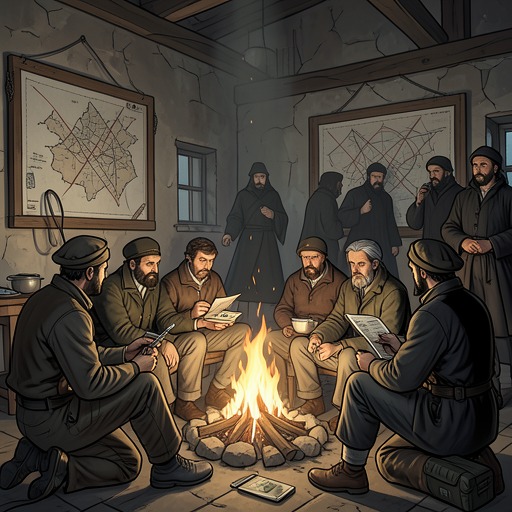
Otawalu Great Evacuation
The Deer KingThe Grand Edict of the Exodus was the mass departure that ended the ancient kingdom of Otawalle’s rule and gave rise to the Kingdom of Aquafa. Its origin lies in a plague associated with black wolves; its defining act was Takaluhalu’s decision to abandon the capital, isolate it, and save those not yet infected. The event survives not simply as a catastrophe but as a founding story whose terrible choices shape later arguments about disease, authority, and divine punishment.
Background: The Plague and the Capital
About two and a half centuries before the events recounted in the novel, an epidemic swept through Otawalle, killing many capable statesmen before spreading through the kingdom. Its political structure weakened, and the decline of a realm that had flourished for thousands of years accelerated. Some later accounts attributed the disaster to divine anger at Otawalle’s exceptional knowledge, but the cause of the kingdom’s original collapse remained obscure.
In the account Hohsalle gives Yotalu, the plague’s story begins with black wolves brought back from the Toga Mountains by noblemen hunting for sport. Their unusual appearance made them fashionable acquisitions, and merchants and hunters captured and sold them. Historical records, as Hohsalle relates them, also say that some wolves were bred with dogs. The first animals may not have carried the disease; the trade nonetheless brought the wolves into the capital and multiplied human contact with them.
The first reported victims were black-wolf merchants who had been bitten. The illness appeared to disappear after the Divine King banned the trade, then returned as summer approached, now killing people who had not been bitten by wolves. Academy of Deeper Learning physicians suspected transmission from wolves to blood-feeding fleas and ticks, then to rats. The disease began in the poorest, most crowded districts and spread across the capital; attempts to exterminate rodents and pests began only after thousands had died.
The Exodus and Its Cost
Otawalle’s capital stood among three islands in a large inland sea. The location had offered strong defense against invasion, but its enclosed environment was also thought to have made the plague unusually lethal. That same geography offered a means of containment: the capital could be cut off from the mainland.
When Yotalu asks how the people stopped the disease, Hohsalle answers that they abandoned the capital. King Takaluhalu left the sick and those who refused to leave behind, then destroyed the long bridge connecting the capital to the mainland. The severed crossing isolated the infected city and helped protect those who had not contracted the illness, but it made the rescue inseparable from the abandonment of the people remaining there.
The ancient records describe the departing Otawalle walking naked and weeping in single file across the bridge. Hohsalle calls the scene a farce in its recorded presentation, while emphasizing that the fate of those left behind was no joke. The contrast exposes the human cost beneath the formal name of an edict: collective survival was achieved by drawing a boundary between those who could leave and those who could not or would not.
From Otawalle to Aquafa
After leaving the capital, Takaluhalu moved the seat of government to Kazan, a trading city in Aquafa that had escaped the plague. He relinquished his crown to Kazan’s young ruler in exchange for a pledge to preserve local autonomy for the diverse peoples of the former realm. In this way, Aquafa’s kingdom began as a political settlement shaped by the flight from black wolf fever, not simply as the continuation of Otawalle under another name.
The transfer of authority followed the ancient kingdom’s longer retreat from centralized rule. Otawalle survivors established a Sacred Territory in a mountain-ringed valley and devoted themselves to preserving and developing medicine and other fields. They retained substantial influence through their learning and information networks, even after giving up their own country. Thus the Exodus ended one form of Otawalle sovereignty while its knowledge and institutions continued to affect the political life of Aquafa.
Memory, Rumor, and Later Consequences
Hohsalle recounts the Exodus through the Ballad of the Fall of Otawalle, an epic whose opening refers to black shadows arriving from white mountain peaks. In his explanation, those shadows are the black wolves. The song gives the outbreak a memorable origin, while Hohsalle’s historical account distinguishes the stages of transmission and the uncertainty surrounding the plague’s earliest appearance.
The story also recurs as a practical warning in the present. Hohsalle tells Yotalu that the disease does not spread from person to person and that symptoms appear quickly after an infected animal bites its victim. This knowledge offers a basis for recognizing and responding to the illness, but the old catastrophe cannot be reduced to a simple lesson: the epidemic’s spread through other carriers and the abandoned capital show how quickly limited knowledge and delayed action can turn an outbreak into a civic disaster.
Later rumors recast the disease as the Curse of Aquafa, claiming that it kills Zolians but spares Aquafaese. Hohsalle rejects the claim as unproved and warns that belief in immunity could make Aquafaese less cautious around disease-bearing animals. He further fears that wider exposure might allow the illness to change and spread through insects feeding on infected humans and animals. The Exodus therefore stands behind both scientific inquiry and political myth: a past plague is invoked to explain present deaths, even as Hohsalle insists that such explanations must not replace attention to how infection actually spreads.
The tale’s political meaning is similarly unsettled. Otawalle’s withdrawal from its capital preserved the uninfected, but Takaluhalu’s decision also meant leaving part of his people behind; Hohsalle suggests that the king may have concluded he was unfit to rule. Centuries later, stories of divine punishment can turn the memory of that loss into a weapon against outsiders. The Exodus remains foundational precisely because it joins a kingdom’s birth to an act of emergency rule whose human and political costs were never erased.