Sae Tracks Van
The Deer KingSae Tracks Van is the pursuit of an escaped slave through the evidence he leaves behind. Sae’s work turns the salt mine’s wreckage and a rain-soaked forest campsite into a sequence of human actions: Van broke free himself, fled the mine, and traveled with the aid of an injured man and a pyuika-drawn cart. Her method gives the chase its direction, but the trail does not promise safety or success; when Sae and Makokan reach the Oki valleys, a black face appears above them on the mountainside.
The Pursuit Begins
Sae arrives at the Aquafa salt mine with almost no baggage: a small leather satchel over one shoulder and a hound at her side. Makokan recalls the Aquafa maxim “Travel light like the trackers.” The saying becomes a practical description of her approach. Their journey has no known duration, and her equipment is pared down to what the pursuit requires.
Seven days have passed since Van escaped, and it has rained in the meantime. Yotalu points out that even a keen-nosed hound may find the old scent difficult to follow. Sae acknowledges the obstacle without claiming certainty: she has a few methods to try, and asks permission to use them. Yotalu initially seems surprised by the resolve beneath her modest appearance, then leaves the work to her and offers whatever assistance she needs.
Before entering the mine, Sae listens closely to a soldier’s account, attending even to details that seem irrelevant. She leaves her hound at the entrance and descends with the soldier to the level where Van had been held. The pursuit begins not with a chase but with a careful survey of the place where it started.
Reading the Mine
Corpses still lie in the dark tunnel. Sae pauses to pray, and Makokan notices that her fingers tremble. She then stands for a long time beside Van’s former bedding before lowering herself almost to the rock floor to study it. At the broken chain, she examines the metal and the ground, but when Makokan asks what she has found, she at first withholds her conclusion.
Sae eventually tells Makokan that she believes Van snapped the chains himself. Her reconstruction depends on the arrangement of traces, not on a witness’s account. She demonstrates how the chain could have pulled his right leg from under him, pitching him forward; marks suggest that he caught himself with both hands. The straw also bears the imprint of heels digging in as he strained against the chain. Had someone helped him, she reasons, the straw nearby would have been disturbed too. Instead, the signs point to a fall, followed by Van springing up and running. She allows for the possibility that her reading is wrong, and asks that Van be questioned directly if they find him.
The broken entrance to a kitchen offers another clue. Sae’s hound eagerly sniffs the door, and she removes a thread caught in its splintered wood, explaining that Van’s clothes had been frayed. Inside, she studies the room from low to the ground, repeatedly changing her position and looking up at the sausages hanging from the ceiling. The movements echo her examination of the mine: she reads a place not as a static scene but as evidence of where a body went and what it did.
At the neighboring, apparently slave-used kitchen, Sae investigates the ground outside, including the area beneath a high window. She returns with a small chair and points out that someone brushed dirt over the spot where it had stood, then used it to climb through the window. Dirt on the undersides of the chair’s legs supports her reconstruction: the person erased the marks left outside and put the chair back inside. Makokan can see no trace of the brushing, a contrast that makes the reach of Sae’s tracking skill plain to him.
The Trail Through Aquafa
Sae continues through the empty slaves’ kitchen as autumn light fades. The floor is covered in footprints, probably left by the men who removed the bodies, and she examines them one by one while her hound searches for Van’s scent. At a clay oven, she remains still for a long time before concluding that Van spent the night there. Marks on the floor indicate that a tub had been placed in front of it. Since no similar marks appear at the other ovens, she reasons that Van washed there before leaving, rather than the spot being part of the slaves’ ordinary bathing routine.
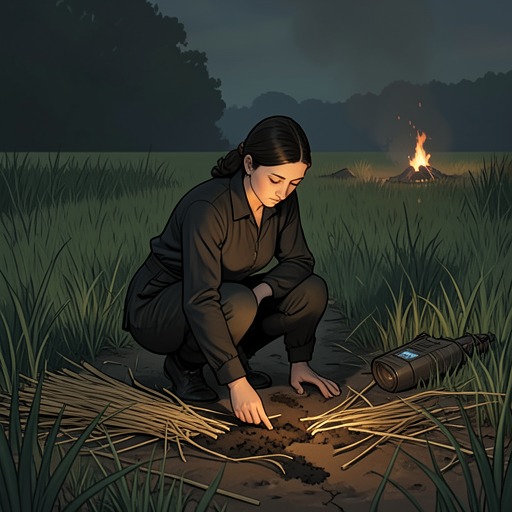
The path from the salt mine to Oki is not established by a single clue. Tohlim determines that Van probably fled toward the Oki region, but Sae’s findings supply the evidence behind that conclusion. Her father and his band of trackers had found a doused campfire in the forest. From the tracks around it, Sae inferred that Van had met someone traveling by cart; the hound also picked up Van’s scent by the firepit despite the days that had passed and the rain.
The rain-wet ground preserves signs of a transfer. Footprints show someone bracing themself while lifting another person into a wagon. The hoofmarks identify the cart’s animal as a pyuika, not a horse or reindeer. That distinction narrows the possibilities: pyuika are difficult to handle, so farmers and merchants would not ordinarily harness one to a cart. A northern nomad traveling to sell furs and goods becomes the more plausible lead.
Many pyuika-drawn carts had come to sell furs, but one trader reported a young man named Tohma who was too badly injured to walk. The trader had seen him supported by a sturdy-looking man. Tohlim matched that man to the escaped slave and passed the information to Sae. The trader also said that the man expected to work for Tohma’s people and would likely return. The lead is promising, but incomplete: Tohma is a common name, Oki is a vast region of plains, low mountains, and valleys, and nomadic settlements are scattered across it.
Choosing the Mountain Journey
Tohlim suggests waiting for spring. Sae rejects the delay: if they are going to search, she argues, they should leave as early as possible. The decision turns a trail that might have been preserved for a later season into an immediate journey through worsening weather. Makokan has agreed to her proposal without understanding that she intended to spend the winter on the move, and he privately longs for a hot bath, good food, a soft bed, and a roof sturdy enough to keep out the cold. For Sae, however, movement is ordinary; for Makokan, it is a deprivation he has not chosen lightly.
As they descend a cliff trail toward the valley floor, the sun appears beneath the gray clouds and lays golden light across the basin. It is still high, but will vanish quickly behind the mountain rim, leaving them to find a settlement before night. Makokan sees men tending their herds in the distance and feels briefly encouraged. The uncertain search has at least brought them into inhabited country.
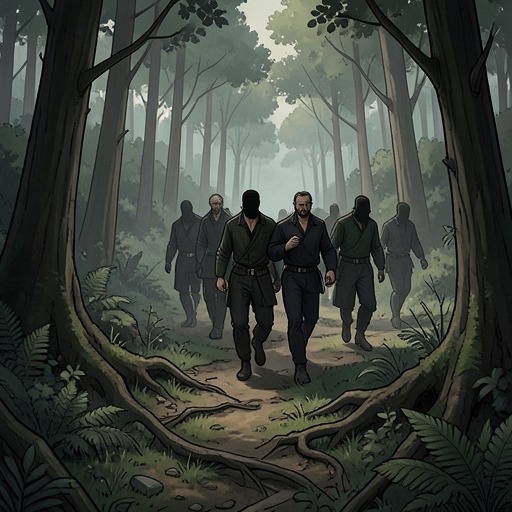
Then Sae halts her reindeer and cocks her head to listen. Makokan senses danger on the side facing the rock wall; goose bumps rise along his right side. Looking up, he sees movement in the underbrush and a black face peering from above. The search has traced Van’s route toward Oki, but it ends this stage not with the fugitive in sight, but with the pursuers exposed to an unseen threat.