Shikan
The Deer KingShikan is Tomasolle’s assistant, a young member of the Ahfal Oma whose skill with animals and sharp, independent presence connect the Academy’s scientific work to the traditions of a people driven from their homeland. He is both an accomplished handler and a keeper of knowledge: in the investigation of a dangerous disease, his account of the Ahfal Oma’s god Kinma turns an experiment with hounds into a history of cultural practice, conquest, and survival.
Identity and Place of Origin
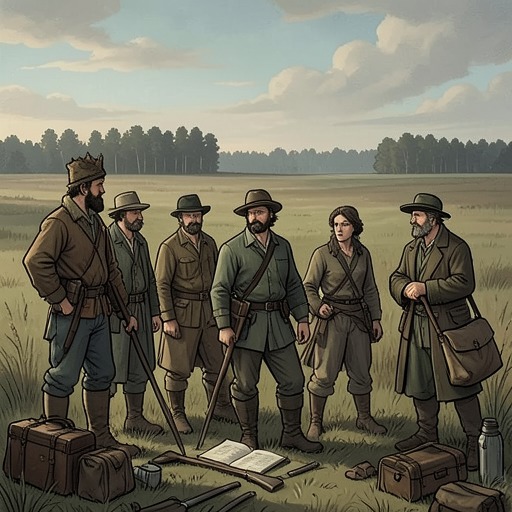
Shikan belongs to the Ahfal Oma, the People of the Fire Horse, and comes from the Yukata Plains in southern Aquafa. The Ahfal Oma bred the fire horses regarded as Aquafa’s pride. His identity is therefore bound to a distinctive animal tradition, not merely to his position as an assistant at the Academy.
Tomasolle’s interest in living creatures had led him to travel to the Yukata Plains in his younger days, where he spent time among the Ahfal Oma studying their horses. His long-standing fascination with the animals helps explain why he later took Shikan under his wing. The relationship also places Shikan within a community whose expertise and livelihood had been directly disrupted by Zolian rule.
Work and Character at the Academy
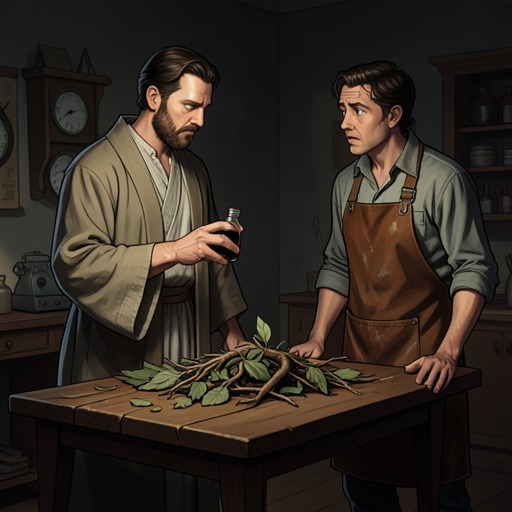
Barely twenty, Shikan is a sober, reliable, and highly capable assistant. His particular strengths are training hounds and horses, and his services are valued both in the kennels and the stables. When he enters the room where Tomasolle and Hohsalle are examining a wolf, the caged animal reacts savagely to his scent, throwing itself against the bars. Shikan notices the commotion but passes without changing expression. Asked what he had done to excite the wolf, he explains that the kennel master had asked him to check one of the hounds.
The episode makes visible the expertise that his quiet manner conceals: his work with the hounds has left a scent the wolf recognizes, though Shikan himself treats the encounter as ordinary. Tomasolle and Hohsalle exchange a wry smile. Shikan’s impassive expression can make him easy to misunderstand, but the account identifies him as intellectually sharp as well as practically skilled. He has no scandal attached to his name, and his competence is not confined to one stable or kennel.
His manner does not soften in the presence of rank. At Tomasolle’s prompting, Shikan gives Hohsalle a perfunctory bow and a barely audible greeting. Although Hohsalle belongs to a powerful family and could significantly affect Shikan’s advancement, the young assistant shows neither nervousness nor deference. Hohsalle accepts the aloofness with a faint smile; Tomasolle, more openly teasing, tells Shikan that his rudeness and unsociability would be easier to work with if he learned to be friendlier. Shikan’s restraint is thus both a source of friction and a consistent mark of his self-possession.
The Fire Horses and Zolian Conquest
Shikan’s reserve sits beside a history of dispossession. After Zoli conquered Aquafa, it banned the Ahfal Oma from raising their fire horses and converted the Yukata Plains into pastureland for sheep. Tomasolle, normally good-natured, was furious at this transformation. Before the Zolian army could take the horses, he paid the Ahfal Oma a large sum for twenty of their best stallions. He would have bought them all, but doing so was financially and politically impossible; Luliya later reported that the head of the Academy of Deeper Learning had severely reprimanded him for his obsession.
Shikan’s employment by Tomasolle is therefore set against a conflict that is at once personal and political. The assistant’s presence at the Academy brings Ahfal Oma knowledge into an institution shaped by the broader order that displaced his people. The narrative does not present him as having abandoned that identity: when Hohsalle alludes to the Ahfal Oma as stubborn, a fierce light flashes in Shikan’s eyes, though he ultimately says nothing. His silence in that exchange contrasts with the force with which he later corrects a misunderstanding of his people’s faith.
Kinma and the Hound Tradition
When Tomasolle raises the god Kinma, Cheehana describes him as a small deity who takes the form of a fly and says that the Ahfal Oma fear him. Shikan immediately rejects the description. They do not fear Kinma, he insists; they revere him. He is a god who knows many things and shows many paths, and Shikan declares that the Ahfal Oma will not give in to people who are ignorant of him and foolish enough to hold him in contempt. The sharpness of this intervention reveals a boundary he will not let outsiders define: a sacred tradition must not be reduced to a superstition of fear.
Tomasolle then places Kinma’s importance in context and begins a long account. Cheehana recites an old teaching attributed to the god: a horse that dies should be burned so wolves do not dig it up and learn the taste of horseflesh, while a horse that dies of sickness should be buried so that a wolf will suffer and no longer want to eat horse. Shikan takes up the chant, his resonant voice drowning out Cheehana’s, and recounts Kinma’s meeting with a pregnant bitch whose pups were fathered by a wolf. Though warned of the pain, the bitch chooses to bear them. Kinma leads her to a mound where sick horses are buried; she eats the carcass, falls ill, gives birth, and dies, while her pups grow into the village’s best hounds.
Shikan does not leave the story as myth alone. He explains that, when fire horses were plentiful, the Ahfal Oma buried those that died of illness and later dug up their carcasses to feed to pregnant bitches. Unlike the bitch in the song, the dogs did not die, and their puppies grew loyal and strong and did not succumb to sickness. The account links an inherited chant to a concrete practice of animal breeding and disease resistance. It also reframes the caged wolf’s response to Shikan: the assistant’s familiarity with hounds is part of a wider body of animal knowledge, one grounded in the historical and religious life of the Ahfal Oma.
Narrative Significance
Shikan’s role is brief but consequential because he moves between forms of knowledge that the Academy might otherwise keep apart. His work with hounds and horses is practical, his defense of Kinma is personal and communal, and his recitation preserves a tradition that explains how the Ahfal Oma bred strong dogs. The episode makes his competence legible through both action—the wolf reacting to a familiar scent—and speech, when he insists on the meaning of his people’s belief and supplies its history.
The contrast between his taciturn behavior and his emphatic defense of Kinma gives his reserve a clear dimension: Shikan is not indifferent to how others see him or his people. He may offer Hohsalle only a perfunctory greeting, but when the Ahfal Oma are misrepresented, he speaks without hesitation. In a story concerned with disease, animals, and the limits of received explanations, his testimony shows that local religious and ecological traditions can encode practical knowledge while also carrying the memory and dignity of a conquered people.