Taya
The Deer KingTaya, chief of a Zolian settlement in Aquafa, becomes an important local informant when Hohsalle and Makokan investigate illness in the region. His account of toxic hybrid grain links livestock deaths to the meeting of immigrant farming and native agriculture, while his position as a frontier settler also reveals how imperial resettlement reshapes both land and community.
Identity and Introduction
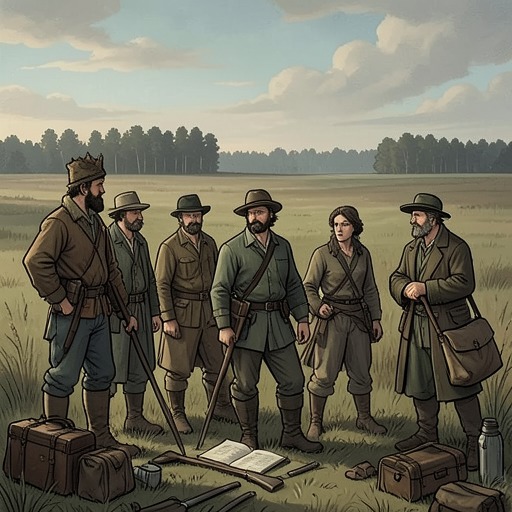
Taya is a middle-aged man and the chief of a settlement whose fields and sheep pastures lie in the frontier country. Wearing the uniform of a low-ranking officer, he approaches Hohsalle and Makokan with his dogs and calls them back in Zolian. He is visibly relieved to find Hohsalle, whom he had sought at his lodgings after receiving notice of the visit. The introduction comes through an official connection: Hohsalle had written to Yotalu, the governor’s son, asking him to alert someone familiar with the area, and Yotalu had responded promptly.
Taya identifies himself by name and office, then leads the visitors to his home. The settlement’s surroundings make its character plain: rye planted in late fall is sprouting despite the bitter cold, and sheep graze nearby. The dwelling is a mud-and-straw house with a thatched roof, set behind a wooden gate; hens scatter noisily when the visitors ride into the yard. These details place Taya within a working agricultural community rather than an imperial center.
Role in the Investigation
Taya’s local knowledge becomes crucial when Hohsalle hears an account of the deaths of fire horses. Nohmeh, an old woman in the household, reacts angrily to the subject, explaining that her older brother was killed at the time and insisting that it was not their grain that the horses had eaten. Taya responds gently, apologizes for her distress, and explains why the memory remains painful. His manner allows Hohsalle to pursue the question without dismissing either the woman’s grief or the account she is trying to correct.
Hohsalle points out that Aquafan wheat was native to the region and had fed fire horses for generations, making it unlikely that the wheat alone explained the deaths. Taya supplies the missing distinction: the horses had eaten Aquafan wheat grown by the Ahfal Oma, but some of it had crossbred with rye brought by the immigrants. The crossing was accidental; Taya says rye pollen was probably carried into the fields by the wind. His explanation turns a dispute over whose grain caused the disaster into a more specific account of how the crops had changed.
Toxic Grain and Its Consequences
Taya confirms that the hybrid grain was toxic and that its poison was powerful. The damage did not fall on one community alone: it killed the Ahfal Oma’s fire horses, but many immigrant sheep also died after eating the same grain. He describes the animals’ illness as involving jumping and leaping before convulsions, and says the settlers called it sheep-dancing sickness. The detail establishes that the crop crossing had consequences for both the native people and the newcomers, even though they occupied sharply unequal positions in the changing frontier.
Taya’s explanation also gives Hohsalle a new line of inquiry. Once Hohsalle understands that a hybrid strain could account for the poison, the horse deaths are no longer simply an accusation against the settlers or a mystery about a familiar native crop. The danger lies in an unintended agricultural change: rye pollen entering Aquafan wheat fields. Taya is not described as having deliberately produced the grain; his contribution is to clarify what happened and how the resulting poison affected the settlement’s livestock.
The Frontier Settlement System
Taya’s community belongs to a broader policy of Zolian expansion. The empire resettles poor farmers and herders from the edges of its own territory as its borders grow, directing them to construct Zolian-style communities in conquered lands. They raise the crops and livestock preferred by Zolians, build towns according to Zolian methods, and are expected to mingle with the conquered population. In this way, settlement is not merely a response to individual hardship: it helps transform new territory into imperial land.
The policy offers material advantages to the settlers. Their taxes are lower than they would have been at home, and land they clear for farming becomes wholly theirs, a sharp contrast with the tenant farmers many had been. But those benefits coexist with forced separation from their original homes: many settlers grieve that they cannot return. Taya’s settlement—with its rye fields, sheep pastures, and Zolian-style mud-and-straw houses—embodies both sides of that arrangement. Its agricultural life is also entangled with the local population’s losses, as the hybrid grain that harms immigrant sheep has already killed the Ahfal Oma’s horses.
Narrative Significance
Taya has a limited but consequential role: he is the local official who welcomes Hohsalle’s party and makes the agricultural history of the fire-horse deaths intelligible. His explanation depends on attending to both the native wheat and the immigrant rye rather than assigning blame to either community in isolation. The resulting account does not erase the unequal conditions of conquest and displacement; instead, it shows how imperial settlement brings people and farming practices into contact, with consequences that cross community boundaries.
The conversation also places personal memory beside structural history. Nohmeh’s anger is tied to her brother’s death, while Taya’s quiet explanation traces the disaster to a change neither group necessarily intended. Through this exchange, Taya helps the investigation move from a painful recollection toward a concrete cause, and his settlement becomes a small-scale view of how Zolian frontier policy reorganizes land, livelihoods, and relations between newcomers and the conquered.