Tomasolle
The Deer KingTomasolle is Hohsalle’s brother-in-law and head of the School of Living Creatures at the Otawalle Academy of Deeper Learning. His appearances connect formal learning with practical knowledge: he helps arrange instruction in pyuika husbandry and later gives Hohsalle the floor to explain the disease among those bitten at the falcon hunt.
Identity and Institutional Role
Tomasolle leads the School of Living Creatures, a scholarly institution within the Otawalle Academy of Deeper Learning. He is also Hohsalle’s brother-in-law, placing him within the physician’s family circle as well as its intellectual one. The available episodes show him less through private history than through the settings in which he enables learning and testimony.
Supporting Pyuika Husbandry
When Van’s household confronts the difficulty of raising reindeer and pyuika together, the seasonal conflict makes cooperation necessary. Reindeer need to move to summer pasture as horseflies and mosquitoes swarm and the grass thins in their winter grounds; that migration overlaps with the pyuika calving period. Tomasolle proposes asking neighboring families for help. The families, including Kiya’s relatives, are eager to learn from Van, and three of Kiya’s nephews stay with Van and Tohma to study pyuika raising while the others take the reindeer to summer pasture. The proposal turns a household problem into shared instruction, with Tomasolle helping create the practical conditions for expertise to pass between families.
That work depends on knowledge of the animals’ behavior rather than simply keeping them penned. Pyuika are wilder than reindeer and resist restraint; successful husbandry requires acclimating them to people and cultivating personal bonds. Their range is relatively narrow, and their habitual paths can be influenced through knowledge of their habits. Van’s account also stresses the importance of allowing them to roam and of caring for them through breeding and calving. Tomasolle’s suggestion therefore belongs to a broader adjustment of husbandry around the animals’ seasonal rhythms, rather than an attempt to force them into an unsuitable livestock routine.
Family and Medical Inquiry
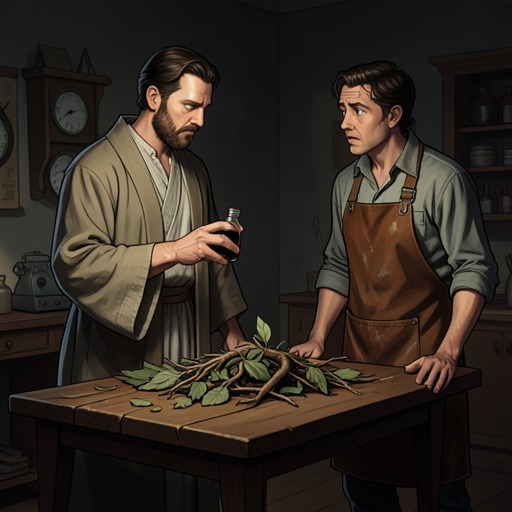
Tomasolle’s relationship to Hohsalle becomes explicit in a scene at the Academy, where a director offers spirits before Hohsalle gives his account. Hohsalle declines, explaining that alcohol might make him woozy while he shares his tale. Tomasolle glances toward him to indicate that he should begin; Hohsalle then provides a concise but detailed account of how the disease manifested and progressed among those bitten at the falcon hunt. Tomasolle’s role in this exchange is restrained but consequential: as a senior figure at the School of Living Creatures and Hohsalle’s brother-in-law, he helps open the institutional setting in which the physician’s observations can be heard.
The contrast between the two episodes defines the limits and reach of Tomasolle’s portrayal. In the herding discussion, he contributes a solution by bringing neighboring families into a practical teaching arrangement. At the Academy, he yields the speaking role to Hohsalle, whose direct experience supplies the medical account. In both cases, Tomasolle’s importance lies in enabling knowledge to move—between households in one instance, and from a physician’s field observations into an institutional conversation in the other.