Van Frees Ohma’s Pyuika
The Deer KingVan Frees Ohma’s Pyuika is the episode in which Van releases the penned herd at Ohma’s settlement, turning his inherited knowledge of the animals into a risky act of rescue. The scene’s decisive contrast is between confinement enforced through mohoki and the pyuika’s return to movement: Van frees them without denying their strength, and earns the men’s gratitude by enduring their anger and the lichen’s effects himself.
The Knowledge Behind the Rescue
Van understands that mohoki, a lichen growing on old trees, can be used to control pyuika. The animals loathe it and will not approach it; braiding dried mohoki into ropes and tying those ropes around a fence can hold them inside. Without this means of containment, pyuika may jump the fence or, if it is too high to escape, fall into a decline. When Van asks whether the sellers from Okuba had told Yoki about mohoki, Yoki’s unfamiliarity makes clear that the sellers must have known a crucial fact they had not shared.
Pyuika are grazers like reindeer, and confinement is not suited to them. They may need to be penned at night when wolves prowl, but they are better left to roam during the day. Their habits make the method both effective and troubling: a herd has broad, indistinct boundaries, though a doe and her fawns form a clear unit; the animals are independent, yet loyal and prone to loneliness. A pyuika bonded to a person as a fawn remembers him and comes at his whistle. The animals migrate seasonally but follow familiar routes, so strategically placed mohoki can guide their movements as well as block them.
That practical knowledge is part of Van’s clan’s way of life. Its children spend their days in the forest alongside adults, learning pyuika habits, watching fawns chosen for training and seeing how the animals bond with people. Their ability to identify and train pyuika develops through this close observation, a practice maintained since ancient times. Van’s intervention draws on that inherited familiarity, not simply on a technique for overpowering the animals.
Van Enters the Enclosure
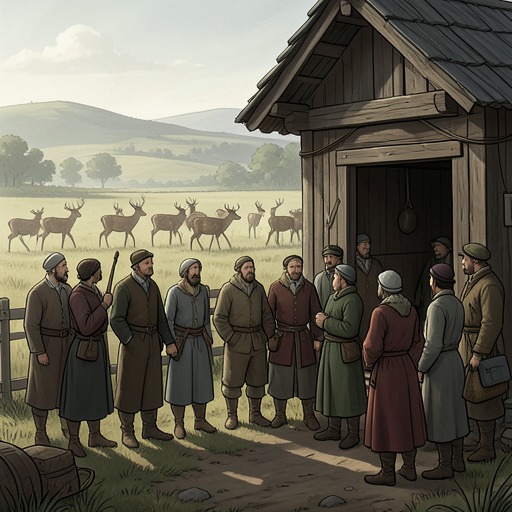
By dusk Van returns to the settlement and goes straight to the fence. The usual method would be to dry mohoki and weave it into rope, but he will not wait: seeing the pyuika tied to stakes has upset him too much to remain still. Ohma and the other men watch from one side without interfering, their expressions turning apprehensive as Van winds mohoki around strategic points in the fence and steps inside.
He approaches a large buck with a stick of firewood in his left hand and an ax in his right. Making short clicks with his tongue, he cuts the rope attaching the buck to its stake with a single stroke. The animal rears, then brings its antlers crashing toward Van’s head. The men gasp. Van thrusts the firewood beneath the buck’s jaw, and the great animal collapses as if its strings had been cut. The gesture is an intervention at close quarters: Van does not keep the buck subdued, but uses a moment of danger to sever its tether.
The buck shudders, waves its legs, rises, and shakes its head. Perhaps recognizing that it is free, it trots around the enclosure while keeping clear of the fence. Van waits silently for it to calm; only when it slows and begins grazing does he move to the next stake. He repeats the process for the rest of the herd, freeing the animals individually rather than driving them out in a panic.
Tsupi and the Herd’s Release
Van leaves Tsupi until last. She is carrying young, and he calms her with clicking sounds before quietly cutting her rope. She bounds up and down like a fawn, then butts Van in the back and nuzzles him beneath the armpit before strolling away to eat grass. Her affectionate response distinguishes her release from the buck’s startled escape: the scene recalls the bond between a pyuika and a person formed through trust, and gives particular force to Van’s care in approaching her.
By the time every animal is free, the meadow’s long shadows have deepened into dusk. Van steps outside the fence and wipes the sweat from his brow. The apparent exhaustion comes not from the physical labor alone but from bearing the full force of the pyuika’s anger and the odor of mohoki. Once outside the enclosure, beyond the range of those sensations, something inside him slackens and he breaks into a sweat. The effort has demanded that he remain exposed to what he was using to control the animals.
Gratitude and Significance
Ohma comes over to ask whether Van is all right, and Van nods, still wiping his face. In the dark, he recognizes the emotion in Ohma’s eyes. Ohma murmurs “Osumari anamanoh,” ancient words of gratitude also used by Van’s own people; the accent differs slightly, but the words are recognizable. The shared expression makes the men’s relief legible across that small difference, while the narrative confirms that they are glad Van has come. Their quiet relief settles over him like a warm blanket.
The release reverses the scene’s central condition: the pyuika begin tied to stakes, held in place by a substance they fear, and end roaming and grazing. Van’s knowledge of mohoki makes that reversal possible, but the action depends equally on patience, timing, and familiarity with the animals. He waits for the buck to settle, frees each animal in turn, and approaches the pregnant Tsupi with particular care. The men’s gratitude closes the episode not with a claim of triumph but with a change in their relation to Van: they are glad he is there, and he receives their welcome as relief.