Van—Tohma
The Deer KingVan—Tohma is a partnership formed around a missing pyuika and a difficult question of how to live with animals that resist being treated as ordinary livestock. What begins as an exchange of help for an introduction to a fur trader in Kazan becomes a sustained collaboration: Tohma offers Van a place with his family, and Van brings knowledge that helps the Oki herders care for Tsupi and plan for the future.
A Meeting in the Forest
Van first encounters Tohma beneath an enormous spruce, where the young man sits against a rock beside a reindeer cart, pale with exhaustion and with one leg stretched out. He is roasting meat over a campfire, dressed in reindeer hides, but his narrow eyes and flat nose strike Van as Zolian. The animal that should be hitched to the cart is missing. The scene puts both men at a threshold: Tohma is stranded without his pyuika, while Van cannot simply return to his homeland and is looking for work on the way to Kazan.
Their first connection is made through Tsupi’s behavior. Tohma tells Van that she often butts him unexpectedly from behind, a habit he reads as mischief. Van recognizes the nudging as affection: pyuika form enduring attachments, and a bonded animal can become lonely when separated from a friend. Tsupi has wandered into the woods during the fall mating season, apparently drawn by the scent of a bull elk. Van understands both the reason she has gone and the signs that can lead to her, turning Tohma’s perplexing account into a practical search.
From Bargain to Invitation
Van proposes an exchange: if he brings Tsupi back, Tohma will introduce him to a fur trader in Kazan. Van explains that he is a capable enough hunter to live by hunting, but cannot return to his homeland; he needs work, and a trader could tell him the local hunting rights and regulations. Since traders protect their territories, a stranger is unlikely to gain their attention without an introduction. The request is not just a convenient favor: it exposes Van’s precarious position and gives Tohma reason to consider the consequences of helping someone he barely knows.
Van sees that Tohma is weighing that risk. After finishing his roasted boar, Van gets up, draws the lead line from beneath the cart, and offers to search for Tsupi while Tohma watches the little one. He does not press for an immediate answer about the trader. Instead, he says Tohma can think it over as they travel together toward Kazan, since Tohma’s injured leg makes the journey alone impractical. The arrangement is generous without being selfless: Van still needs a route to work, but his willingness to go after the missing animal is what makes the proposed partnership credible.
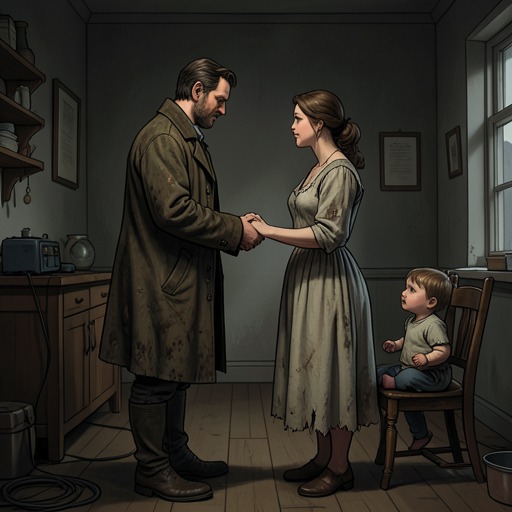
The relationship changes when Tohma considers what Tsupi’s return will mean. If she is pregnant, she must deliver safely; none of the family has seen a pyuika calve, and a cross with an elk could make the birth more difficult. Tohma asks Van to live with them, promising to persuade his father and the others because the family cannot afford to lose Tsupi. He offers his hand and introduces himself as Tohma of the Oki clan; Van accepts and gives his own name. The invitation replaces the tentative road-bound bargain with a concrete place for Van in the family’s life.
Shared Work and Animal Knowledge
Van’s usefulness to Tohma’s family depends on knowledge learned among the pyuika in his homeland, the Toga Mountains. Pyuika are loyal and can bond for life, but their independent habits make confinement a poor substitute for familiarity with people. They follow seasonal routes and established paths; a doe and her fawns form the clearest unit within her broad, loose-ranging herd. Van explains that herders can guide their movements using mohoki, a lichen the animals avoid, but keeping them penned too tightly can make them decline. The relationship with Tohma therefore develops through a practical education in observing the animals rather than simply controlling them.
In spring, Van persuades the men to let the pyuika roam. They fear that the animals will not return, but Van’s experience tells him that confinement is the wrong foundation: pyuika resist restraint, whereas early familiarity with people and a personal bond can endure for life. He can predict their movements because boys in his clan grow up watching the herd in the forest. This knowledge becomes especially important when he tells Tohma that the calving place is almost always the same. His assurance is grounded in patient observation, not a claim that the animals can be made entirely predictable.
The collaboration also has to accommodate the different rhythms of pyuika and reindeer. The previous year, the pyuika bore no young, and the family had simply led them behind the reindeer on a rope. Van suspects that the unnatural schedule contributed to their failure to breed. In summer, reindeer must leave their winter grounds: horseflies and mosquitoes swarm there, the grass is thin, and the animals need pastures where sea winds disperse the pests. Yet the migration coincides with the pyuika calving season, so moving the herds together would put the two kinds of animal on incompatible schedules.
To solve the problem, Tohma suggests asking neighboring families for help. Ohma agrees, and the family approaches Kiya’s Zolian immigrant relatives, who have also struggled to breed pyuika and have heard of Van’s expertise. Three of Kiya’s nephews—Mino, Chida, and Moki—stay to learn from Van and Tohma, while the others take the reindeer to their usual summer pasture. Kiya remains behind to care for Yuna. The arrangement makes Tohma’s household the center of a wider shared effort, though its cooperation is not emotionally easy for Van: he loathes the nephews’ Zolian appearance because it calls up enemies from battlefields, while the young men themselves follow him through the forest in intimidated silence.
Attachment, Loss, and the Partnership’s Meaning
The bond between Tohma and Van is repeatedly expressed through the care given to Tsupi. Van understands that a bonded pyuika does not forget a friend and is vulnerable to loneliness when separated. He also recognizes that Tsupi’s familiar butting is not a bad habit but a sign that she has grown attached to Tohma. Later, the care shifts to her possible offspring: Van’s knowledge of the calving place and of pyuika behavior gives the family a way to protect a birth none of them has witnessed before.
That work extends into winter. Van gathers ashimi, a green lichen that grows fresh even under frost, and lays a bundle before Tsupi. During mating season and pregnancy, pyuika eat a great deal of it; collecting it through deep snow is strenuous but important if the does are to bear strong calves. Tsupi butts and nuzzles Van insistently, and he pats her between her antlers before returning to the task at hand. This scene shows the relationship’s practical intimacy: Van is not merely an adviser to Tohma’s household but a caretaker whom its animals also recognize.
The partnership is consequently more than a rescue followed by hospitality. Tohma provides Van with a reason and a place to remain among the Oki; Van offers experience that can help the family raise pyuika without forcing them into a husbandry pattern that undermines breeding and welfare. Their cooperation brings other families into the effort and makes animal care a shared undertaking, even as Van’s painful associations with Zolians complicate his life with Tohma’s relatives. The relationship’s central commitment is concrete: help Tsupi thrive, learn the rhythms of the herd, and make room for the different needs of pyuika and reindeer.