Yotalu
The Deer KingYotalu is Governor Ohan’s second son, an intellectually disposed man whose cautious judgment makes him a crucial partner to Hohsalle during the investigation of the salt-mine disease. He is not merely a recipient of medical advice: he helps distinguish evidence from rumor, authorizes difficult preventive action, and identifies the administrative records that could broaden the search for cases. Yet his family’s experience becomes entangled with the very explanations he resists, as the deaths of Zolian relatives and the survival of his eldest son, Olimu, are used to support claims that the illness is divine judgment.
Identity and Introduction
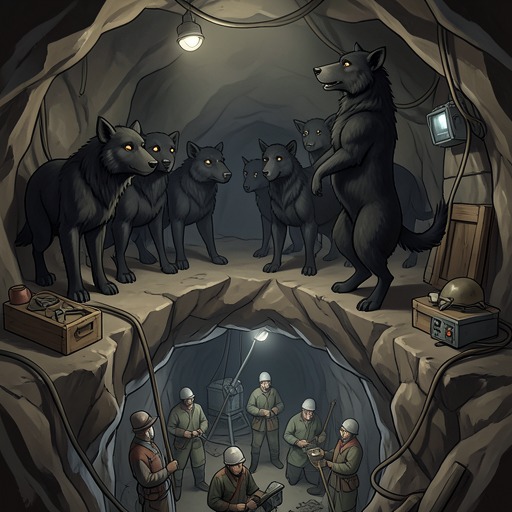
The narrative identifies Yotalu as the second son of the Zolian governor and gives him an intellectual disposition. When he first appears on the journey to the salt mine, he rides ahead of Hohsalle and Makokan on a fawn-colored horse. The approach is practical and uneasy: the packed road used to transport rock salt has become slick with rain, and Yotalu’s horse slips in the mud. The scene places him within the provincial authority investigating the crisis, while the mine’s working landscape and the danger surrounding it quickly become more important than ceremony.
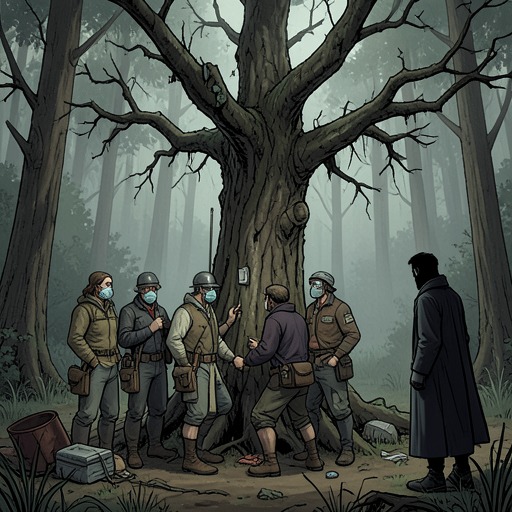
At the mine entrance, Hohsalle advises Yotalu to put on a mask and ask the workers to stop burning bodies temporarily. Yotalu complies with the precaution but questions the request to halt cremation, reasoning that bodies left unburned could allow the disease to spread. Hohsalle agrees that cremation is necessary but wants to examine some victims first. Their exchange establishes a working relationship based on practical reasoning: Yotalu recognizes the immediate containment need, while Hohsalle presses for the evidence required to understand the illness.
Investigation and Decisions
Yotalu gives Hohsalle room to investigate without pretending that the diagnosis is settled. When they discuss progress, he reports that Governor Ohan and Yotalu’s elder brother, Utalu, have set out for a conference with the emperor but have not yet traveled far from Kazan. Both take the outbreak seriously and have urged Yotalu to seek Hohsalle’s advice. Yotalu also explains that he summoned Hohsalle after receiving their reply to his message. The family’s concern thus becomes an explicit authorization to consult expertise, rather than a reason to bypass it.
Hohsalle intends to inform the Sacred Territory and seek advice, but has held back until receiving Governor Ohan’s permission. Yotalu welcomes that cooperation, noting that his administration knows little about the disease and that Lona, the provincial chief priest-doctor, shares his view. At the same time, the discussion recognizes the political risk of public disclosure: fear of an unfamiliar illness could cause panic and leave the realm vulnerable to invasion. Yotalu’s response is neither to dismiss that danger nor to let it prevent consultation. He supports seeking help from the Otawalle because the lack of local knowledge is itself a threat.
As the inquiry turns to transmission, Yotalu follows the reasoning rather than accepting a simple explanation. Hohsalle observes that the victims appear to have been exposed and become ill at roughly the same time, with no earlier patient living long enough to alert officials to a gradual outbreak. The mine’s disease acted quickly and killed almost everyone there, including slave keepers as well as enslaved workers, while people who continued working at the mine after the incident showed no symptoms. These circumstances argue against ordinary person-to-person spread and make fleas, ticks, or airborne transmission seem less likely. Yotalu draws the provisional conclusion that infected animals may be spreading the illness through bites and suggests hunting them.
Hohsalle qualifies that proposal. If wolves or ossam had attacked the sheep and carried the disease, shepherds who were bitten should have become ill, yet no such cases had been reported. That difference means indiscriminate hunting would be a poor substitute for identifying the actual carriers. Yotalu understands the distinction and faces its administrative consequence: he will have to order Malji, the head of the Aquafa slave trackers, to find and cull the beasts while also tracking Van. Disease control and pursuit are joined in a single order, an indication of how the crisis overlaps with the authorities’ other concerns.
Family, Treatment, and Public Rumor
Yotalu’s decisions become more consequential when Hohsalle considers experimental medicine. The treatment under discussion uses a drug made from a dog disease agent, and Hohsalle warns that people who develop mad-dog disease may otherwise have no prospect of being saved. Yotalu accepts that the treatment may disable those who receive it, but gives priority to keeping them alive. His consent is presented as a deliberate choice under uncertainty, not as confidence that the remedy is harmless or proven.
That uncertainty later becomes politically charged. After the death of Yotalu’s father and elder brother, Governor Ohan confronts Hohsalle over rumors that Aquafaese people do not die of black wolf fever. The rumor has spread in Kazan as an account of the disease’s return as the Curse of Aquafa, divine retribution against those who violated the land. Hohsalle refuses to treat the claim as established fact: the diagnosis remains uncertain, and the fact that only Zolians died in the salt-mine incident does not prove that Aquafaese are immune. He points out that Izam’s symptoms were much worse than those of Olimu, who is half Zolian, and that Limuelle’s intervention was crucial to Olimu’s survival.
Yotalu’s family is therefore read in conflicting ways. In the rumor reported by Tohma, Utalu’s contempt for Aquafaese and death from the disease are set against Yotalu’s marriage to the King of Aquafa’s niece and the survival of their eldest son, Olimu. People cite Olimu’s mixed ancestry as evidence that the gods spared him because Aquafaese blood runs in his veins. The account turns family relationships and unequal outcomes into a moral distinction between Zolians and Aquafaese, even though Hohsalle’s evidence does not justify that conclusion. The inference is especially stark because survival in this case is not proof of immunity: Hohsalle says Olimu was seriously ill and might have died without Limuelle’s drastic treatment.
Hohsalle warns Governor Ohan that the immunity rumor could itself make the danger worse by lowering Aquafaese people’s guard around infected animals. He also raises a further possibility: if the illness has the characteristics of black wolf fever, its nature might change, and fleas or ticks could help spread it as their numbers increase in warmer weather. The distinction matters to Yotalu’s role in the crisis. A claim that the disease only threatens Zolians would not merely assign blame; it could prevent people from taking precautions and allow a wider epidemic to develop.
Records, Evidence, and the Wider Search
Yotalu helps turn the investigation beyond the mine. When Hohsalle explains that it would be difficult to survey all of Aquafa, find people who had contracted and survived the illness, and collect information about their cases, Yotalu offers a practical route forward. The region has a thorough tax-management system, he says, whose collection officers gather information even about nomadic groups in outlying areas such as the Oki Valley and the Toga Mountains. The records categorize groups and accurately count the people living in each place, along with their ages. An administrative system designed to make dispersed populations legible can thus serve a medical inquiry that would otherwise be too extensive to conduct directly.
The wider investigation exposes how much remains unknown. A map assembled by Tomasolle and Cheehana shows reports of mittsual-like symptoms scattered across the former territory of the Kingdom of Aquafa, from the Yukata Plains in the south to the Oki forests in the north. The oldest account reaches back eight years, before the salt-mine incident. These cases were isolated wolf or ossam attacks, each associated with only one or two sick people and no reported onward spread. Hohsalle argues that this pattern is unnatural if infected animals were moving through packs and transmitting disease: several years and multiple summers should have produced more secondary cases, especially if insects could carry infection onward.
The map and records do not resolve the mystery; they sharpen it. The cases’ broad distribution, their long history, and the absence of larger clusters demand an explanation for why the illness has not spread as expected. Tomasolle also asks how the disease could have reached dogs and wolves across such a wide area, given that northern and southern wolf populations could not simply have mingled. Yotalu’s contribution is consequential because it makes this wider comparison possible, but the evidence that emerges continues to unsettle easy conclusions rather than confirm them.
Narrative Significance
Yotalu’s defining contribution is his willingness to act while keeping the limits of knowledge in view. He listens to Hohsalle’s qualified conclusions, supports cooperation with the Otawalle, accepts an experimental treatment despite its possible cost, and moves from a broad proposal to hunt animals toward a more discriminating effort to identify carriers. His intellectual disposition appears not as abstract cleverness but as a readiness to revise a policy when evidence complicates it.
His family also becomes a contested archive of the outbreak. Utalu’s death, Yotalu’s marriage into the Aquafa royal family, and Olimu’s survival are assembled into a story of divine favor and ethnic difference. Against this simplification, Hohsalle insists that the cause of the disease and the significance of different outcomes are still uncertain. Through Yotalu’s position between provincial government, medical investigation, and a family caught in public rumor, the narrative shows how an epidemic can turn individual lives into political evidence before their meaning is understood.