Yuna
The Deer KingYuna is the child Van finds alive in an oven amid the dead in the Aquafa salt mine. Rescued from a place where survival has seemed almost impossible, she becomes part of Ohma’s family and the focus of Van’s quiet, deeply felt care; later, her connection to him also draws her into the novel’s unsettling questions about infected animals, dreams, and the boundary between body and soul.
Rescue and Survival
Van discovers Yuna after moving her mother’s body away from an oven that the woman had apparently struggled to protect. The child is inside, looking up at him with tearstained cheeks and a piece of fahmu in her fist. The scene establishes her first as a survivor: she has endured the catastrophe in the mine, but is too young to understand the loss around her.
Van finds that Yuna has a small, healed-over scratch beneath her left ankle, like the mark on his own arm. He recognizes that she, too, has been grazed by fangs. Of the many people who had been in the mine, only Van and the child have lived. This shared survival, initially an eerie fact in a landscape of death, becomes an early bond between them and foreshadows the later significance of their respective encounters with biting creatures.
When Van reaches toward her, Yuna takes his hand. She then reaches for her mother, whom Van has laid aside, and he steadies her as she presses her face against the woman. After allowing her to grieve, he carries her, cleans her, and wraps her in a soft cloth. Her immediate dependence is made tangible in these acts of care: Van cannot restore the family she has lost, but he chooses not to leave her to the mine’s brutal order, where enslaved people are treated as disposable.
A Place in Ohma’s Family
Van gives the child the name Yuna when Tohma’s grandmother Manya asks what she is called; it is simply the first name that comes to his mind. At first Yuna does not recognize it when Manya says it. Before long, however, she calls herself Yunacha, using a child’s lisp. The name marks her passage from an anonymous child discovered in the mine into a recognized member of a household.
Yuna quickly makes herself part of Ohma’s family. After years without a child among them, the women are delighted to care for her, and she soon sits on Kiya’s lap as though she has always belonged there. The welcome is not just shelter: it gives Yuna a daily life in which adults hold and play with her, and in which Van can return from hunting to a familiar home.
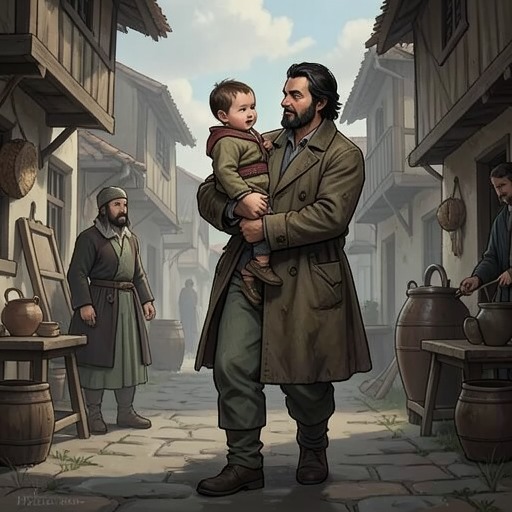
Van’s attachment is expressed through recurring domestic moments rather than declarations. Each evening he sits by the hearth with Yuna on his lap, and her face lighting up when she sees him brings him a deep, quiet joy. Returning to camp after a day’s hunt gives him peace in part because she is there. When she runs toward him, calls him Ochan, and falls before Kiya can catch her, her sobbing turns a small mishap into an ordinary family scene—one sharply unlike the mine from which he carried her.
As Yuna grows, her bond with Van remains physically demonstrative and sure. During a later encounter in the woods, she calls Ochan and rushes toward him without tripping over the roots. Van is struck by how quickly the toddler has become a child; she beams, leaps into his arms, and presses her nose against his. The scene registers growth not through a measured account of years but through a changed ability to run toward the person who has become her home.
Yuna and the Wider Family
Yuna’s place with Van is reinforced by her ease among the people around him. She plays on Kiya’s lap, and Tohma’s grandmother takes an interest in her name. When a woman asks her who she is, Yuna answers warily but plainly, “Yunacha.” Asked her age, she looks to Van, who answers that she is almost four and still speaks with a slight lisp. Her glance toward him makes their relationship visible in a small exchange: he supplies the practical answer, while she turns to him for reassurance.
Yuna’s name for Van, Ochan, is one of the recurring signs of their closeness. She calls it as he comes home and again as she runs to him in the forest. The word belongs to their everyday bond, but it also carries the force of a chosen family: Van is not merely the person who rescued her in a moment of crisis; he is the person she expects to find and runs toward.
Shared Encounters and Uncertainty
The narrative later places Yuna alongside Van in a disturbing dreamlike episode. She burrows against his abdomen and clings to him, trembling with an agitation that is not described simply as fear. Van holds her close and tries to soothe her without waking the others. The reversal of their earlier roles is telling: the rescued child, who once depended on Van for warmth and safety, now reaches for him in a moment when his own experience is unsettled.
The uncertainty deepens after Van examines an animal that resembles a wolf but has features associated with the mountain dogs called ossam. He recalls that ossam have light-gold coats and are shunned because people say they bear the light of the next world; their numbers rose after black wolves were culled, and they sometimes attack pyuika. The beast before him is darker and larger, and its paws are difficult to distinguish from an ossam’s. Van begins to suspect that these creatures, rather than ossam alone, may account for missing young game. He also remembers that he was bitten, that his body changed afterward, and that Yuna survived a bite too. His concern shifts from their shared survival to the possibility that the same unknown influence has entered both their bodies.
Suohl identifies the animals Van and Yuna ran with as rochai, a cross between ossam and black wolves, and describes the pair as having been “completely inside out.” He explains otsufah as a reversal in which soul and body exchange places, with effects on sight and smell; the fact that Yuna and Van did not see a raven’s feathers as black is offered as evidence that the change has affected them even outside the episode. Yuna’s role in this revelation is not that she explains what has happened, but that she shares the condition under investigation. The girl first encountered as the mine’s other survivor is now bound to the central mystery by the same bite and the same altered perception that trouble Van.
Narrative Significance
Yuna’s story joins intimate care to the book’s larger concerns without making her childhood a mere device for explanation. Her rescue begins in a room where the dead and the living are nearly indistinguishable; the warmth of the child in Van’s arms gives survival a human, immediate meaning. Her adoption into Ohma’s family then turns that fragile moment into a continuing life, built from names, shared domestic routines, and the daily certainty of Van’s return.
At the same time, the healed mark beneath her ankle prevents the rescue from being separated from the mine’s wider mystery. Yuna and Van are the two survivors, and both have been bitten. Their closeness consequently has two linked dimensions: she is Van’s beloved child and the person whose experience may reveal what his own changing body means. The narrative lets the ordinary signs of attachment—the name Ochan, a run through the trees, a child clinging to him—carry the emotional stakes of a threat neither of them yet understands.