serum
The Deer KingThe serum is one of three experimental approaches developed to fight black wolf fever: a treatment made from substances produced by infected patients’ bodies, intended to help those already ill resist the disease. Its potential is inseparable from uncertainty. Supplies are limited, human testing is sparse, and a severe allergic reaction can threaten a patient’s life; when Sulumina and her son Olimu receive it, that danger becomes immediate, while the doctors’ coordinated response demonstrates both the promise and the cost of the treatment.
Origin and Intended Use
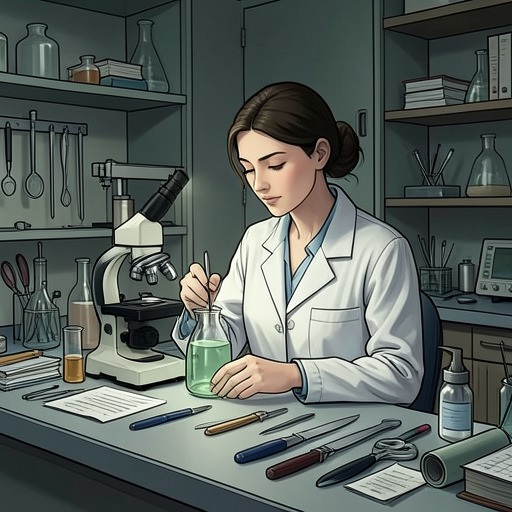
After the salt-mine disaster yielded samples of the disease agent, Hohsalle’s medicine makers divided their research among three teams. One worked to weaken the infectious agent so it could strengthen resistance; another sought medicines, including those made from lichens, to suppress the agent. The third tried to manufacture serum from components produced by the bodies of infected patients. The approach drew on the possibility that those who had encountered the disease might produce substances capable of helping the body fight it.
The three strategies addressed different parts of the problem: preparing the body to recognize the disease, suppressing the agent, and using substances associated with infected patients’ response. The serum team could produce only a small amount, and the medicine makers hoped that combining the approaches would improve their chances. Promising substances had been tried on rats, but not on human patients; the serum therefore belonged to an ongoing investigation, not an established cure.
Risk and Clinical Judgment
The serum’s promise did not make it a routine choice. Hohsalle explained that the new medicines might cause a severe allergic reaction, and his warnings made the decision to use the serum a matter of weighing uncertain benefit against potentially fatal harm. He had already told the governor that the available treatments remained experimental and that, if many people fell ill, the small supply would not be enough for everyone.
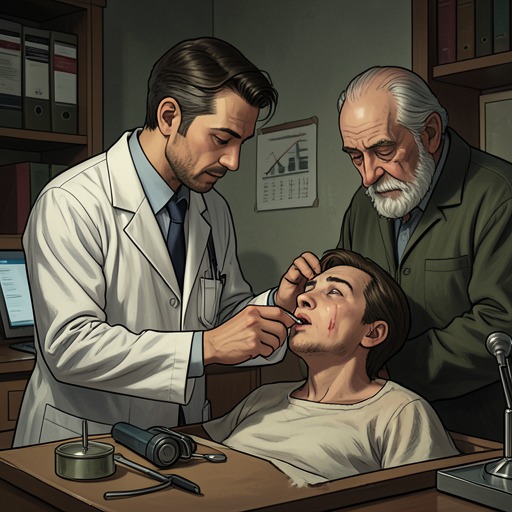
At the patients’ bedside, doctors did not treat need alone as sufficient reason to inject. When Mazai asked for the remedy, Hohsalle explained that an adverse reaction could stop his breathing and kill him. Mazai pointed out that Hohsalle had given it to Izam; Hohsalle replied that Izam’s body was already losing its battle with the disease. He acknowledged that an injection might help Mazai but could also cause other adverse effects. Mazai, feverish and aching after a bite from a dog infected with the disease, asked to take the risk rather than leave his wife and children with the prospect of his death. His plea frames the serum not as a guaranteed rescue but as a gamble made under urgent, imperfect conditions.
Treatment of Sulumina and Olimu
Sulumina also wished to try the serum. Limuelle accepted that it could be attempted if she understood the risks, but first sought permission from Yotalu, her husband’s father, because Sulumina was connected to the governor’s family and Olimu was his grandson. Sulumina agreed to the request for permission, and treatment proceeded once Yotalu’s approval arrived. Limuelle brought supplies in case of an allergic reaction, making preparation for danger part of administering the experimental medicine.
Although Sulumina had asked to be injected first, Limuelle began with Olimu. He measured the serum, removed air bubbles from the syringe, prepared the child’s arm, and gave the injection. Olimu winced but showed no signs of an allergic reaction. The injection site swelled more than Mazai’s had, but no pronounced symptoms appeared even after time had passed.
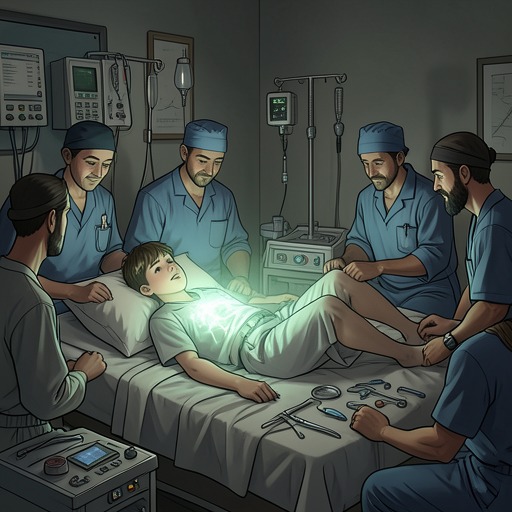
Sulumina’s response was sharply different. Soon after receiving the injection, she struggled to breathe. Hohsalle, Milalle, and Limuelle acted in coordination: Hohsalle positioned her head to secure her air passage, Milalle administered medicine into her throat, and Limuelle gave another injection. Hohsalle explained to Olimu that the medicine was made from something secreted by an organ in the body and reassured him as his mother began to recover. Sulumina soon breathed normally again, though she remained pale and close to fainting. Milalle told her that her blood pressure had dropped and that dim vision and tightness in her chest might persist briefly.
Significance and Limits
The paired outcomes make the serum’s uncertainty concrete. Olimu tolerated it without a major reaction, while Sulumina experienced the very kind of acute allergic danger the clinicians had warned about. The response to that emergency showed that the doctors had prepared for complications, but successful treatment of the reaction did not establish that the serum itself cured black wolf fever. The scene instead presents an experimental remedy whose administration can create a second crisis even as it is intended to address the first.
The serum also marks a difference between medical frameworks. Hohsalle and his colleagues investigate disease agents and seek substances that can counter them; Mana, a priest-doctor of the Pure Heart Creed, declines to look at the tiny organisms Hohsalle offers to show him. Mana maintains that illness can be understood by examining the patient and removing the defilement obstructing a good life, without identifying the specific cause. In this contrast, the serum embodies an approach that treats knowledge of the disease agent and its effects as grounds for intervention, while the exchange leaves visible the limits and risks that accompany that search.