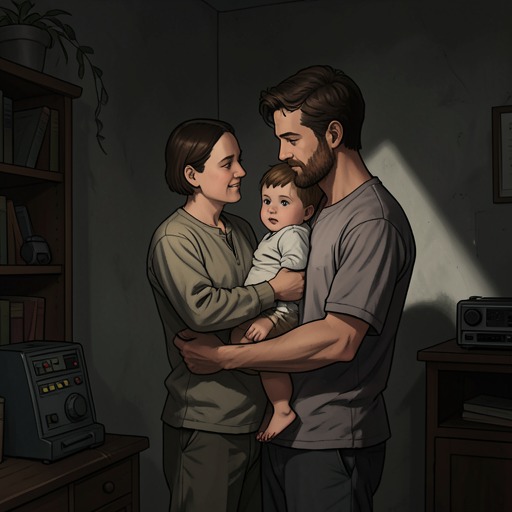
“Home is a place where you have never been”
The Dispossessed“Home is a place where you have never been” names a paradox at the heart of Shevek’s thinking: a person can return, but neither the person nor the place is simply the same as before. The phrase links his personal need for return to the General Temporal Theory and to the novel’s changing, contested spaces, where a boundary may imprison, exclude, or be crossed into a different form of belonging.
Return and the Theory of Time
When Shevek returns to the Regional Institute, where he has lived since he was thirteen, the return is a joy. Yet he has grown beyond the adolescent world he left: his friends seem callow, the boys his age seem trapped in childishness, and he welcomes isolation rather than trying to restore old bonds. His homecoming is therefore not a recovery of an earlier life. It brings him back to familiar hills, gardens, dormitories, and laboratories as someone changed by a year away.
The narration explicitly connects this disposition to the immense inquiry Shevek undertakes. Going out is only half a journey for him; return matters too, even when the traveler himself may not come back. His General Temporal Theory gives that intuition a conceptual form: change does not merely destroy identity. Relations among a person, a river, and the river itself are more complex than simple sameness or loss, so that return remains possible without repetition. The phrase’s home is consequently not a known place preserved intact, but a place encountered anew.
That meaning also makes the expression more than a comforting maxim. The possibility of return depends on accepting transience: Shevek’s theory joins what is most changeable with what is fullest of eternity. Home is not an escape from time but a relation understood through time, and the journey out gains meaning through the possibility of coming back changed.
Walls, Cities, and the Meaning of Belonging
The novel gives this idea a physical counterpoint in the wall at the Port of Anarres. Built of rough rocks and easy for an adult to look over or a child to climb, it appears almost insignificant; at the roadway it dwindles into a line, an idea of a boundary. Yet for seven generations it has been more important than anything in the world. The wall’s meaning depends on which side a person occupies: it encloses the port, ships, visitors, and the wider universe, leaving Anarres outside and free. A boundary can thus define home by separating it from the world, but the separation also makes return a political and spatial problem.
Abbenay presents a contrasting arrangement of shared life. Its cellular neighborhoods gather workshops, factories, dormitories, learning centers, meeting halls, and distributories around open squares. In the textile district, banners and pennants display the work of holum-fiber processors, mills, dye factories, and clothing distributories. The city’s plain, low buildings, small durable windows, and limited use of lighting and heat reflect the principle of organic economy. This built environment makes home less a private possession than a network of communal places and practical relations.
Scarcity tests that arrangement. During the drought, water is rationed and directed toward keeping crops alive; thirst and hunger take precedence over cleanliness, while food and clothing for Anarres’s twenty million people depend on holum plants. The confidence that there will never be another Great Drought, voiced alongside recognition that desalinization could at most alleviate the crisis, contrasts with the immediate dependence on rain. Home remains a shared habitat, but one vulnerable to ecological conditions that no expression of belonging can simply overcome.
The Phrase in Contrast with Urras
Shevek’s visit to Urras makes the question of home concrete by placing him in unfamiliar urban spaces. In Old Town, after his costly day with Vea and a taxi ride to Nio, he emerges from the subway into darkness and fine rain. Streetlights are absent; shopfronts are shuttered, refuse litters the pavement, and a burned-out storefront stands black and empty. A woman he mistakes for old is not even thirty. The scene makes the city legible through hardship and deprivation rather than through the polished image of a welcoming destination.
During the Nio Esseia demonstration, the boundary between public space and private property becomes an immediate obstacle. Separated from the main crowd and supporting an injured demonstrator, Shevek finds every door locked. He breaks the hasp and padlock of a warehouse basement, not furtively or vindictively, but with the assurance of someone opening his own front door. Inside, he tends the man’s mangled hand with water from a fire hose. The act briefly turns property’s exclusion into shelter and care: a place becomes usable as home through mutual aid, not ownership.
These contrasts keep the expression from resolving into a simple claim that home is wherever one returns. A wall may guard separation; a carefully organized city may embody shared provision; drought may imperil the community; and an ostensibly alien warehouse may become a refuge when someone opens it to another. Across Shevek’s return, his temporal theory, and his encounters on Urras, home names a relation made and remade through change, boundaries, and the choice to share space.