“Suffering is a misunderstanding”
The Dispossessed“Suffering is a misunderstanding” is Shevek’s paradoxical expression of a distinction between the unavoidable pain of existence and the unnecessary suffering that a society can relieve. In a late-night conversation about happiness and death, the phrase does not dismiss pain as unreal: Shevek insists that it exists and that people know it as truth when it comes. Instead, he questions the attempt to grasp at happiness and flee pain, and gropes toward a reality that might be found by enduring pain fully. The statement remains open-ended, but his account of an injured man’s death gives it a concrete ethical consequence: brotherhood begins, he says, in shared pain.
The Conversation and Its Setting
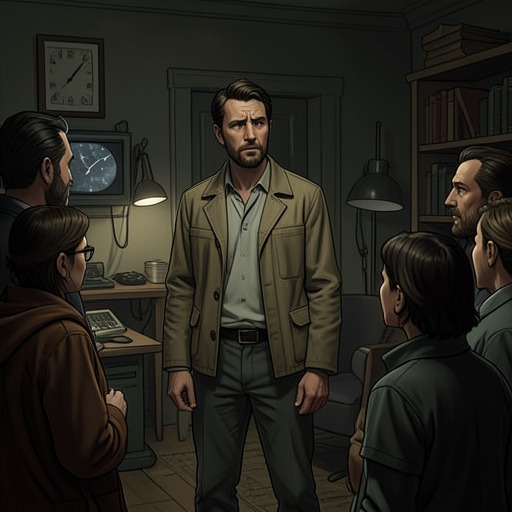
The phrase emerges after most of the young people at a gathering have drifted away to sleep or to be with lovers. Shevek, Bedap, Tirin, two other boys, and three girls remain among the empty cups, fishbones, and pastry crumbs, talking through the night. Their subjects range from temporal physics and the ancient Numerical Harmonies to swimming, childhood, and the meaning of happiness. The conversation moves freely between abstraction and experience; it is in this intimate, unhurried setting that Shevek puts suffering at the center of the question.
Shevek is described as lanky, with large hands, protruding ears, and angular joints, his fine dun-colored hair held back by a band. He leans forward with wide, light eyes as he speaks. The physical immediacy of this portrait accompanies an argument that refuses to treat pain as a detached philosophical problem: he speaks from a recognition of fear, grief, and death as conditions that people actually undergo.
What the Expression Means
Shevek distinguishes between particular pains and Pain as a condition of existence. Society can cure diseases, prevent hunger, and oppose injustice; it can relieve social and unnecessary suffering. It cannot, he argues, alter the fact that people suffer, grieve, and eventually die. Even a life of fifty years will contain pain for all fifty. His formulation therefore holds two claims together: some suffering can and should be prevented, while no social arrangement can abolish the underlying vulnerability of being alive.
That distinction gives “misunderstanding” its force. Shevek does not retract the reality of pain; he calls it the reality he recognizes more readily than comfort or happiness. What may be mistaken is the effort to avoid pain at all costs, or the assumption that happiness can answer the fundamental condition of existence. He wonders whether, instead of fearing pain and running from it, a person might endure it all the way and pass beyond it. He locates this possibility in a place where the suffering self ceases, but admits that he does not know how to describe it. The thought is a tentative search, not a promise that suffering can be overcome by will.
The Dying Man and the Limits of Help
When Shevek asks whether the others have seen anyone die, most have: in a domicile, on hospital duty, or while helping to bury the dead. One young woman then recounts a death she witnessed while working in a camp in Southeast. An aircar crashed on takeoff after an engine defect and caught fire. The badly burned man lived for about two hours while the group waited for anesthetics to be flown in from the coast. There was no doctor, and the people present could do nothing to save him.
The account concentrates on the limits of even well-intended care. The man was mostly conscious and seemed to feel his injuries especially in his hands. Touch could not comfort him: his skin and flesh came away, and he screamed. The witness stayed beside him with two girls, unable to offer aid beyond being there. Shevek draws from this memory the stark conclusion that people cannot save one another, or themselves. The scene does not make pain abstractly meaningful; it makes the gap between presence and rescue unmistakable.
Solidarity Without Rescue
A tall, soft-eyed girl objects that Shevek’s view leaves only isolation and despair and denies brotherhood. She offers love as the true condition of human life. Bedap sides with Shevek, arguing that love is one possible way through pain, but it can fail; pain, by contrast, does not miss. His response shifts the emphasis from a guarantee of comfort to the unavoidable fact that people will have to endure.
Shevek rejects the idea that acknowledging helplessness means rejecting solidarity. He is trying, he says, to define what brotherhood really is: “It begins—it begins in shared pain.” The repeated start gives the claim the quality of thought being discovered in speech. Yet when asked where brotherhood ends, he answers that he does not know. The conversation thus leaves the phrase unresolved in two directions: suffering is not a condition society can abolish altogether, but shared suffering may be where human connection begins. Love is not made irrelevant, and endurance is not offered as a cure; the exchange holds their limits alongside the possibility of solidarity.
Narrative and Thematic Significance
The expression’s apparent contradiction keeps the discussion from settling into either despair or easy consolation. Calling suffering a misunderstanding could sound like denial, but Shevek immediately insists that pain is real and that no society can prevent it altogether. His argument is more precise: social action can relieve avoidable suffering, while existential pain remains. The phrase names not the unreality of pain but the possibility that fear, flight, or the demand for guaranteed happiness misreads the conditions of life.
The remembered death tests that distinction against a particular body and a particular failure of assistance. The witnesses cannot heal the man or make his pain useful; they can only remain with him. Shevek’s account of brotherhood begins at that boundary, where mutual presence does not amount to mastery over another person’s suffering. Because he cannot say where such solidarity leads, the scene ends not with a doctrine but with an acknowledged limit. The expression’s significance lies in that unfinished movement: from pain’s irreducible reality, through the rejection of false rescue, toward a form of human relation founded on shared endurance.