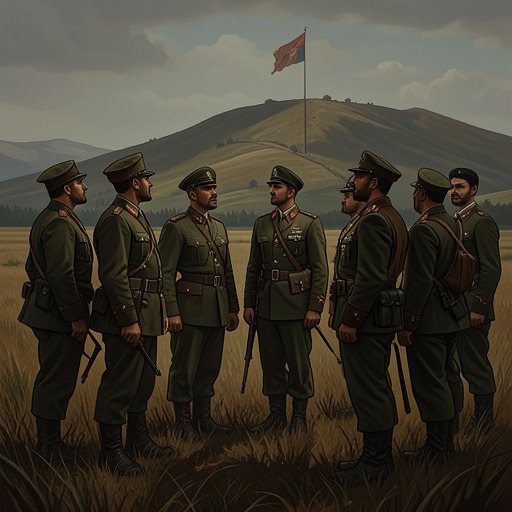
A-Io intervention in Benbili
The DispossessedA-Io’s intervention in Benbili is a military operation presented as support for the country’s government, but it places armed state power against a revolution whose partisans are mostly unarmed. The episode sharpens Shevek’s conflict with Urras’s political order: where its defenders describe power as realism, he sees the destruction of freedom—and later carries that opposition into a public confrontation with the state itself.
Causes and Political Justification
Benbili is a poor, underpopulated country of mountains and arid savannahs. Though formally a parliamentary democracy, it is in practice a military dictatorship governed by generals. A revolution breaks out, and reports from its capital, Meskti, describe rebels advancing against the army. President-General Havevert escapes in his armored airplane; retreating government forces burn fields and towns, while guerrillas harry them. The revolutionaries open the jails and grant amnesty to the prisoners.
On the fourth day of the revolt, Shevek watches a debate in the Council of World Governments. A-Io’s ambassador announces that the country is sending armed reinforcements to support Havevert, describing the action as assistance to Benbili’s democratic government. Yet the intervention aligns A-Io with a president-general whose government is, in practice, a military dictatorship. The claim of democratic support therefore sits uneasily beside the power the operation is meant to restore.
A-Io’s stated justification is also strategic. Oiie tells Shevek that A-Io and Thu will not invade each other directly, but are officially at war and will fight in Benbili. He calls this kind of intervention a way of maintaining the balance of power. In his account, the conflict is not principally about who governs the Benbilis; it is part of the struggle between A-Io and Thu. Benbili becomes the ground on which rival states exercise power while avoiding war on their own territory.
The Unequal Encounter with Force
The revolutionaries are mostly not even armed. A-Io’s reinforcements, by contrast, come with guns, armored cars, airplanes, and bombs. Reading the descriptions of that equipment, Shevek feels sick. The contrast is not simply between two armies of different size: it is between a popular revolt and the machinery of an established state arriving under the name of support.
The retreating army’s burning of fields and towns and the revolutionaries’ opening of prisons make the struggle’s stakes concrete. Against that destruction, the amnesty offers Shevek a moment of hope. But the arrival of A-Io’s forces changes the meaning of the rebellion in his eyes: the question is no longer only whether Benbili’s people can overthrow their rulers, but whether their attempt at freedom can withstand intervention by a state with overwhelming military resources.
Shevek’s Response and Political Conflict
Shevek follows the distant revolution with growing intensity, despite having rarely used the radio after discovering that it chiefly advertises goods for sale. Official reports are brief and dry; popular papers print Revolution! across their pages. The competing forms of news make the intervention visible in different registers: as controlled political information and as an event capable of stirring public feeling. For Shevek, the reports cease to be remote. He thinks he should have gone to Benbili and imagines its pale plains and wind, while the prospect of the armed intervention leaves him physically ill.
He has no comfortable confidant in Urras. Saio Pae is out of the question, Atro is an ardent militarist, and Oiie’s personal regard for Shevek does not free him from the property owner’s attachment to law and order. Oiie treats the Benbili rebels as people learning that freedom without guns cannot defend itself. Shevek responds to the phrase with irony: calling the politician’s account of force the “politics of reality” sounds strange coming from a physicist. Oiie insists that both politicians and physicists deal with real forces and basic laws. Their exchange brings the intervention’s central disagreement into focus: whether power is an unavoidable law of political life, or a force whose dominance should itself be challenged.
War, Control, and the Wider Stakes
The declaration that A-Io is officially at war has consequences beyond Benbili. Oiie explains that wartime rules will bring research in the College of Noble Science under classification, delay publication when authorities suspect a paper they do not understand, and limit travel—especially for non-nationals. Shevek is not supposed to leave the campus without the Chancellor’s clearance, though Oiie offers to help him evade the restrictions. The intervention thus reveals how military conflict can extend state control into scientific work and personal movement, even for someone not fighting in Benbili.
Later, the Terran ambassador interprets the violence in Nio Esseia partly through the precedent of Benbili. He recognizes that the revolutionaries there belong to the same libertarian tradition and argues that the scale of the demonstration and the government’s panic response become more intelligible in that light. The comparison places A-Io’s intervention within a broader political pattern: the state treats a challenge to power not merely as a dispute over wages or policy, but as a danger capable of spreading.
From Intervention to Public Confrontation
The intervention’s logic resonates in the Nio Esseia demonstration, where a vast crowd gathers in Capitol Square to hear Shevek speak. He presents solidarity not as a gift bestowed by rulers but as something people must make together, and sets mutual aid and free association against governments, armies, and war. His speech insists that freedom cannot be bought or delivered by someone else; it must be lived by those who seek it.
The police helicopters drown out his voice, and machine-gun fire is directed at the people nearest the Directorate’s steps. The contrast between collective speech and armed force gives the Benbili episode a later echo: military power again answers a gathering of people acting together. In the wake of the shooting, the Terran ambassador recognizes the connection between the Nio revolutionaries and the libertarian tradition associated with Anarres. What began for Shevek as news of distant Benbili has become part of a wider confrontation over whether organized violence can contain the demand for freedom.
The Intervention and Anarres’s Political Boundary
On Anarres, the question of contact with Urras raises a related fear. At a meeting, Rulag argues against admitting visitors, warning that an opening could lead from a few arrivals to profiteers and then an armed occupation. She invokes the Settlement’s restriction on Urrasti leaving their ships as protection for the society’s survival. Bedap counters that contact would signal confidence rather than weakness, while Shevek distinguishes the proposal to receive visitors from an individual’s right to travel to Urras.
When Shevek argues that Anarresti should not be made subjects of majority rule, he identifies revolution as an ongoing responsibility rather than a settled guarantee of safety. Rulag answers that his choice risks involving everyone in dangers driven by private motives. The Benbili intervention lends weight to that dispute without resolving it: it demonstrates the danger of armed states intervening in weaker societies, while leaving open how a society founded on freedom should respond to that danger without turning its own protections into authority.