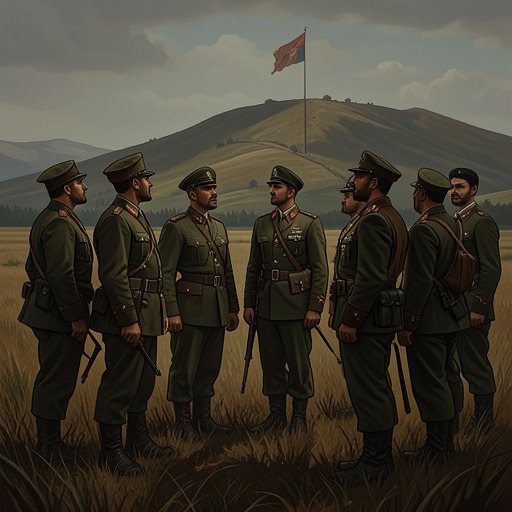
A-Io–Thu rivalry
The DispossessedA-Io–Thu rivalry is the contest between two powerful states whose competing claims to socialism expose how political labels can conceal centralized authority and strategic self-interest. In Shevek’s account, Thu’s government controls public life more comprehensively than A-Io’s, while A-Io’s capitalist economy draws him into a bargain over scientific knowledge. Their rivalry comes into sharp view during the Benbili revolution, when A-Io sends armed forces under the claim of supporting democracy. It helps explain why Shevek refuses to treat either state as a neutral home for his work, and why he insists that his theory be given to all rather than used by one power against another.
Competing Political Orders
Chifoilisk, a representative of Thu, presents his country as closer to Odonian values than A-Io. He says that both are products of the same revolutionary movement and identifies Thu as socialist. Shevek does not accept that description as sufficient. He calls Thu an archist state, arguing that a single power structure controls government, administration, police, army, education, law, trade, and manufacturing. Thu also retains a money economy, which Chifoilisk defends as payment to workers according to the value of their labor. Shevek’s question about whether workers themselves determine that value exposes a central dispute: state ownership and socialist language do not, by themselves, establish that workers govern their own lives.
Chifoilisk challenges Shevek to visit Thu and see how its socialism functions. Shevek answers that he already knows how real socialism functions, then asks whether Thu’s government would allow him to explain it there. The question is pointed but not answered: the conversation makes the invitation itself political, since a visit could place Shevek’s work and public voice within a state-controlled setting. The exchange distinguishes Thu’s rivalry with A-Io from a simple opposition between capitalism and socialism. Both states compete for influence, yet Shevek sees centralized rule and money as features of Thu’s system as well as A-Io’s.
Shevek Between the States
Shevek understands that A-Io is not simply offering hospitality to an independent scientist. Chifoilisk warns that the Council of World Governments has been under A-Io’s influence for thirty years and tells Shevek that his position in the capitalist economy may already have compromised him. Shevek acknowledges the danger without denying his purpose: he says he came to bargain with that economy. His stated aim is to end the isolation between Urras and Anarres and restore free exchange between them. He believes A-Io fears him less than Thu would because A-Io has forgotten the revolution and expects material comfort to keep people content.
Chifoilisk offers Shevek a place in Thu, but Shevek refuses the invitation. He believes Thu would fear the possibility that contact with Anarres might revive the earlier revolution, which Shevek regards as a struggle for justice left unfinished. The refusal is not an endorsement of A-Io: Shevek’s decision to work there is tactical, an attempt to advance communication where he believes it can be attempted. He names the difference between the two choices plainly: on Anarres he acted as he could, while on Urras he bargains. The rivalry therefore shapes his route without turning either state into an ally he can trust.
Benbili and the Rivalry Made Visible
The revolution in Benbili turns the competition between A-Io and Thu from political argument into military intervention. News reports describe rebels holding territory west of the capital, Meskti, and pressing the government’s forces. Shevek follows events through the papers and public broadcasts. The reports present Benbili as a poor, sparsely populated country governed in practice by generals, despite its parliamentary form. As the revolutionaries take Meskti, they open the jails and grant amnesty to prisoners; Shevek responds to that news with hope.
On the fourth day, Shevek sees the Ioti ambassador announce that A-Io will send armed reinforcements to support the government of President-General Havevert, who has escaped in an armored aircraft. The stated defense of democratic government sits uneasily beside the revolutionaries’ own actions and the military reality: the rebels are mostly unarmed, while A-Io’s forces bring guns, armored cars, aircraft, and bombs. The retreating government army burns fields and towns, and guerrilla partisans harry it. Shevek is sickened by the prospect of A-Io’s intervention, recognizing that the local struggle is being overtaken by the contest between rival powers.
Oiie gives the competing interpretation. He argues that the decisive political reality is the power struggle between A-Io and Thu, not the identity of whoever governs Benbili. He presents the rebels as learning that freedom without weapons cannot withstand an aggressive rival. Shevek repeats Oiie’s phrase, “The politics of reality,” and questions its use by a physicist. Their exchange brings the rivalry’s underlying claim into focus: Oiie treats power as the basic fact to which politics must answer, while Shevek’s response resists reducing political truth to the force available to enforce it.
Knowledge, Power, and the Rivalry’s Stakes
The contest between A-Io and Thu matters to Shevek because he fears that either state could make knowledge an instrument of advantage. In his conversation with Keng, he rejects the idea that selling his theory is the only available course and asks whether a gift is possible. He wants to give the work to Anarres, Hain, and the countries of Urras, so that no one state can use it to dominate others, gain wealth, or win wars. That wish gives his scientific choices a political consequence: open circulation is a refusal to let the rivalry determine who owns the benefits of discovery.
Shevek is unwilling to wait for truth to benefit the common good eventually. He has one lifetime, he tells Keng, and will not spend it serving greed, profiteering, or a master. His insistence does not make the conflict between A-Io and Thu disappear; it identifies a different measure of political relationship, one based on sharing rather than control. In that sense, the rivalry is both the immediate context for his negotiations and the condition he seeks to overcome: free exchange across the divide, without either state claiming exclusive power over what is shared.