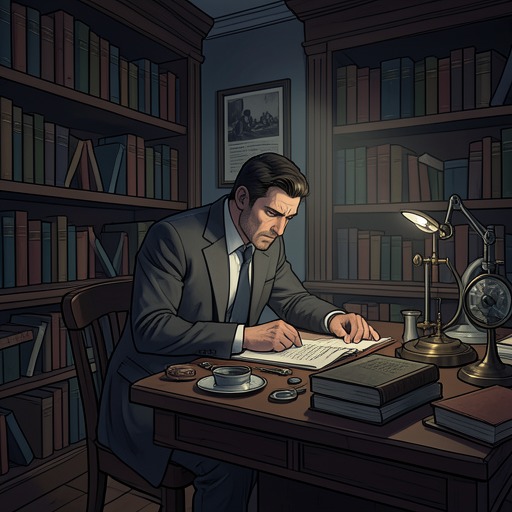
Ainsetain
The DispossessedAinsetain is a Terran physicist remembered for the Theories of Relativity and an unsuccessful search for a unified field theory. Though he lacked the tools to complete that synthesis, his work becomes decisive for Shevek: studying Ainsetain’s intellectual choices helps Shevek abandon the demand for a guarantee and see how Sequency and Simultaneity can be brought into a single framework. His importance rests not on a finished solution, but on a failure whose limits and insight together open a way forward.
Identity and Scientific Work
Ainsetain originated the theory that explained gravity as a function of the geometry of spacetime. He then tried to extend that synthesis to include electromagnetic forces, pursuing a unified field theory that he did not manage to complete. His two Theories of Relativity nevertheless remain beautiful, valid, and useful centuries later. Their achievement is inseparable from a hypothesis about the limiting role of the velocity of light: that hypothesis could not be proved true and, in certain circumstances, had been proved false. The work therefore endured not as an unassailable system but as a powerful theory whose reach depended on an assumption open to challenge.
Ainsetain’s intellectual restraint was part of this legacy. He cautioned that his physics embraced no mode but the physical and should not be taken as implying the metaphysical, philosophical, or ethical. Shevek recognizes the caution as superficially true, yet sees that Ainsetain’s use of mathematics reached beyond a narrow technical instrument. Number, described by the ancient founders of the Noble Science as “Number the Indisputable,” could serve as a bridge between the rational and the perceived, psyche and matter. It belonged to a mode of inquiry that preceded and led toward other modes. Ainsetain had understood that reach, and, with what Shevek regards as endearing caution, admitted that he believed his physics did describe reality.
A Failed Synthesis and Its Historical Limits
Ainsetain sought a unified account of nature, but the physicists of his own world turned away from both his effort and its failure. During his lifetime and for decades afterward, they pursued quantum theory, whose magnificent incoherences yielded substantial technological gains. Their increasing concentration on the technological mode eventually led, in Shevek’s judgment, to a dead end and a catastrophic failure of imagination. The contrast makes Ainsetain’s abandoned project more than an episode in scientific history: its lack of immediate success concealed an intuition that could matter later.
That intuition was not simply vindicated in every respect. Shevek sees that progress at Ainsetain’s historical moment had depended on indeterminacy, which Ainsetain had refused to accept; in the long run, however, that refusal was also correct. What Ainsetain lacked were the tools to work through the problem: the Saeba variables and the theories of infinite velocity and complex cause. A unified field theory existed in Cetian physics, but on terms Ainsetain might not have accepted, because the velocity of light as a limiting factor had been essential to his theories. His achievement and limitation thus remain joined: the theories survive, while one of their foundational assumptions cannot hold universally.
Influence on Shevek’s Breakthrough
Shevek encounters Ainsetain’s work through a book translated from the Terran, a symposium on the theories of Relativity given to him by Saio Pae. The physics is largely outdated, its methods cumbersome, and its intellectual attitude sometimes alienating to Shevek. Yet the encounter is compelling precisely because strangeness and familiarity coexist. The Terrans seem to him like intellectual imperialists and jealous wall builders, but Ainsetain’s search for a unifying field theory feels recognizably akin to his own. The book’s historical distance does not make it inert: the failed effort supplies Shevek with a fresh angle on the problem that has occupied him for years.
The decisive turn comes when Shevek questions whether a theory whose every element is provably true would amount only to a tautology. The region of what cannot be proved, or can even be disproved, may be the only place from which thought can break out of its circle and advance. Reflecting on Ainsetain’s unresolved hypothesis of real coexistence, Shevek recognizes that he has been grasping for certainty as if it were something he could possess. He has demanded security and a guarantee that cannot be granted, and that, if granted, would become a prison. By assuming the validity of real coexistence instead, he can use the geometries of relativity without first securing that assumption as an absolute certainty.
From there, the next step becomes clear. The coexistence of succession can be handled by a Saeban transformation series; successivity and presence need not be opposites. The interval connects the static and dynamic aspects of the universe, revealing the fundamental unity of the Sequency and Simultaneity points of view. Shevek sees that the method had been available in the problem all along, though he had stared at reality for ten years without seeing it. His breakthrough is not presented as Ainsetain’s discovery: it comes from Shevek’s own work. But Ainsetain’s failed synthesis, encountered through an old Terran book, gives him the historical perspective that lets him recognize what certainty had kept out of view.
Narrative Significance
Ainsetain’s role is brief but structurally pivotal. The book about his theories leads Shevek from recollection of Saio Pae, who supplied it, back to the scientific problem itself; the focus then shifts from the politics of the encounter to the unexpected value of inherited knowledge. Ainsetain is at once foreign and familiar, an earlier physicist whose abandoned ambition mirrors Shevek’s search without simply anticipating its result. His work illustrates how a theory can remain useful even when its assumptions are vulnerable, and how an apparent failure may preserve an intuition for another thinker to develop.
The breakthrough culminates in the image of the wall coming down. For Shevek, Ainsetain’s past failure has made the route ahead visible: the vision is clear and whole, and the way is home. The passage presents scientific insight not as possession of final certainty but as release from the demand for it. Ainsetain matters because the limits of his work become productive in another time, allowing Shevek to move where the older theory could not.