Anarres
The DispossessedAnarres is the dry, resource-poor world where the Odonian Settlers established a society organized around cooperation rather than ownership. Its defining boundary, the wall at the Port of Anarres, can be read from either side: it keeps the ships, visitors, and worlds beyond at a distance, or it encloses the entire planet as a quarantine. The same isolation that protects the settlement also tests its founding ideals. Anarres is at once home, a precarious ecological system, and a political experiment whose inhabitants must choose between preserving their separation and renewing contact with other worlds.
World and Settlement
For two centuries after its first landing, Anarres was explored and mined rather than colonized. The change came after the collapse of Thu’s government in 771. The Council of World Governments proposed giving the Moon to the International Society of Odonians, seeking to buy them off before their movement undermined law and national sovereignty on Urras. The mining settlement of Anarres Town was evacuated; rockets sent to retrieve Thu’s goldminers brought some back, while others chose to remain in the desert.
Over more than twenty years, twelve ships carried a million people who chose the new life from Urras to Anarres. The port was then closed to immigration and left open for freight under the Trade Agreement. Anarres Town, which had grown to a hundred thousand inhabitants, became Abbenay, a name meaning Mind. The settlement’s origin thus joins a collective act of departure to a continuing dependency on limited transport and exchange: the new society was separated from Urras, but not created in a world without material connections to it.
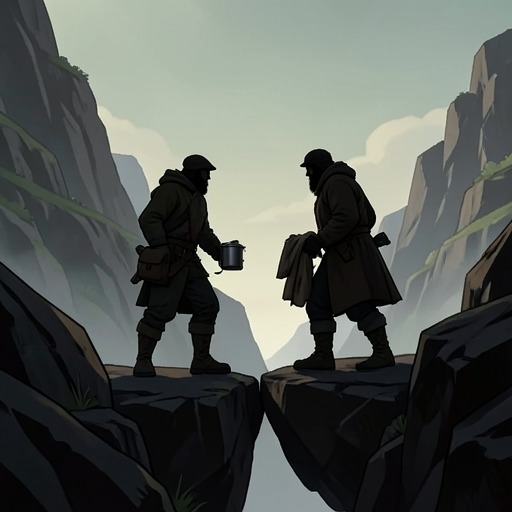
The port’s wall gives that separation its most compact physical form. It is a low, roughly mortared line of uncut rocks, easy for an adult to see over and even for a child to climb; where it crosses the road, it becomes a boundary in the mind as much as a barrier in the landscape. On one side, it surrounds a barren sixty-acre port with gantry cranes, a rocket pad, warehouses, a truck garage, and a grim dormitory used as quarantine. From that perspective, the wall encloses the ships and the outside universe, leaving Anarres free. From the other side, it encloses the whole planet, making Anarres itself look like a prison camp cut off from other worlds. Neither reading cancels the other.
Ecology and the Shape of Daily Life
Anarres’s ecology sets hard limits on the society built there. Its oceans hold abundant animal life, but on land only sparse, spiny plants and a narrow range of animals thrive in the long era of dust and dryness. People can live within this system by fishing without taking too greedily and cultivating crops with organic waste as fertilizer, but the planet cannot readily support the food chains familiar on Urras. There is no grass for herbivores, no herbivores for carnivores, and no insects to fertilize flowering plants; imported fruit trees must be hand-fertilized. The Settlers brought no animals from Urras that might disrupt the balance, and even their efforts to limit imported organisms left Anarres almost without familiar land life.
The urban pattern expresses the same effort to sustain connection without a central command. Abbenay consists of repeated neighborhood clusters of workshops, factories, homes, dormitories, learning centers, meeting halls, distributories, depots, and refectories. Industries that need one another tend to gather around the same squares and streets; low, sturdy buildings reflect the frequency of earthquakes, while small windows avoid shattering. In the textile district, poles strung with brightly colored banners and pennants announce the local work. The city’s wind turbines and earth-temperature generators supply power, but lighting and heating are limited by the principle of organic economy: artificial light is not provided from an hour before sunrise to an hour after sunset, and heat is withheld when the outside temperature rises above 55 degrees Fahrenheit. Abbenay’s spare appearance is not simply a sign of technical incapacity; it reflects an ethic that treats excess as a social and material burden.
The society’s practical dependence on cooperation gives solidarity a different force from a freely chosen ideal. Shevek argues that the poverty of Anarres, not cooperation itself, constrains individual creativity: if people fail to give up some personal desires for the common good, the barren planet cannot sustain them. Human solidarity is their only resource. That argument makes scarcity both the grounds of mutual aid and a persistent pressure upon it. On Anarres, cooperation is not an ornament of social life but part of the means by which life continues.
Community, Memory, and Social Pressure
Anarres’s institutions and traditions preserve a history of collective action. At the midsummer Insurrection Day feast in Abbenay’s North Park, the community commemorates the uprising in Nio Esseia and honors cooks and refectory workers, whose syndicate began the strike that led to it. The festival places the labor of feeding people at the heart of political memory. Other celebrations, including harvest homes and the Feast of the Solstice, arose from the rhythms of work and the desire of people who labor together to celebrate together.
The social order is sustained through education and shared work as well as through public ritual. When Shevek describes Anarres to children on Urras, he explains that schooling includes farming, carpentry, sewage reclamation, printing, plumbing, road repair, playwriting, and other occupations of adult life. He says that nobody is punished, though sometimes a person may be sent away alone for a while. The account presents a society that tries to make practical competence common rather than reserve it for a governing class. It also shows why outsiders ask what keeps people from robbing and killing one another: Anarres rests on forms of social order that do not depend on the ordinary apparatus of punishment and private property.
That ideal is not proof that Anarres has escaped power. Bedap warns Shevek that cooperation has become obedience and that the social conscience, once a living thing, is turning into a machine controlled by bureaucrats. Takver’s criticism of research appointments illustrates the stakes in ordinary institutional life: she suspects that a capable biologist has been sent away while a less capable but compliant colleague benefits from a project’s transfer to direct PDC management. The accusation is made amid a festival, where the society honors its traditions of shared labor even as its participants dispute how labor and authority are actually distributed. Anarres’s informal pressures can restrain dissent without looking like the overt laws and commands of Urras.
Isolation, Scarcity, and Crisis
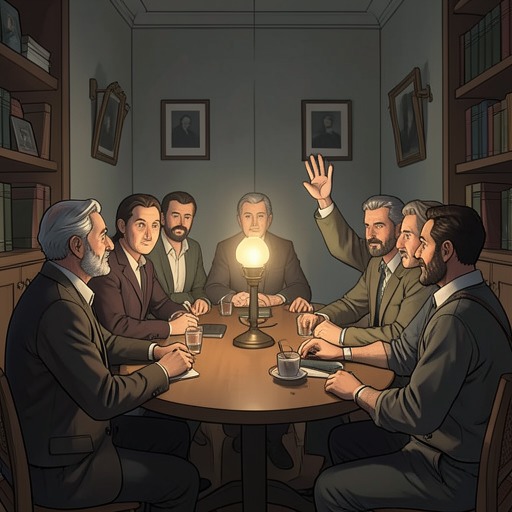
The wall is not the only structure that keeps Anarres apart. The Terms of the Settlement forbid Urrasti visitors from leaving their ships, except for the Settlers, and forbid mixing or contact. To Rulag, the new transmitter and the proposed opening to visitors risk handing scientific information to a powerful enemy and inviting a progression from a few visitors to profiteers and, eventually, armed occupation. She invokes the settlement’s long separation as the defense of the Promise. Bedap answers that the same act of opening the door could declare the experiment strong enough to meet others as an equal. Their disagreement reveals that isolation is both a safeguard against domination and a limit on exchange.
The planet’s physical vulnerability makes that argument urgent. During a drought, a participant in the Insurrection Day gathering insists there will never be another Great Drought because modern desalinization plants can prevent one; another replies that they might only alleviate it. That winter comes early, cold, and dry. Water for baths is strictly rationed because thirst and hunger take precedence over cleanliness, and water is diverted to keep the holum plants alive. Food and clothing for Anarres’s twenty million people depend on those plants, while food reserves have never been large. The sky over Abbenay is yellowed by dust from drier regions to the south and west. The contrast between confidence in technology and immediate rationing makes the ecological limit concrete: organized cooperation can distribute scarcity, but it cannot make the rain fall.
The danger of social fracture becomes especially visible when a train is stranded during famine. The passengers grow hungry while it sits for hours between a quarry and a shut-down mill. Some propose raiding nearby truck gardens, and resentment deepens as townspeople shelter behind their own walls and property instead of acknowledging the train. Once the train moves and the passengers receive a half loaf of holum bread and a bowl of thin soup, their gloom gives way to laughter and joking. They have seen one another through. The episode does not erase the threat of force or the possibility that solidarity will fail; it shows how a shared, inadequate meal can restore a sense of mutual dependence.
A Contested Home
Anarres acquires meaning through its contrast with Urras, but Shevek’s experience refuses an uncomplicated opposition between a free world and a corrupt one. On Urras he explains that he came to bargain with its economy, seeking open exchange and human solidarity rather than private profit. Later, he argues that he wants to give his theory to Urras, Hain, and other worlds so that no state can use it to gain power over rivals, enrich itself, or win wars. His insistence on a gift turns scientific knowledge into a test of whether exchange can serve a common good rather than a buyer’s advantage.
His judgment of the two planets changes as he sees both from outside their borders. Shevek once hoped to make Anarres a society among other societies, giving and taking instead of holding apart behind a wall. After his experience on Urras, he concludes that Anarres needs nothing available there and that profit and power penetrate even ordinary dealings. Yet his return does not mean that the wall has solved Anarres’s problems. His friends tell him by radio that things have been loosened: the journey and the Syndicate of Initiative’s work have stirred habits and questions. The result is uncertainty rather than a settled political victory.
At the end, the interstellar Davenant turns from Urras toward Anarres, seen among the stars as a bright, rounded rock. Shevek tells Ketho that the visitor would not land as an official representative: after walking through the wall, Ketho would be one of the community, responsible to it and responsible for himself, but without safe options and likely to find himself alone. Ketho chooses to try. The planet that once received a million people seeking a new life may now receive a single newcomer under the same unresolved terms of freedom and responsibility. Anarres remains a boundary and a home, but the possibility of change depends on crossing that boundary without turning openness into another form of possession.