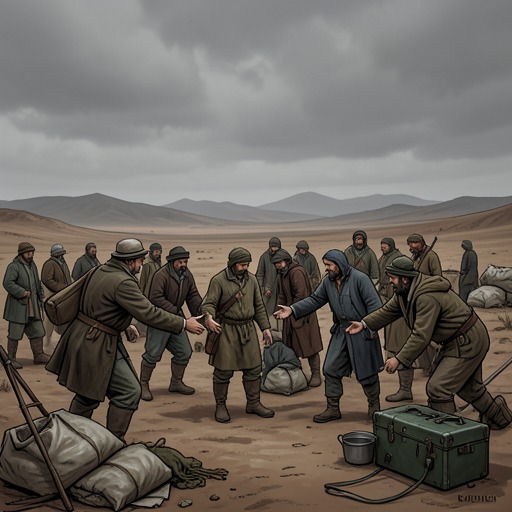
Anarres Famine
The DispossessedThe Anarres Famine is a remembered crisis whose force in the novel lies not only in hunger but in the questions it leaves behind: how a society built on sharing responds when there is not enough, and whether solidarity can survive unequal access to food and transport. Its memory recurs in scenes of public protest and later shortages, making famine a test of social arrangements rather than a simple measure of scarcity.
Memory and Political Background
Years later, the sight of a crowd standing outside the Port of Anarres recalls how people had once gathered at produce-train stations during the Famine. The resemblance frightens the Defense foreman, who had expected the routine at the gate to remain uneventful. The memory gives the waiting crowd a history: stillness itself can signal need and a gathering that has yet to find words or action.
The famine also sharpens political arguments over the trade that links Anarres to Urras. Anarresti debate whether to continue exchanging minerals for supplies, including food-producing strains and manufactured goods that local production cannot readily provide. One argument for maintaining the arrangement is that its economic benefit to Urras discourages invasion; its opponents see it as profitable commerce with propertarian powers. Seven generations of peace have not produced trust, and the remembered vulnerability of scarcity helps explain why dependence remains a charged question.
Drought and the Limits of Provision
A later dry winter in Abbenay shows how environmental stress can endanger the food supply. Frozen dust blows through the streets, water is rationed, and water is directed to keeping holum plants alive. The plants provide food and clothing—leaf, seed, fiber, and root—for Anarres’s twenty million people, while food reserves have never been large. The city’s needs therefore depend on a closely connected system of water, cultivation, storage, and distribution; a shortage in one part of that system cannot be treated as an isolated inconvenience.
The novel distinguishes scarce resources from the decisions and infrastructure that determine who can reach them. During an emergency, transport is overwhelmed: provision trains take precedence, vehicles and workers are pressed into service, and an error on the line leaves a passenger train stranded after a wreck. The episode makes clear that food may exist elsewhere while those who need it remain unable to obtain it. The famine’s remembered significance thus extends beyond a natural shortage to the capacity of distribution networks and collective arrangements to withstand pressure.
The Stranded Train and the Test of Sharing
At a mill town dependent on transport for food, 450 stranded passengers have gone without breakfast, while the town’s 160 residents have no surplus in their commons or warehouses. The residents give the travelers nothing. Sharing the available food, the account explains, might leave the town itself without provisions for days, with no certainty about when the next train will arrive or how much grain it will carry. The decision is not presented as effortless selfishness: the arithmetic of need places two vulnerable groups in direct conflict.
The passengers fast for sixty hours before reaching a station with a stocked refectory. For Shevek, this is his first experience of hunger as an involuntary condition: he had sometimes skipped meals while working, but food had always been available. As the train waits beside a quarry and a shut-down mill, he considers whether Anarresti society can endure famine without losing the solidarity on which it rests. When there is enough, even barely enough, sharing is possible; when there is not, force and power threaten to take its place, aided by the choice to look away.
The passengers’ resentment grows, and some seriously propose raiding the town’s truck gardens. Yet the train eventually moves, and at the next station the travelers receive half a loaf of holum bread and a bowl of soup. Their relief gives way to laughter and conversation: they have got through the ordeal together. The episode holds both outcomes in view—the temptation to seize food and the renewed fellowship that follows shared hardship—without treating either as proof that solidarity is automatic.
Social Consequences and Significance
A driver later invokes hungry children and food passing through that was not meant for them to explain how hunger can provoke people to mob trains. He also recalls an episode in which a man responsible for a train put it into reverse while people were taking it apart, without stopping to count who might be affected; afterward, the man was ill at what he had done. The driver distinguishes such actions under desperate pressure from assigning someone the deliberate responsibility of deciding who lives and who dies. His account frames famine as a moral and institutional danger: scarcity can make desperate acts understandable, but it does not make every form of authority over life acceptable.
Taken together, these recollections make the Anarres Famine a continuing measure of the society’s promises. Ecological limits, weak reserves, and transport failures create real hardship; the crucial question is how people distribute risk and respond to one another when ordinary provision breaks down. The novel neither assumes that mutual aid will always prevail nor reduces famine to population pressure alone. It shows solidarity as a practice that must be sustained under material constraint, and exposes the violence that can enter when need is met with exclusion, coercive decisions, or deliberate indifference.