Anarres drought and famine (163–167)
The DispossessedAnarres drought and famine (163–167) was a four-year crisis in which persistent dryness and food shortages tested the practical foundations of Anarres’s cooperative society. The emergency revealed that solidarity depended not only on shared ideals but also on water, food, labor, and transport—and that under severe scarcity, decisions about who receives provisions could become decisions about who bears hunger.
Ecological and Economic Background
The crisis struck a world already marked by long-term aridity. The fertile southeastern coast supported fishing and farming communities, but cultivable land formed only a narrow strip by the sea. Inland and west across the plains of Southwest stretched the Dust, a sparsely inhabited region whose former holum forest had been killed by millennia of drought. The trees’ loss left soil so dry and fine that wind lifted it into barren hills. Anarresti efforts to restore the land through replanting were an attempt to reverse that damage, but the wider ecological limits remained.
Anarres’s economy was also connected to Urras through a trade arrangement that many residents regarded as humiliating. Freighters arrived only eight times a year, bringing fossil fuels, petroleum products, delicate machine parts, electronic components, and trial varieties of fruit trees and grain; they departed with ores including mercury, copper, aluminum, uranium, tin, and gold. Anarresti critics objected to continuing profitable trade with propertarian societies, while defenders argued that ending it could invite invasion. The arrangement made Anarres a mining colony in economic terms, even as the planet remained politically separate. The book presents this dependence as part of the crisis’s larger context, not as a direct cause of the drought.
Escalation and Emergency Measures
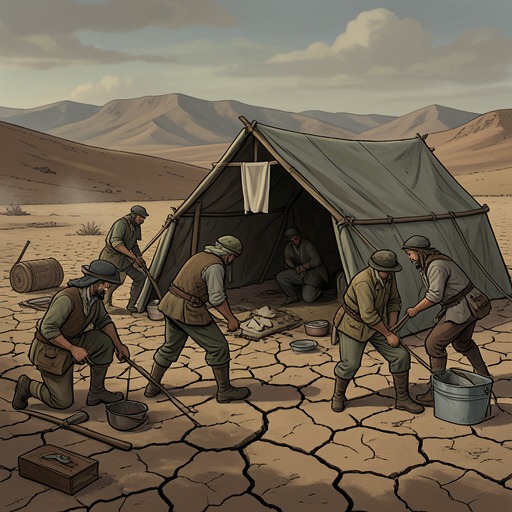
The drought began in the summer of 163 and received no relief during that winter. By the summer of 164, hardship had set in and prolonged failure threatened disaster. Rationing became strict and labor drafts imperative; growing enough food and distributing it became an urgent, comprehensive struggle. In Abbenay, water was directed to keeping plants alive, while water for baths was sharply restricted and thirst and hunger took precedence over cleanliness. Food and clothing for Anarres’s twenty million people came from holum plants, and warehouses held some textile reserves but had never maintained much reserve food.
The emergency strained the systems meant to move supplies and workers across the planet. After a year of drought, the transport network could not meet demand despite the efforts of its regional syndicates and their coordination with local and central PDC. Vehicles and personnel were insufficient; trucks, trains, ships, ports, and yards were staffed by regular workers alongside apprentices, retired workers, volunteers, and emergency draftees. The transport system was adaptable in ordinary conditions and limited emergencies, but simultaneous famine threats and large labor movements exceeded its capacity.
The crisis lasted beyond the drought’s eventual break. In the third quarter of 168, many people were still serving long shifts under emergency postings. The drought had ended in the winter of 167, but the economy had not returned to normal: skilled workers still faced long assignments and short commons, although food had become adequate for a day’s work, unlike in the preceding years. The interval between ecological relief and social recovery shows that rain alone could not immediately restore disrupted production and distribution.
The Stranded Train and the Test of Sharing
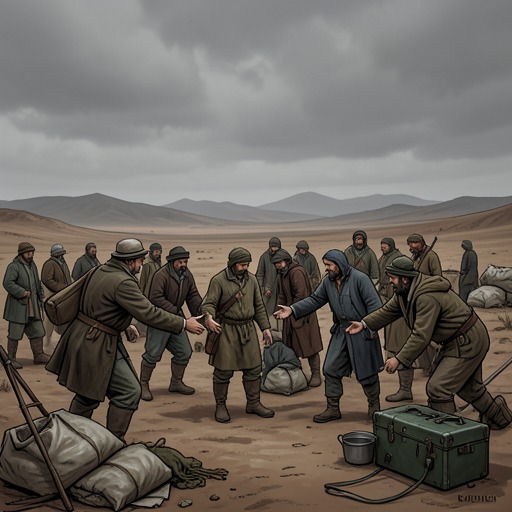
During the transport emergency, Shevek’s train advanced in short bursts and long waits because provision trains had priority. It then stood for twenty hours after a dispatcher’s error and a wreck farther up the line. The stop occurred in a small mill town that made concrete and foamstone and depended on transport for food. Its commons and warehouses had no surplus. The train carried 450 people, while the town had 160 residents; feeding the travelers would have left the local community without food for days, with no certainty about when provisions would arrive. The townspeople gave the passengers nothing.
Having already missed breakfast, the travelers went without food for sixty hours, until the track was cleared and the train reached a station 150 miles farther on, where a refectory was stocked for passengers. This was Shevek’s first experience of hunger: he had sometimes skipped meals while working, but food had always been available. The delay made deprivation concrete rather than hypothetical, and prompted him to question whether his society could endure famine without losing the solidarity on which it relied.
For Shevek, the stoppage exposed a moral fault line. Sharing seemed straightforward when supplies were sufficient, even barely; when they were not, he feared that force might replace mutual obligation, with power determining whose needs counted and violence serving that power. The travelers grew resentful, but what troubled him more was the townspeople’s withdrawal behind the boundary of what they treated as their own property and their refusal even to look toward the train. Passengers debated whether to raid the truck gardens, an idea that might have been acted upon had the train not resumed its journey. At the next station, a meal of holum bread and soup lifted their spirits, and they returned to the train laughing and joking. Their renewed fellowship did not erase the town’s refusal; it showed that they had endured the ordeal together.
Solidarity, Scarcity, and Ethical Limits
The crisis did not produce only despair. In Abbenay during the summer of 164, difficult work could carry an undercurrent of shared exhilaration: people took care of what could be done, then set their cares aside, and the old ideal of solidarity felt newly alive. The account places that communal energy beside the train episode’s harder lesson. Cooperative commitment could be renewed through necessary work, yet scarcity could also expose the limits of sharing when one group’s aid seemed likely to deprive another of food.
Later, after Shevek quit work making ration lists at the mills in Elbow, a driver objected that assigning who lived and who died was not a task anyone had the right to impose on another. He distinguished such rationing decisions from other desperate acts during the famine, including hungry people mobbing trains and a train worker reversing a train being dismantled by a crowd; those involved, he said, had lost their tempers under intolerable pressure, and the worker had been sickened afterward by what he had done. The exchange gives the emergency an ethical aftermath: survival measures could become morally unbearable when they required one person to determine who would go without.
As a narrative episode, Anarres drought and famine (163–167) tests the society through material pressures rather than through an abstract argument about its principles. Water scarcity, crop dependence, inadequate reserves, overloaded transport, and emergency labor make the crisis systemic. Its outcome is neither a simple vindication nor a simple refutation of Anarresti solidarity: collective effort persists, but the stranded train and the ration-list work show how easily necessities can become instruments of exclusion when supply and distribution fail.