Anarres–Urras Trade Agreement
The DispossessedThe Anarres–Urras Trade Agreement is the narrow, recurring channel through which the isolated settlement exchanges essential supplies for the mineral wealth of its former homeworld. Its terms are defended as a way to make invasion uneconomic, but the bargain also leaves Anarres in the position of a mining colony and makes every shipment a reminder that seven generations of peace have not produced trust.
Terms and Material Exchange
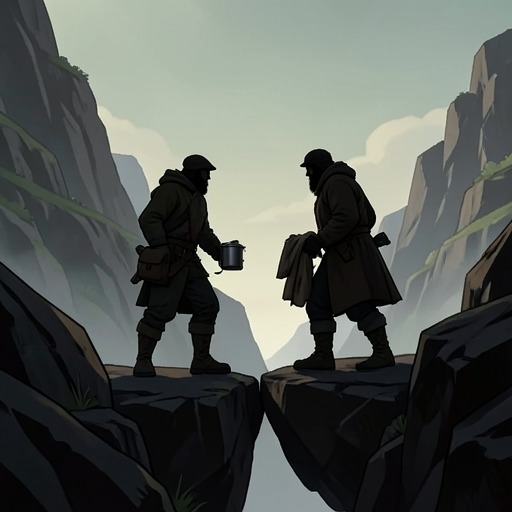
Freighters from Urras arrive only eight times a year and remain just long enough to load and unload. They bring fossil oils and petroleum products, delicate machine parts and electronic components that Anarresti manufacturing cannot supply, and sometimes new strains of fruit trees or grain for testing. In return, they carry away mercury, copper, aluminum, uranium, tin, and gold. The arrangement benefits Urras: exporting the materials is cheaper than having Urrasti workers dig the ores themselves. The novel therefore describes the nominally free world of Anarres as, in economic fact, a mining colony of Urras.
The exchange also binds the planets through institutions beyond the docks. Dividing the cargoes eight times a year is the most prestigious function of the Urrasti Council of World Governments and a major event on Urras’s stock market. Anarres experiences the same traffic differently: the freighters are unwelcome visitors, and their repeated arrival can feel like a renewed humiliation. A transaction presented on one world as orderly commerce thus carries a different political meaning on the other.
The Bargain’s Defense and Its Cost
In Abbenay’s PDC debates, protesters ask why Anarres continues profitable business with warmaking propertarians. The answer is strategic: mining the ores themselves would cost Urras more, so the trade makes an invasion less attractive; ending the agreement, the argument goes, could invite force. The defense treats cost as a barrier against war, but it does not establish confidence between the worlds. People who have never used money find the marketplace’s psychology difficult to accept, and seven generations of peace have still not brought trust.
The arrangement’s logic is especially uneasy in light of Anarres’s own scarcity. Its population depends on holum plants for food, clothing, and water-dependent crops, and reserves of food are limited. The trade provides certain goods that local production cannot supply, but the evidence does not portray it as an equal or comprehensive exchange: valuable ores leave Anarres while the settlement remains exposed to shortages of its own necessities. Peace is maintained partly by a calculation of what invasion would cost, not by a resolution of the unequal relationship.
Exchange, Gift, and Dependence
Shevek makes the conflict between market exchange and mutual provision personal as soon as he arrives on Urras. Having brought no money, he explains that he cannot buy what he needs and asks to be kept alive through giving rather than selling. He calls himself the Beggarman, presenting his dependence not as an accidental embarrassment but as the practical consequence of arriving from a society that does not use money. Later, when offered clothing and small necessities, he again describes himself as coming empty-handed: he could bring neither money nor gifts of goods the hosts lacked. These encounters expose the social assumptions concealed by the trade agreement: on Urras, access is organized through purchase, while Shevek asks whether receiving can instead create a relation of generosity.
That question becomes political when Shevek tells Chifoilisk that he came to bargain with Urras. What he wants is not a better private return from the existing economy, but an end to the separation between the planets and free exchange between their peoples. He understands that Urras’s welcome, resources, and attention to his scientific work exist within a profit economy; the agreement is therefore part of the larger framework he hopes to alter, not a neutral bridge between societies.
Knowledge and the Limits of Exchange
Shevek’s proposed gift of his theory sharpens the contrast between an exchange bounded by price and knowledge offered for common use. He asks whether there is any alternative to selling and says that he wants to give the theory to Urras, Hain, and the other worlds so no one country can turn it into power over others, greater wealth, or victory in war. His objection is not to circulation itself, but to the concentration of its benefits through private profit and political advantage.
On Anarres, however, the desire to open communication meets a different fear. At a meeting about contact with Urras, Rulag argues that broadcasting and publishing communications have already exposed the settlement’s weakness and that admitting visitors could lead from a small group to profiteers and ultimately armed occupation. The meeting upholds the Settlement’s restriction on Urrasti leaving their ships, while Shevek argues that sending an Anarresti to Urras is not forbidden and should remain an individual’s right. His appeal is that the settlement was founded for freedom, not merely safety: solidarity cannot mean that majority opinion becomes an unquestionable rule. The agreement’s material exchange can continue under tightly guarded separation, but the question of open relations reveals the political cost of treating that separation as permanent.