Anarresti ethic of sharing and non-ownership
The DispossessedThe Anarresti ethic of sharing and non-ownership is the social principle that things are for use and sharing, not private ownership. It appears first as an ordinary lesson in communal life, but its force extends from food and personal possessions to the exchange of scientific knowledge: against the market logic Shevek encounters on Urras, giving without selling becomes both an ethical practice and a political choice.
The Principle in Everyday Life
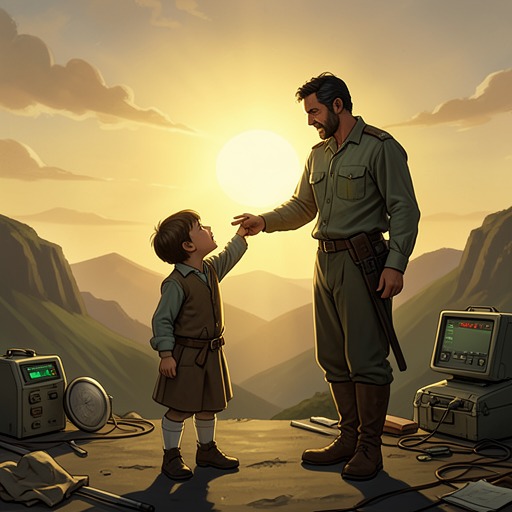
The ethic is taught through a small childhood conflict over sunlight. When the young Shevek claims a square of sunlight as his own, a one-eyed woman tells him that nothing belongs to him: things are to be used and shared, and refusal to share means forfeiting their use. She gently but firmly moves him out of the sunlit space so another child can have it. The lesson is not merely verbal; communal access is enforced through everyday care, while Shevek’s father comforts him as he cries over the loss.
The principle also governs expectations about food and material comfort. At the Central Institute of the Sciences on Urras, Shevek finds dessert served every night, though on Anarres most refectories serve it only once or twice a decad. He wonders whether the Institute’s members are considered better than other people, and whether its abundance fits the ethic of sharing he has known. Rather than ask anyone, he stops taking dessert. His discomfort exposes the gap between a shared ideal and an unequal distribution of comforts; he keeps the private room because its practical value helps him do socially useful work, but relinquishes the extra dessert that troubles his conscience.
Giving Across Worlds
Shevek’s arrival on Urras makes the ethic legible through contrast with a society organized around buying and selling. When his luggage is lost, he explains that he brought nothing: he cannot buy necessities because he has no money, and could not have carried enough food to sustain himself. If his hosts mean to keep him alive, they must give him what he needs. He describes himself as an Anarresti making Urrasti give rather than sell, and calls himself the Beggarman. The apparent dependence is also a challenge: hospitality reveals whether another society can meet need without turning it into a transaction.
Later, when Saio Pae arranges clothing for him, Shevek again frames his empty hands as an ethical distinction. He could bring neither money, which Anarresti do not use, nor gifts of goods that his hosts already have; he has come, as a good Odonian, empty-handed. His hosts assure him that he is their guest and owes no payment, although Chifoilisk points out that the Ioti Government is paying the bill. That detail sharpens the tension between personal hospitality and institutional expenditure: a welcome can feel generous while remaining embedded in a government’s interests.
Knowledge as a Gift
Shevek understands his visit as a bargain with Urras, but not a sale of his principles. He tells Chifoilisk that he came to bargain because he wants his people to come out of exile and wants free exchange between Urras and Anarres. His aim is solidarity across the wall of political isolation, not the private enrichment of either world. The language of bargaining acknowledges the power of the society hosting him while leaving open what may properly be exchanged.
That distinction becomes decisive when Shevek recognizes that allowing the propertarians to buy his scientific truth would betray the human solidarity that helped make him. He asks whether there is an alternative to selling: the gift. He wants to give his theory to Urras, Hain, and the other worlds so that no one power can use it to dominate rivals, grow richer, or win wars. His objection is not to knowledge traveling beyond Anarres, but to its enclosure as private advantage. A gift, in this instance, is a way to make scientific exchange common rather than proprietary.
Solidarity and the Public Meaning of Sharing
At the mass demonstration in Capitol Square, the ethic takes on a collective political voice. Shevek sees a crowd too large to count, gathered, marching, singing, and listening together. Speaking from the Directorate steps, he argues that people are bound not by compulsory love but by shared suffering, hunger, poverty, and hope. Mutual aid is necessary because no outside hand will save them; freedom begins with the recognition that people possess nothing and must give what they are.
He presents Anarres as a society with no government, wages, police, soldiers, or owners, but insists that it is neither prosperous nor powerful. Its alternative rests on mutual aid and free association, not on abundance. The crowd’s promise is therefore not a promise to acquire Anarres as a model or purchase its revolution: it requires people to give themselves to a shared future. The ensuing helicopter attack drowns out his speech and turns the square into a scene of panic and violence. The contrast makes the ethic’s stakes concrete: a public appeal to solidarity meets state force, while the principle itself remains a demand for free association rather than coercive possession.
The rule connects intimate conduct, social distribution, and political action without making them identical. The childhood lesson concerns access to a patch of sunlight; Shevek’s refusal of extra dessert tests his conscience against institutional privilege; his empty-handed arrival tests hospitality across economic systems; and his offer of scientific work resists turning knowledge into a weapon or commodity. Across these contexts, sharing is not simply the transfer of goods. It is a refusal to make need, knowledge, or freedom the exclusive property of those able to pay or command.