Ans Hos
The DispossessedAns Hos is the region of Anarres first known to Urrasti astronomers as the Garden of Mind and later celebrated as the Eden of Anarres. Though it was the green place where the first manned ship landed, the apparent paradise was cold, dry, windy, and poor in life; it became first a mining settlement and then the site of Abbenay, the principal city of the new society. Its history makes the gap between a name bestowed from afar and the lived conditions of a place central to Anarres’s story.
A Name Seen from Urras
In the Third Millennium, astronomer-priests in Serdonou and Dhun observed the seasons changing the brightness of the Otherworld and gave mystical names to its plains, ranges, and seas. They called Ans Hos, the Garden of Mind, the region that turned green earliest in the lunar new year. Later telescopes confirmed that it was indeed Anarres’s most favored spot, and the first manned ship to the Moon came down in the green country between the mountains and the sea.
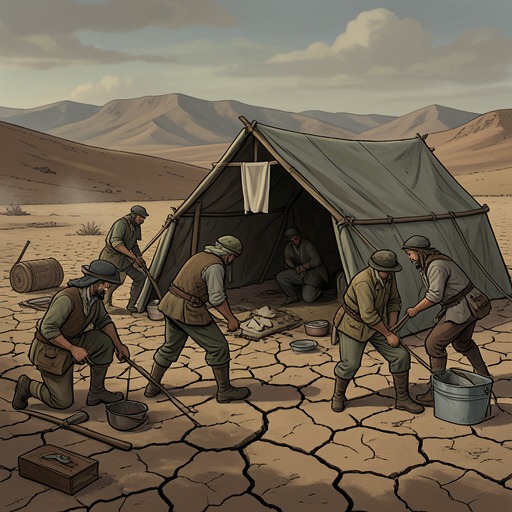
The name’s promise did not describe the world that settlers encountered. Ans Hos was dry, cold, and windy, while the rest of Anarres was harsher still. Life had developed no further than fish and flowerless plants; the air was thin, the sun burned, the wind froze, and dust choked. The Eden was not an easy refuge but the least forbidding part of a difficult planet.
From Mining Settlement to Abbenay
For two centuries after the first landing, Urrasti explorers mapped and investigated Anarres without colonizing it. The turn came when the exhausted mineral lodes of Urras made it cheaper to mine the Moon than to obtain metals from poor-grade ores or seawater. In IX-738, a settlement for mercury miners was founded in old Ans Hos at the foot of the Ne Thera Mountains. Called Anarres Town, it was a work camp rather than a settled community: there were no women, and male miners and technicians signed on for two or three years before returning to what they considered the real world.
Anarres’s political future changed after the collapse of Thu’s government in 771. Thu had secretly maintained a rocket base and a settlement of gold miners, including their wives and children, in the Moon’s eastern hemisphere. When the government fell, the Council of World Governments proposed giving Anarres to the International Society of Odonians, hoping to buy off a movement that threatened law and national sovereignty on Urras. Anarres Town was evacuated; rockets sent to retrieve Thu’s miners carried some away, but some chose to remain on the Moon.
Over more than twenty years, the twelve ships granted to the Odonian settlers carried a million people across the dry abyss. When immigration ended and the port was left open only to freight ships under the Trade Agreement, Anarres Town had grown to a hundred thousand inhabitants and had been renamed Abbenay, meaning Mind in the new language. Ans Hos thus became the setting not just of an extractive outpost but of the society founded by the settlers.
Place, Settlement, and Separation
The region’s development places two different uses of space in succession: first, a mining camp organized around Urras’s demand for metals; then, a city formed by a mass migration and given a name in the settlers’ own language. The change does not erase the planet’s ecology. Anarres remains a dry world, and its inhabitants build their life amid scarcity rather than in the easy abundance suggested by the Eden name.
The port’s later boundary gives that history a stark physical expression. The wall around the Port of Anarres encloses a barren sixty-acre field with cranes, a rocket pad, warehouses, a truck garage, and a grim dormitory that functions as quarantine. It shuts in the landing field, arriving ships, their crews, and the worlds they come from, leaving Anarres outside. The boundary separates the settlers’ world from Urras even as freight continues to cross it, making the landing place a threshold between exchange and isolation.
Ecological Limits and Meaning
The contrast between Ans Hos’s early green appearance and Anarres’s enduring environmental hardship recurs in the planet’s later crises. During a drought, Desar invokes modern desalinization plants as a safeguard against another Great Drought, while Terrus answers that they might only alleviate the danger. Their exchange recalls that no hopeful name or technical assurance can simply abolish the conditions of life on Anarres.
Ans Hos therefore carries several histories at once: a region first interpreted through distant astronomical imagination, a landing site whose promise proved misleading, a mining settlement shaped by Urrasti extraction, and the ground from which Abbenay grew. The movement from Garden of Mind to Anarres Town to Abbenay does not turn the land into a paradise; it shows how people name, exploit, and inhabit a place whose material limits remain real.