Capitalism and the profit economy
The DispossessedCapitalism and the profit economy are the novel’s name for a system that makes money, prices, and private gain central to material life and political power. Shevek encounters that system as both an outsider and a participant: on Urras he is paid for research, while on Anarres he has been formed by shared provision and labor without financial reward. The contrast is not simply between abundance and scarcity. It asks what kinds of obligation an economy creates, who bears the costs of necessary work, and whether knowledge can be exchanged as a gift rather than sold for private advantage.
Money, Need, and the Beggarman
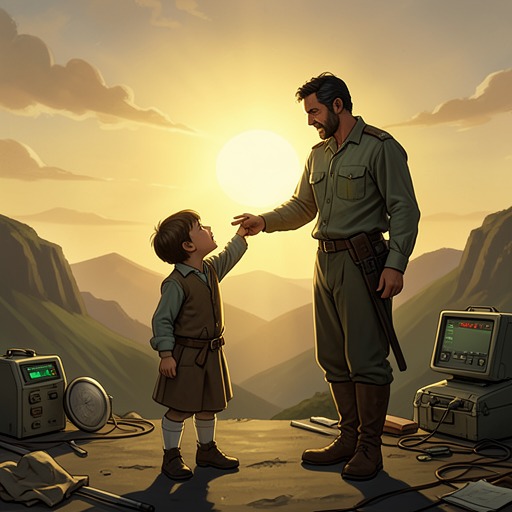
Shevek’s first difficulty on arriving in Urras is practical. He has brought no money, and the difference between the two economies becomes clear in the question of how a visitor is to remain alive. He explains that in Urras people must buy things, whereas he cannot buy and cannot carry enough supplies to sustain himself. If he is to be kept alive, his hosts must give him what he needs. He calls himself the Beggarman, turning his lack of purchasing power into a direct challenge to the assumption that every need must be met through a transaction. His worn holum-fiber suit still fits, and he feels like himself in it; its plainness marks a continuing connection to his society rather than a mere failure to acquire Urrasti goods.
The same principle shapes his response when Saio Pae arranges clothing and small necessities for him. Shevek thanks his hosts but reminds them that he could bring neither money nor gifts, because the things he might offer are already available to them. He has come, he says, “with empty hands.” The phrase makes hospitality more than a polite exception to commerce: it exposes how difficult it is for a society organized around buying and selling to understand an exchange that asks for no payment. Chifoilisk makes the economic power behind the arrangement explicit by observing that the Ioti Government is paying the bill. Shevek is welcomed as a guest, but the conditions of his welcome are still embedded in state expenditure and its interests.
What Money Means on Urras
As Shevek lives in A-Io, income accumulates around his scientific work. He has the 10,000 International Monetary Units of the Seo Oen award, a 5,000-unit grant from the Ioti Government, a professor’s salary, and payments from the University Press for three monographs. At first, the sums seem comic to him; then their importance becomes impossible to dismiss. He tries to learn how banks function, but the operations of capitalism remain as remote as the rites of a religion whose premises he does not share. What frightens him is not merely an unfamiliar financial mechanism. It is a social order that treats greed, laziness, and envy as ordinary motives and makes money appear to explain what people do.
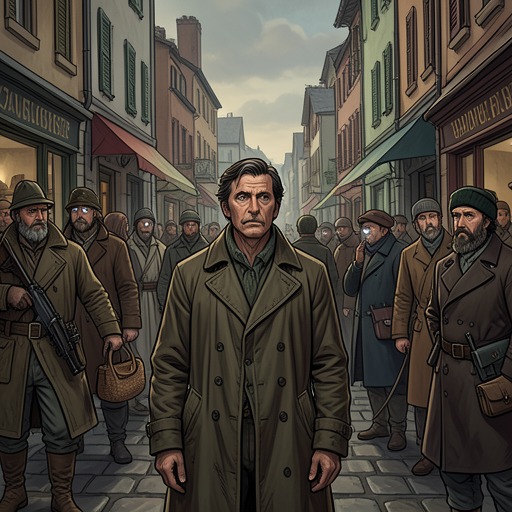
Chifoilisk gives that order its bluntest political formulation: Urras is a “profit economy.” He warns Shevek that the hospitality, research facilities, praise, publication, and protection surrounding him are not simply acts of scientific generosity. Shevek answers that he knows and came to bargain with the system. His purpose, however, is not to maximize his own earnings. He wants his people to come out of exile, to restore human solidarity, and to establish free exchange between Urras and Anarres. He believes A-Io fears him less than Thu because it has forgotten the revolution and supposes that people contented with possessions will accept confinement. In this exchange, the economy is inseparable from political interpretation: hospitality can be a means of access and influence, while Shevek tries to turn that access toward communication across the divide.
The novel sets the apparent abundance of Urras against the social costs concealed by its prices. At the Oiie household, Shevek asks who performs dirty work and whether such workers are paid more. He learns that dangerous work may bring higher pay, but menial work can pay less. Oiie explains the blunt incentive: low pay is better than no pay. He recalls that his grandfather scrubbed hotel floors and changed dirty sheets for fifty years, ten hours a day, six days a week, so that his family could eat. The account gives the profit economy a human history within the household: its labor is not abstract, and its bargains do not distribute burdens equally. Oiie’s wife responds by citing her own father’s ownership of four companies, a contrast that places family memory and ownership side by side without resolving the unease between them.
Labor Without Wages—and Its Pressures
Shevek explains to the Oiie family that Anarresti labor is not assigned by a wage offer. A person goes to Divlab, the Division of Labor office, asks what work is available, and chooses a posting. In small communities, difficult or dirty jobs may be done together; a person who usually works at a mechanical loom may find it pleasant to spend a tenth day laying pipe or plowing with a different group. People also take hard or dangerous work for challenge, skill, and the satisfaction of doing it well. Shevek describes the wish to demonstrate one’s competence as a kind of showing off, but stresses that work itself can be a lasting pleasure. In the absence of financial reward, personal satisfaction and neighbors’ respect become important motives.
That account does not present Anarres as free of compulsion. When Oiie asks what happens to someone who refuses to cooperate, Shevek describes ridicule, rough treatment, exclusion from a community meal listing, and the pressure to move elsewhere. Some people move throughout their lives; they are called nuchnibi. Shevek identifies himself as a kind of nuchnib, since he is in Urras evading his own work posting, and explains that he has moved farther than most. His calm description qualifies the contrast between a profit economy and voluntary labor: Anarres dispenses with wages and formal laws, but communal opinion can become a powerful force, and exclusion can make the nominal freedom to move costly.
The contrast becomes particularly sharp when Shevek asks why Urrasti workers accept menial tasks for poor pay. Oiie’s answer and the story of his grandfather reveal a system in which access to food depends on income. On Anarres, according to Shevek, people work for the work’s sake, for their own pleasure, and for the respect of their fellows; on Urras, the need for money can compel people to accept work whose reward is inadequate. The novel does not erase social pressure from its account of Anarres, but it distinguishes the sources of pressure: shared expectations and belonging on one side, the need to earn a living on the other.
Scarcity, Trade, and the Limits of Solidarity
Anarres itself is materially dependent on trade with Urras. Freighters arrive only eight times a year, unload fossil oils, petroleum products, specialized machine parts and electronic components, and sometimes new varieties of fruit trees or grain for testing. They depart with minerals including mercury, copper, aluminum, uranium, tin, and gold. The exchange is profitable for Urras, and the division of cargo is a major occasion for its political and financial institutions. Anarresti critics object to trading with wealthy, war-making propertarians, but defenders argue that the cost of extracting the ores themselves discourages invasion: if the agreement ended, Urras might use force. The bargain preserves peace while perpetuating an unequal relationship. Seven generations without war have not produced trust, and Anarres remains, in economic fact, a mining colony of Urras.
The drought makes the material basis of solidarity visible. In a cold, dry winter, water in Abbenay is rationed, with agriculture taking priority over baths; the holum plants provide food and clothing for Anarres’s twenty million people, but food reserves have never been large. This shortage is not a simple illustration of money’s absence: it shows the strain placed on collective provision when essential resources and reserves are limited. Takver, pregnant and working to an exacting schedule, can miss the extra meal available to pregnant people, children, and the elderly. Friends sometimes bring her a bun or a piece of fruit saved from their own meals. Such sharing is practical and local, but the reduced commons meals and her unmet need for sweets make clear that mutual aid does not abolish deprivation.
During the emergency, Shevek experiences hunger when a provision train’s schedule leaves his passenger train stranded for twenty hours after a wreck. The mill town where it stops has no surplus in its commons or warehouses. It depends on transported food, and its 160 residents cannot feed the 450 passengers without risking their own subsistence; they give the travelers nothing. The passengers fast for sixty hours before reaching a station with food. For Shevek, who has never had to go without the two meals routinely available on Anarres, the experience tests an assumption he had not needed to examine: whether a society can preserve solidarity when there is not enough to share.
On the siding, he considers how scarcity might bring force and violence into relations that appear egalitarian when supplies are adequate. Passengers grow resentful, while the townspeople remain behind their walls and do not engage with them. Some travelers seriously propose raiding the truck gardens. The train departs before that proposal is acted upon, and the passengers later receive a half loaf of holum bread and a bowl of soup. Their gloom gives way to shared elation; they return to the train joking together, having endured the delay collectively. The episode neither proves that solidarity inevitably fails nor treats it as effortless. It places the refusal to share, the prospect of taking by force, and the renewed companionship after food in one sequence, showing how quickly material insecurity can expose competing claims to need and possession.
The Gift of Knowledge
The economic conflict reaches its decisive form in Shevek’s scientific work. Chifoilisk warns him that Urrasti institutions are not supporting him from disinterested love. Shevek accepts the underlying danger: if the propertarians pay for his truth, they may use it to gain power over others, become richer, or win wars. He later describes his scientific pursuit as a betrayal of the ideals that made him: freedom, change, and human solidarity. The issue is not whether the theory has value, but who may control its use and who benefits from that value.
Shevek’s alternative is to give the theory to Urras, Hain, and the other worlds, so that no one country can turn it into private profit or use it to dominate the rest. He asks whether there is any alternative to selling and whether a gift is possible. Keng suggests that truth will in the end serve the common good; Shevek refuses to wait for that eventual outcome, because he has one lifetime and will not spend it serving greed, profiteering, and lies. The gift is therefore not a denial that scientific knowledge can have consequences. It is an attempt to prevent its benefits from being enclosed by a single government or converted into an instrument of power.
The same dispute returns on Anarres as a question of communication and political risk. The Syndicate of Initiative has built a transmitter, broadcast to Urras, received communications, and published them despite objections from much of the PDC and the Brotherhood. At a meeting, Rulag argues that sharing scientific information with a powerful enemy reveals Anarres’s weakness and that inviting Urrasti visitors could begin a progression from a few visitors to profiteers and then armed occupation. Bedap replies that contact would show Anarres is strong enough to meet Urras as an equal. The group declines to bring Urrasti visitors to Anarres, but the discussion turns to whether an Anarresti may travel in the other direction. Shevek argues that the Terms of the Settlement do not forbid an individual’s journey and that preventing it would mean the PDC assuming authority over harmless individual initiative.
The profit economy is thus one part of a larger argument about exchange: what must be bought, what can be shared, and how fear can turn a protective boundary into enforced isolation. Shevek’s Beggarman identity, his bargaining with A-Io, and his proposed gift of scientific truth form a connected progression. He first makes dependence on another society’s generosity unmistakable; then he confronts the interests attached to that generosity; finally, he tries to release knowledge from the ownership and national rivalry that would make it a source of private gain. The novel’s contrast is not a simple claim that one world has solved every problem. It holds economic compulsion, communal pressure, scarcity, and political risk in tension, while insisting that the terms of exchange remain choices with consequences.