Drio
The DispossessedDrio is a Urrasti town whose redevelopment by the Space Research Foundation erased the prison where Odo spent nine years and wrote the Prison Letters and the Analogy. The contrast between the rebuilt town and the ruin still standing above the Seisse makes Drio a place where modern achievement and revolutionary memory collide.
Setting and Historical Memory
Drio is associated with the Fort in Drio, where Odo was imprisoned for nine years after the Insurrection of 747. She wrote the Prison Letters and the Analogy there. On Anarres, children learning history encountered the idea of prisons through accounts of Odo’s years at the fort: a place where a state confined people who disobeyed its laws, prevented them from leaving, and could force them to labor. The children’s questions made the coercion of imprisonment newly strange to a society whose young listeners had never seen anyone beaten except in immediate personal anger.
The fort’s history also survives in collective memory through the account of Odo’s imprisonment, rather than through an intact site that visitors can enter. For Shevek, the place matters not as an interchangeable old building but as the material setting of Odo’s years of confinement and writing.
Reconstruction and Erasure
When Shevek visited the Space Research Foundation near Drio, he was shown its interstellar propulsion project, from computers and drawing boards to a half-finished ship in a vast, brightly colored hangar. The Foundation’s work impressed him: he praised the resources available to its engineers and the coordination of their enterprise. Yet the surrounding redevelopment had also transformed the town. In response to a question about the old fort, an engineer explained that the Foundation had rebuilt Drio entirely; a local colleague added that the town had been moribund and that the Foundation had wiped it out and started afresh.
The explanation establishes the cost embedded in the Foundation’s achievement. The new institution’s spacious laboratories, factories, and hangars stood in a town remade so completely that the historic prison Shevek sought was said to have been pulled down. Its modernization did not merely add new facilities to an old setting: it removed the site that gave the town significance in Odo’s history.
The Ruin and Shevek’s Encounter
Shevek explicitly names the Fort in Drio as the place where Odo spent nine years after the Insurrection of 747 and wrote the Prison Letters and the Analogy. His response is set and grave as he speaks; he nods when told the fort is gone. The exchange clarifies why the Foundation’s account of reconstruction cannot settle the question for him: technical progress has not preserved the history he came to see.
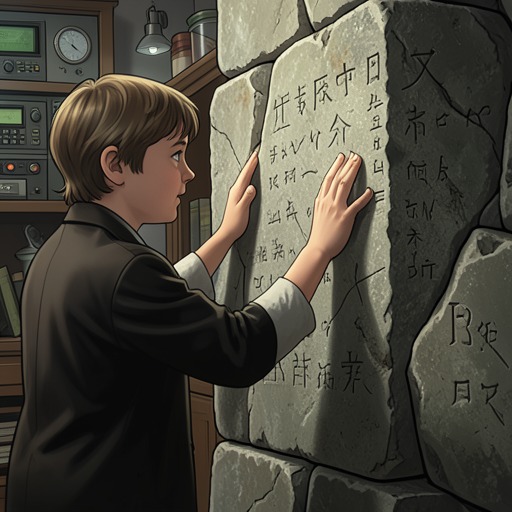
Yet the fort has not wholly disappeared. As the car travels beside the Seisse, Shevek sees a heavy, ruined building on a bluff, with broken black-stone towers. Its implacable, ruinous appearance contrasts sharply with the Foundation’s colorful domes, bright factories, tidy lawns, and paths. Against the surviving ruin, the new architecture seems insubstantial, like pieces of colored paper. Drio thus holds two incompatible measures of what endures: the Foundation’s capacity to build anew and the ruined fort’s stubborn presence as a trace of confinement and revolutionary memory.