Great Drought
The DispossessedThe Great Drought is a prolonged ecological and social crisis on Anarres that tests the society’s commitment to mutual aid against shortages of water, food, and transport. Rather than presenting scarcity as a simple consequence of too many people or too little land, the account follows the material systems that distribute necessities—and shows how, under pressure, decisions about access can fracture solidarity.
Background and dependence
Anarres’s political independence coexists with an uneasy economic dependence on Urras. Freighters arrive only eight times a year, bringing petroleum products, machine parts, electronic components, and experimental crops; they depart loaded with minerals. Anarres’s critics regard these transactions as humiliating profiteering, while their defenders argue that the bargain deters invasion: extracting the ores themselves would cost Urras more than maintaining trade. Seven generations of peace have not produced trust, and the drought makes that background of insecurity newly consequential.
This arrangement also reveals a limit in Anarres’s self-sufficiency. Its manufacturing cannot supply every delicate component, and its food system depends heavily on holum plants and successful cultivation. When drought threatens the crops, the society has little reserve to buffer the shock. The crisis therefore bears on more than weather: it tests an economy already shaped by ecological constraint, external trade, and the politically fraught question of how much protection can be secured without surrendering independence.
Climate and rationing
The drought develops into an extended emergency. Southrising’s leaf crops are already failing after thirty decads without rain, and the hope that modern desalinization plants will prevent another Great Drought is tempered by the recognition that they might alleviate rather than eliminate the damage. Winter arrives early, cold, and dry. Frozen dust blows through Abbenay’s streets, while the cloudless sky is yellowed by dust carried from drier regions to the south and west.
For Anarres’s twenty million people, food and clothing depend on holum plants—leaf, seed, fiber, and root. Warehouses hold some reserve textiles, but the society has never maintained much reserve food. Water is directed to keeping plants alive, and supplies for bathing are strictly rationed because thirst and hunger take precedence over cleanliness. The details make scarcity a matter of allocation as well as natural conditions: water, labor, transport, stored provisions, and the order in which needs are met all become decisive.
Transport failure and the experience of hunger
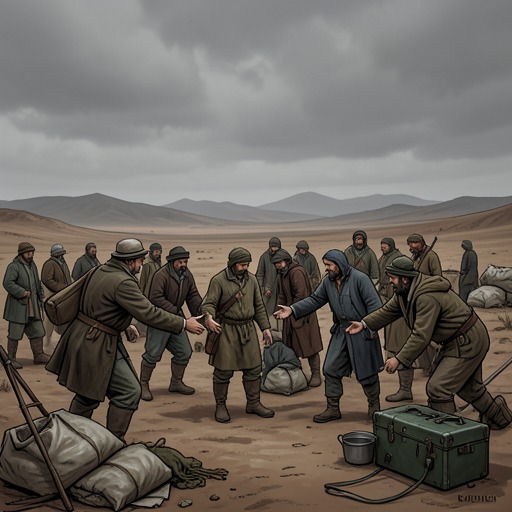
Emergency demands strain the transport system. A train carrying Shevek and 450 passengers is delayed while provision trains receive priority, then stops for twenty hours after a dispatch error and a wreck farther up the line. The town where it is stranded is a mill town of 160 people, dependent on transport for food rather than able to feed a large influx from local production. Its commons and warehouses have no surplus. Giving food to the passengers could leave the residents without food for days, with no certainty about when the next provisions train will arrive. The townspeople give nothing.
The travelers, who have already missed breakfast, go without food for sixty hours. For Shevek, this is a first encounter with hunger: he had sometimes skipped meals by choice while working, but food had always been available. The distinction changes his understanding of deprivation. Hunger is no longer an abstraction or voluntary interruption; it is enforced by circumstance, and it raises the question of whether a society built on sharing can preserve that principle when there is not enough to go around.
The passengers’ resentment grows, and some seriously propose raiding the town’s truck gardens. Shevek considers the deeper danger in the townspeople’s refusal even to acknowledge the train: under pressure, people can retreat behind the idea of “their” property and avert their eyes from others’ need. Force, power, and violence become imaginable where the expectation of shared provision fails. The train finally moves, and at a station a hundred and fifty miles farther on the passengers receive a meal. Their relief and shared laughter briefly restore a sense of fellowship, but the episode has shown how fragile that fellowship can be when access to food is contested.
Solidarity under pressure
The crisis does not yield a simple verdict on Anarres. The town’s lack of stores and dependence on transport make its choice materially understandable, while the refusal to share exposes the human cost of decisions made in the name of protecting a local supply. Neither the numbers nor the principle of mutual aid settles the dilemma: 450 passengers cannot be fed without serious risk to 160 residents, and the next delivery is uncertain. Scarcity makes the distribution problem unavoidable rather than theoretical.
Elsewhere, the drought’s pressures also make labor and responsibility contentious. A driver condemns the assignment of deciding who lives and who dies through ration lists, arguing that such a task is not one person’s right to perform or impose on another. He distinguishes that duty from acts committed in hunger or anger, including attacks on trains and a train operator’s panicked reversal, while noting that the operator later fell ill at what he had done. His protest connects emergency administration to the same central question raised by the stranded train: when systems fail, who is authorized to decide whose needs can be sacrificed?
The Great Drought thus tests Anarres at several linked scales: agricultural production, reserves, transport, local survival, and the authority to allocate what remains. Its significance lies not in proving that scarcity must destroy mutual aid, but in exposing the choices and exclusions that can emerge when a society’s ideals meet material limits. The crisis makes solidarity an active, vulnerable practice rather than a settled achievement.