Horses
The DispossessedHorses, including the donkey Shevek briefly mistakes for one, mark a concrete difference between Anarres and Urras: Shevek has never encountered a large animal before. The startled recognition of a horse on a night drive gives physical form to the distance between the worlds, then opens a moment of attention to lives beyond the human.
An Unknown Animal
At sixteen, Shevek hears the prospect of going to Urras defended as a chance to discover what another world is like and to see what a “horse” is. The example catches his attention, though he initially dismisses the wish as childish. The animal is thus present in his imagination before it enters his experience: a simple word pointing toward a world he has not seen.
The Forest Encounter
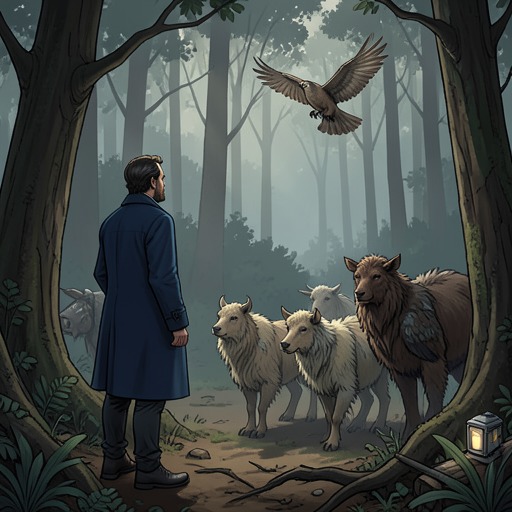
Years later, on a drive away from Nio Esseia, Shevek sees a face in the darkness beneath roadside foliage. It is long, pale, and marked by a large dark eye; breath jets from what he takes to be nostrils. The car’s lights reveal it for only an instant. Shevek asks what it was, and his companions first guess a donkey. When they confirm that it was an animal, they realize that Anarres has no large animals; another passenger clarifies that the creature was a horse, since donkeys are not that size.
The encounter is framed by the forest itself, which Shevek has not previously known at such scale. As the car climbs out of the foggy river valley, the trees extend from hillside to hillside, a living expanse he contrasts with the desert he expected. The horse appears within that newly perceived world, not as a specimen brought forward for inspection but as a fleeting presence encountered on its own ground.
A Life Beyond Human Use
After the others identify the animal, Shevek’s thoughts turn to Takver. He wonders what she would have made of the gaze from beneath the trees. Takver’s interest in forms of life beyond the human—her kinship with fish in laboratory tanks and her desire to experience other existences—makes her, in Shevek’s imagination, especially able to meet the animal’s look without reducing it to a curiosity. The horse’s eye remains opaque: Shevek cannot say what it means, only imagine how Takver might have looked back.
The scene gives the animal a brief but distinct narrative presence. Its body is first perceived as something strange in the darkness, then categorized through the travelers’ conversation; yet the lingering image is not simply the name “horse.” It is the encounter with an unfamiliar living gaze. The contrast between Anarres’s absence of large animals and Urras’s forested landscape also makes the worlds’ ecological difference immediate, while the horse’s appearance unsettles a purely human account of what it means to discover another world.