It is pain that brings men together
The Dispossessed“It is pain that brings men together” is a recurring idea in Shevek’s account of solidarity: suffering can disclose the bonds people share, but it can also expose the failures of a society that claims to embody mutual aid. First spoken publicly on Urras and later reinterpreted by Bedap in relation to Anarres, the expression moves from a moral appeal to a challenge about social responsibility and change.
The statement on Urras
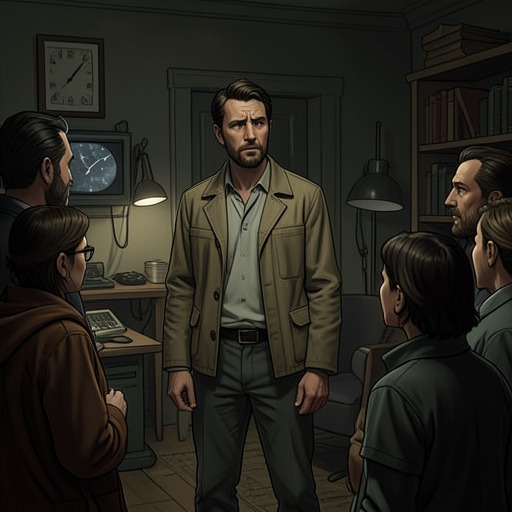
Shevek came to Urras intending to urge brotherhood and to represent, through his own presence, solidarity between the two worlds. At receptions he spoke about anarchism before audiences who listened politely and answered that his words were true. Addressing one such gathering, he declared, “It is pain that brings men together.” The response was assent, but the audience’s good manners and apparent agreement did not persuade him that genuine contact had occurred.
The gap between the statement and its reception became personal. Shevek began to wonder why the government allowed him to speak so freely, then saw that he was speaking repeatedly to the same well-dressed, well-fed, comfortable people. He came to hate them and stopped accepting invitations. That withdrawal intensified his isolation: he recognized that he had not reached the people beyond those gatherings, and felt that he had touched no one on Urras. The phrase’s appeal to shared pain therefore stands in contrast with the privileged audience’s polite recognition of it.
Bedap’s reversal of the idea
In a later conversation, Bedap uses Shevek’s own account of pain to interpret disaffection on Anarres. He argues that social discontent, alienation, and frustration may be understood as pain serving a function in the social organism. Shevek resists the comparison, insisting that he had spoken in personal and spiritual terms. Bedap answers by distinguishing physical suffering from the spiritual suffering of people whose talents, work, and lives are wasted, whose minds submit to those he considers less capable, and whose strength is suppressed by fear and the pursuit of power.
Bedap’s argument gives the expression a political consequence. Pain does not merely bring people together in sympathy; social suffering can register that a society is failing its members. He connects that suffering to the stagnation of Anarres, where, in his view, nothing changes despite the Odonian identification of change with freedom and life. Shevek initially calls this diagnosis diseased, but Bedap insists that denying reality, rather than facing it, is what drives people toward despair.
Solidarity, language, and social reality
The expression’s force depends on what counts as pain and what forms of solidarity can recognize it. Shevek first presents pain as a basis for human connection to audiences who affirm the sentiment without demonstrating that they share the experience he means. Bedap shifts its scale from individual suffering to social conditions: wasted ability and constrained lives become evidence of a collective problem. The same principle thus tests both the audience on Urras and the society Shevek comes from.
The book repeatedly shows how assumptions can obstruct mutual understanding. In a conversation with Kimoe, Shevek discovers that the physician takes established religion and morality outside law for granted in ways that do not fit Anarresti concepts; even the Urrasti use of “higher” to mean “better” reveals a different hierarchy of thought. Elsewhere, Shevek asks whether status is the same as class, and explains that in Pravic the ordinary verb for sex has a plural subject, framing the act as something two people do rather than something one person possesses. These linguistic differences do not define the pain expression, but they sharpen its problem: shared words and apparent agreement do not guarantee shared social realities.
A principle tested by events
The novel places the idea alongside scenes in which suffering has concrete material conditions. During the drought, food and clothing for Anarres’s twenty million people depend on holum plants, water is directed toward keeping crops alive, and bathing water is strictly rationed. Later, a train carrying 450 people stops in a mill town of 160 residents with no surplus food. The townspeople give the travelers nothing because feeding them would leave the local community without food for days; the passengers ultimately fast for sixty hours. The episode makes solidarity an urgent question of shared scarcity rather than a comfortable sentiment.
The question returns in the dispute over contact with Urras. Rulag warns that the Syndicate of Initiative’s broadcasts and proposed visits could expose Anarres to an enemy and imperil the settlement’s independence. Shevek argues instead that the individual must be able to undertake harmless action without the PDC assuming authority to forbid it. Speaking at the meeting, he says the Odonians came to Anarres for freedom rather than safety, and that solidarity cannot mean compulsory agreement. In this setting, pain and solidarity are not simple guarantees of harmony: they demand that a community confront the costs of its choices and preserve the capacity to change.