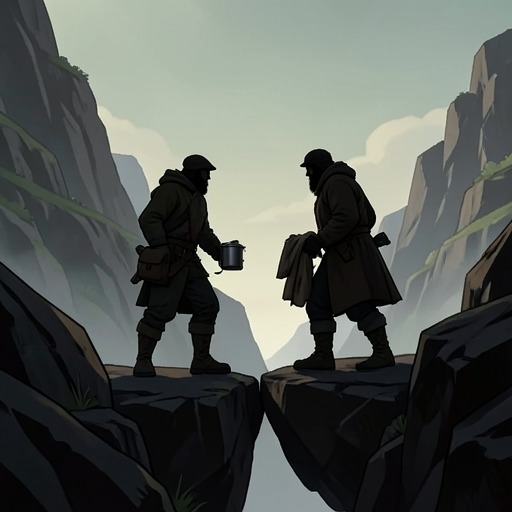
Ketho
The DispossessedKetho is the Hainish first mate of the Davenant, the ship carrying Shevek home from Urras to Anarres. Although he belongs to an ancient interstellar civilization, he has not treated that age as a substitute for personal experience: his reading of Odo and his tentative study of Pravic have made him curious about anarchism as a life he has not yet tried. His decision to land with Shevek turns the return voyage into a threshold between observing Anarres from afar and accepting responsibility within it.
Identity and Introduction
Ketho controls the radio contact aboard the Davenant during its conventional-speed voyage from Urras to Anarres. The ship’s first mate, he is Hainish, about thirty, tall and light-skinned, with a nearly hairless appearance and strong, fine features. His manner is quiet and conscientious; even his questions about Anarres, asked during an hour spent with Shevek and other crew members after dinner, are described as undemanding.
The Hainish aboard the ship live in surroundings designed for journeys that may extend far beyond the few hours or days of interstellar travel. The Davenant is spacious and humane rather than opulent like Urras or austere like Anarres. Among its meditative, reserved crew, Ketho stands out not through display but through the seriousness with which he listens. Shevek is largely absorbed in the homecoming ahead, yet Ketho watches him thoughtfully and seeks to understand the society to which he is returning.
Curiosity About Anarres
Ketho’s interest predates Shevek’s arrival on Urras. He tells Shevek that reading Odo’s works first stirred his curiosity, and that he has learned a little Pravic, though not much. The details make his interest more than a passing fascination with a distant world: he has already begun to approach its language and ideas, while recognizing that intellectual acquaintance is not the same as having lived there.
When Shevek asks whether the wish to land is genuinely Ketho’s own initiative, Ketho answers that it is entirely his. His choice also reaches beyond private curiosity. He agrees to take Shevek down in the landing craft despite the danger expected at the Port of Anarres, where supporters and enemies may gather and an attack is possible. Shevek says that the authorities intend to protect him, but that he is himself a dissident and has chosen to accept the risk as an Odonian. Ketho’s willingness to share that danger makes his interest practical: he does not remain safely in the role of a visitor observing another person’s political risk.
Shevek and the Landing Decision
Shevek’s conversation with Ketho establishes a marked difference between official access and voluntary participation. Shevek explains that he cannot bring Ketho as the representative of a foreign government; that would be unacceptable on Anarres. The settlement’s terms were drawn up when no other races were known, and the managers later interpreted them to include all foreigners. Shevek calls that interpretation another wall, a barrier built by people who had tried to speak with Anarres decades earlier.
Ketho accepts that he cannot arrive under official protection or status. Shevek warns that once Ketho walks through the wall with him, he will, in Shevek’s understanding, be one of the Anarresti: responsible to them, and with the same choices as everyone else. Those choices, Shevek stresses, are not safe, and Ketho would find himself very much alone. The warning gives the proposed landing its weight. It is not simply permission to see Anarres; it means entering a society undergoing disruption without the distance or security of a diplomatic role.
Ketho answers by placing his decision in the scale of Hainish history. His people, he says, have been civilized for a thousand millennia, have histories extending across hundreds of those millennia, and have tried everything, including anarchism. But he has not tried it. The assertion that nothing is new under any sun does not persuade him that an individual life can be exhausted in advance: if each single life is not new, he asks, why are people born? Shevek replies in Pravic that they are the children of time; Ketho repeats the words in Iotic. Their brief exchange joins the distance between their languages to a shared confidence in the newness of an individual choice.
Choice and Narrative Significance
Ketho says he will speak to the commander about landing. Though his usual manner remains grave, his voice carries a slight tremor of excitement and hope. The moment is consequential precisely because the decision has not yet been shown as completed: Ketho commits himself to seeking permission, and the novel leaves the choice poised between personal initiative and the ship’s command structure.
As a first mate, Ketho is part of the crew that manages the return voyage; as a prospective entrant into Anarres, he is prepared to exchange the protected position of an observer for uncertain membership. His movement toward the landing is a counterpoint to Shevek’s homecoming. Shevek is returning to family and to a society whose habits his journey has helped unsettle, while Ketho approaches that same society as someone who has never lived its anarchism. The wall that Shevek identifies as a product of institutional interpretation becomes, for Ketho, a boundary to cross through choice rather than official authorization. His significance lies in that voluntary crossing: he treats a political and social order not as an exhausted historical experiment but as something whose meaning must still be tested in a single life.