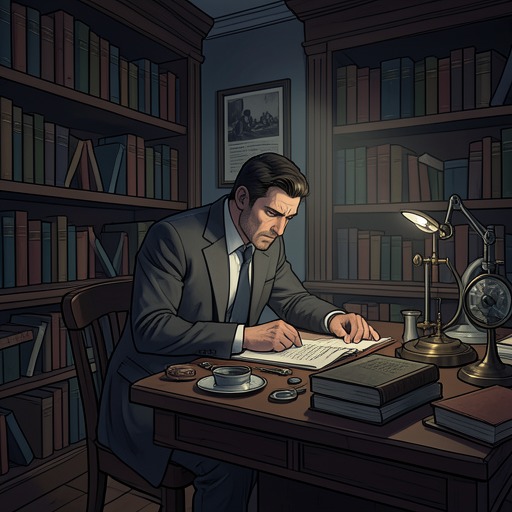
Mitis
The DispossessedMitis is the senior physicist at the Northsetting Regional Institute and one of the people who first recognizes the scale of Shevek’s scientific ability. Though she holds no current administrative position, her long experience and intellectual clarity give her an authority that requires no official enforcement. She helps Shevek see what is missing in his work, then sends him toward Abbenay with both encouragement and a warning: scientific opportunity can open a path, but institutional centers also create dependence and power.
Identity and Authority
Mitis has worked at the Institute for thirty years and is fifty-five when Shevek, at nineteen, brings her the promise of his early research. The physics curriculum is not under her direction at the time; administrative jobs rotate annually among the Institute’s twenty permanent postings. Her standing instead rests on her ability and judgment. The narrative describes a clear space around her, like the uncrowded peak of a mountain, and distinguishes her unforced authority from power maintained by titles or other reinforcements.
Her physical circumstances are present in the same scene as her intellectual authority. She has circulatory trouble in her legs and moves behind the table to sit down, a small movement that briefly interrupts Shevek’s absorption in the equations. The moment makes their difference in age and condition concrete without diminishing her command of the scientific question: she watches him with compassion and admiration as he studies the answer she has brought.
Recognizing Shevek’s Work
Mitis has sent Shevek’s paper on Relative Frequency to Sabul in Abbenay. Sabul replies on a ragged fragment, apparently torn from a larger sheet, with a single equation: “ts/2 (R) = 0”. Shevek immediately understands that it identifies what his work lacks. He takes a pencil and begins writing on the scrap; as he reconstructs the argument, his face flushes and his ears turn red. He says he can finish the work in a day or two.
The exchange shows Mitis’s contribution as both scientific and relational. She could not identify the error herself, but she recognized that Sabul might, and wanted him to see what Shevek was trying to do. When Shevek asks why she sent the paper with such a large hole in it, his pleasure in discovering the missing step softens the question. He becomes aware again of Mitis, whom he loves. Her help has not substituted her judgment for his: it has placed the right problem before him and allowed him to make the discovery.
Advice About Abbenay and Power
Mitis tells Shevek that Sabul will want him to come to Abbenay, and asks whether he wants to go. Shevek says not yet. She understands his hesitation, but insists that he must eventually leave: he needs access to books and to the minds he will encounter there, and she will not accept that his ability should be wasted in a desert. Her appeal is urgent and practical. She tells him to seek out the best and not let false egalitarianism mislead him; he should work with Sabul, whom she regards as good and demanding, while remaining free to follow the line of inquiry he chooses.
Her encouragement is inseparable from a warning. She advises Shevek to stay at the Institute for one more quarter, then go to Abbenay and take care there. Power, she says, inheres in a center. She does not claim personal knowledge that Sabul will exploit him, but warns that Shevek will become “his man.” In Pravic, possessive forms are unusual outside emphasis: ordinary usage speaks of “the mother” or of using an object, rather than claiming that it is “mine.” The marked possessive phrase therefore sounds strange to Shevek, who does not understand the institutional dependence she is naming. Mitis ends with a command to do the work that awaits him; he initially takes her urgency as a demand to correct the equations, and only much later understands the broader warning.
Shevek’s Later Remembrance
The warning acquires force after Shevek’s move to Abbenay. In his later dealings with Sabul, he understands their arrangement as a bargain rather than mutual aid: access to work and publication has become entangled with an unacknowledged exchange of advantage. Remembering Mitis’s caution, he also thinks back to the Northsetting Institute and the party held before his departure, which now seem childishly peaceful and secure. The memory links her advice about the center to his recognition that the institution can shape a scientist’s career through informal dependence, even without declaring itself a hierarchy.
Mitis remains present to Shevek as he confronts the limits of that arrangement. When he considers sending her one of the new books, he asks Sabul for a copy. The gesture makes his continuing attachment to his earlier mentor tangible: amid conflict over publication and professional control, he still thinks of the woman who helped him identify the opening in his theory and urged him not to waste his mind.
Narrative Significance
Mitis’s role is concentrated in a few scenes, but her advice supplies an early measure of Shevek’s later choices. She recognizes that the pursuit of knowledge requires contact with other minds and access to shared intellectual resources, while also seeing that a centralized institution can turn necessary collaboration into dependence. Her warning does not amount to a prediction that Sabul will necessarily act in bad faith; its importance lies in teaching Shevek to notice the structure of the relationship and to preserve freedom within it.
Her mentorship also models a form of authority distinct from command. She initiates the exchange with Sabul because she cannot solve the problem herself, celebrates Shevek’s independent insight, and urges him toward opportunities beyond her own Institute. The care behind that urgency is neither possessive nor passive: she wants his work to develop, even though doing so means sending him away from the place where she has guided him. Shevek’s later recollection and his wish to send her a book preserve that bond across the distance between the Institute and Abbenay.