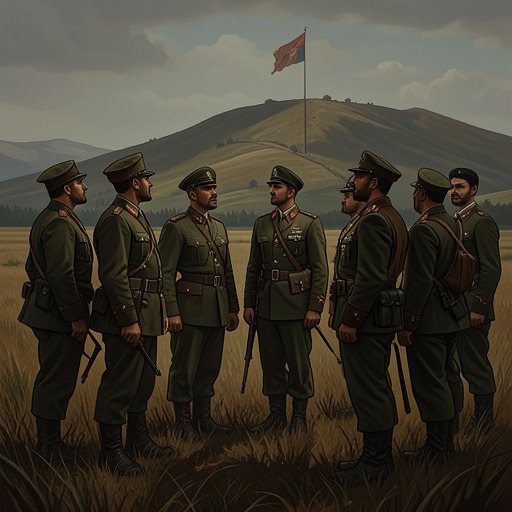
Nio Esseia Insurrection (Ninth Month Strike)
The DispossessedThe Nio Esseia Insurrection (Ninth Month Strike) was the uprising led by Odo in Nio Esseia in the Urrasti year 740, an event whose significance reaches beyond its place in the past. On Anarres it is remembered in a midsummer festival honoring the workers whose strike helped set it in motion; on Urras, its example gives later dissidents a language for challenging war, inequality, and state power. Its enduring question is whether a revolution can ever be considered finished.
Origins and Commemoration
The insurrection began with a strike led by a syndicate of cooks and waiters. Nearly two centuries later, Anarres marks it with Insurrection Day, a midsummer holiday observed through a street festival and communal feast. Cooks and refectory workers are honored as the day’s guests, reversing the usual relation between those who prepare food and those who eat it. The ritual keeps the labor behind collective life visible: the uprising is recalled not only as political history but through the workers whose action helped bring it about.
Insurrection Day sits alongside traditions with different origins. Some festivals were instituted by the Settlers; harvest homes and the Feast of the Solstice arose spontaneously from the planet’s work rhythms and the desire of people working together to celebrate together. The juxtaposition places the insurrection within Anarres’s broader practice of making shared observances, rather than treating political memory as separate from everyday communal life.
A Revolutionary Example on Urras
The insurrection remains a point of reference for political opposition in Urras. When Maedda describes Nio Esseia as nearing a breaking point, he names the pressures behind the unrest: four hundred thousand unemployed people, rising food prices, increased taxes, and opposition to conscription and war. He calls for a general strike and mass demonstrations, comparing the moment to the Ninth Month Strike that Odo led. His appeal is not simply for a repetition of the past; he stresses that the present has no moon that can be offered to buy the protesters off, and insists that justice must be made where they are.
Maedda also explains why Anarres matters to people organizing against the existing order. For a century and a half, its existence has served as proof that a society without government, police, or economic exploitation is not merely an unattainable ideal. The remembered insurrection and the continuing existence of Anarres reinforce one another: Odo’s uprising offers a precedent for action, while the society founded by the Settlers demonstrates that a different social arrangement can endure.
History Reopened as a Present Conflict
On Anarres, the anniversary’s celebratory form coexists with disagreement about what revolutionary freedom requires. In a meeting about contact with Urras, Rulag invokes the Terms of the Closure of the Settlement to argue that no one may go farther than the boundary of the Port of Anarres when arriving from a freight ship. She treats that restriction as protection against renewed domination. Bedap and Shevek, by contrast, challenge the assumption that collective safety should settle every question of individual action.
Shevek argues that the Settlers came to Anarres for freedom, not safety, and that a society requiring everyone to agree and work in the same way risks becoming machine-like. In his account, revolution is not a secure achievement preserved by rules: it is an ongoing responsibility to initiate action, accept responsibility, and keep society capable of change. His appeal makes the memory of Odo’s insurrection more than an anniversary story. It turns that past into a test of whether Anarres still lives by the freedom its founding struggle was meant to establish.