Northsetting Regional Institute
The DispossessedNorthsetting Regional Institute is the educational and scientific community that shapes Shevek’s youth and early career, and a place to which he repeatedly returns in search of both intellectual work and a sense of home. Its ordinary landscape of scrub-covered hills, gardens, dormitories, workshops, classrooms, and laboratories holds contrasting possibilities: communal learning and scientific discovery, but also isolation, stalled research, and accommodation to informal authority.
Setting and Institutional Life
The Institute stands among low hills where patches of bronze-leaved scrub holum break up the ground. Its community includes kitchens and gardens as well as residences, workshops, classrooms, and laboratories. Shevek has lived there since he was thirteen, and the familiarity of its landscape and routines makes it the closest thing to a home he has or wants. For him, however, home is not simply a fixed place to which one returns unchanged. His account of the General Temporal Theory connects return to change: a person can come home only by understanding that home is also a place never previously reached.
The Institute’s administration is formally organized around rotating appointments. Mitis, its senior physicist, has worked there for thirty years, although she is not currently directing the physics curriculum because administrative responsibilities rotate annually among twenty permanent postings. The arrangement limits the permanence of administrative authority, but it does not flatten every distinction of influence. Mitis’s standing comes from her mind and presence rather than from an office: the narration describes a clear space around her, an authority that needs no formal enhancement.
A night scene on a hill above the Institute gives its scientific setting a wider frame. Four boys of fifteen or sixteen sit between patches of holum, looking down at the institution and up at the Moon. Tirin calls the view peculiar, although he cannot at first complete what he means. The scene puts the Institute between the familiar ground of communal life and a celestial object that invites questions beyond it; youthful thought begins there as an incomplete remark, met by the others’ comments on its apparent self-evidence.
Shevek’s Education and Returns
Shevek’s relationship with the Institute is shaped by departures as much as by residence. After a period in Southeast, where he has adjusted to steady physical labor and begun developing ideas in temporal physics, he returns glad to have time to work them out. He has learned to value return as an essential counterpart to departure: exploration is not merely going out, but a voyage whose meaning includes the possibility of coming back. The Institute supplies the setting in which this conviction and his scientific ambition can meet.
That homecoming does not restore his earlier social ease. Shevek feels he has grown considerably during the year away and finds some former friends less mature than he is. He keeps contact with women casual because he does not want another episode of indiscriminate sex and has other work to do. Some of the young women, including Rovab, have also moved beyond adolescent experimentation; they want to complete their training and find satisfying work before having children, and seek mature relationships rather than temporary ones. The Institute is thus a place where adult plans are taking shape, not merely a school preserving the patterns of adolescence.
Shevek had left Northsetting about ten days before the earthquake in Wide Plains that killed thirty-two people, among them his father, Palat. Palat had been a construction engineer for the community and was inside the damaged learning center with others trying to free trapped children when a second quake brought the building down. In recalling the loss, Shevek stresses that Palat’s intervention reduced the likely death toll, even though he became one of the thirty-two recorded dead. The Institute enters this history as the place where Shevek had begun his training just before the disaster, a departure that placed him away from his father at the moment of his death.
The Institute also supplies the earlier setting for Shevek and Takver’s first significant encounter. At a party on the night before Shevek left Northsetting, four years before their later conversation, some of the young people stayed up talking. Takver remembers seeing something in him then, although he did not even know her name. When they meet again in Abbenay, Bedap identifies her as a former Northsetting student, and Shevek recognizes that he has forgotten someone who had already seen him closely. The old Institute gathering becomes an uneven beginning: Takver recalls a perception of Shevek, while he has no memory of her.
Research, Mentorship, and Constraints
Mitis provides a direct link between Shevek’s work at Northsetting and the wider physics community. She tells him that she sent his paper on Relative Frequency to Sabul in Abbenay, then shows him the reply: a single equation scribbled on a ragged corner torn from a larger piece of paper. The scant response makes the journey of a scientific paper concrete. The Institute can foster original work, but its researchers depend on channels beyond its own walls for response and recognition.
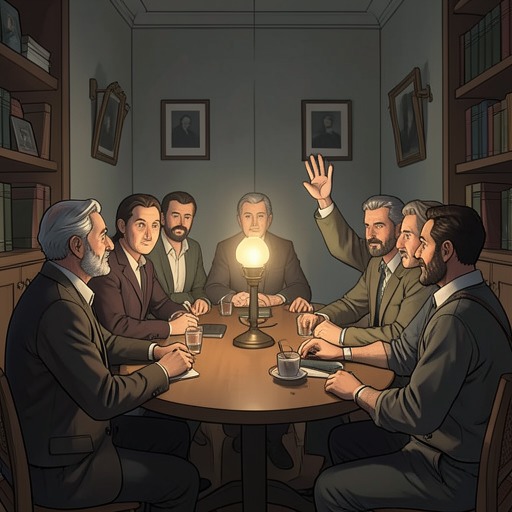
Shevek’s later attempt to develop his physics at the Institute exposes those limits more sharply. He cannot find a local colleague who knows enough pure temporal physics to keep up with him, and his request to teach the subject or obtain a classroom is rejected by the faculty-student Syndicate of Members. The syndicate does not want a quarrel with Sabul. Shevek’s difficulty is therefore not simply that his ideas are demanding or that he is isolated by temperament: the institution’s decision closes off a practical route to teaching and discussion in order to avoid conflict with a powerful colleague.
His effort to reconnect with Gvarab also reveals the human cost of a thin intellectual community. Shevek seeks her out in a burst of new resolutions, but she is ill, deaf, and old; she abandons a spring course, sometimes barely recognizes him, and at other times draws him into a long evening of conversation. He has moved beyond many of her ideas, yet correcting her risks confusing or hurting her, while listening for hours becomes difficult. He evades her, feeling guilty, and remains without a conversation partner capable of following his work. Northsetting offers mentorship, but not a simple or durable solution to the isolation of an emerging specialist.
In a conversation with Bedap, Shevek says he has recognized his limitations. Bedap distinguishes the limits of Shevek’s character from his ability in physics, affirming that even someone who is not a temporalist can recognize the quality of a physicist’s work. The exchange occurs against Shevek’s deeper despair: he admits that he has thought often of suicide during the year, and Bedap answers that suicide is hardly the way through suffering. The Institute’s educational and social world is therefore present not only as a setting for research but as the background against which friendship must answer a crisis that expertise alone cannot resolve.
Takver and the Institute’s Scientific Community
Northsetting is also part of Takver’s intellectual formation. She studied biology there with enough distinction to decide to pursue further study at the Central Institute. After a year, she joined a new syndicate establishing a laboratory to improve edible fish stocks in Anarres’s three oceans. She describes herself as a fish geneticist and values the work because it combines careful factual research with a definite practical goal. Her Institute education leads toward specialized science, but her interests exceed her profession: she has a passionate concern for landscapes and living creatures that Shevek understands as a relation to the living world rather than a merely technical interest.
Her path contrasts with Shevek’s in both subject and orientation. His work in temporal physics is abstract and difficult to pursue without qualified interlocutors; her research connects scientific precision to an identifiable need, increasing and improving food resources. Yet neither vocation exhausts the person pursuing it. Takver’s attention to the natural world extends beyond fish genetics, just as Shevek’s intellectual life cannot by itself resolve his need for companionship. Northsetting stands behind their later bond as a shared place of education, while their reunion depends on Shevek’s belated recognition of the person he had once failed to know.
Taken together, these episodes make Northsetting more than a backdrop or a simple haven. It gives Shevek a home to return to, a scientific culture in which his early work can be sent onward, and the formative setting of his connection with Takver. At the same time, the rejected teaching request and the deference to Sabul show how a formally communal institution can reproduce constraints through ordinary decisions. Its significance lies in that tension: it nurtures inquiry and return, yet cannot guarantee the open intellectual exchange that inquiry requires.