Old Town
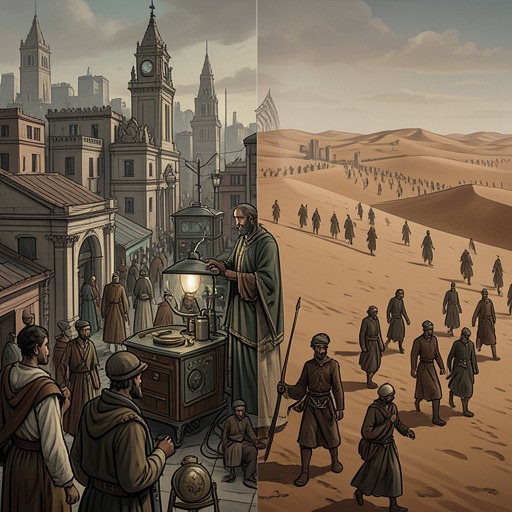
The DispossessedOld Town is a district of Nio Esseia where Shevek’s flight from Ieu Eun carries him into a cityscape sharply unlike the Nio Esseia he has known. Its maze of streets and alleys is both a physical obstacle and a social threshold: there, the fugitive sees deprivation at close range and eventually finds a route to Tuio Maedda, while the district’s underground networks shelter people beyond the reach of ordinary public life.
Setting and First Impressions
Shevek reaches Old Town after an expensive day with Vea has consumed most of his ready cash. A taxi ride into Nio costs ten units; from a major subway station he follows his map toward the district, but Joking Lane is absent from it. He gets off at Old Town’s central stop and emerges from a spacious marble station into a place he does not recognize as part of Nio Esseia.
Rain and darkness make the streets difficult to read. Streetlamps stand unlit or broken, and yellow light leaks around shuttered windows. A group of men lounges by an open doorway; elsewhere, low shopfronts are closed behind heavy metal or wooden shutters, except for one gutted by fire, its broken windows still edged with glass. People pass as silent, hurrying shadows. The contrast between the marble subway station and the neglected street above it makes Old Town feel less like another quarter of the same city than a concealed underside.
Poverty and Social Isolation
Trying to find Joking Lane, Shevek asks an apparently elderly woman for directions. In the light by the subway entrance, he sees that she is not yet thirty: fatigue, illness, or bodily deformity has made her appear much older. She ignores him and continues up the stairs. A man walking alone also cannot or will not help. Shevek avoids approaching the group gathered by the doorway, sensing the danger of being a lone stranger among them.
On a better-lit cross street, wineshops and pawnshops remain open amid advertisements and garish signs. People jostle in and out of the shops, while a man lies in the rain in the gutter with his coat over his head; Shevek cannot tell whether he is asleep, sick, or dead. Passersby do not look at him. An unshaven, toothless man laughs at Shevek and points at his hair, an encounter that makes the newcomer’s conspicuousness—and his inability to interpret the street’s social rules—plain. The district is not simply poor in appearance: its inhabitants’ indifference, wariness, and vulnerability shape the terms on which Shevek can move through it.
A Route to Tuio Maedda
After wandering at random, Shevek reaches a shop whose proprietor eventually agrees to guide him. The man closes his shop, lowers and padlocks its metal shutters, and leads Shevek through twenty or thirty blocks, deeper into Old Town’s crooked streets and alleys. They turn into an unlit, unsigned passage between tall, old tenements, many of whose ground floors contain shops.
The guide knocks at the shuttered window of V. Maedda, Fancy Groceries. After a long wait, a pawnbroker confers with someone inside and admits Shevek. A girl in the back hallway recognizes the possibility of his identity and asks urgently whether he is the man from Anarres. Tuio Maedda, a dark, intellectual-looking man in his forties, rises from a book in which he has been writing and keeps his eyes on Shevek. The hidden shop, the delayed opening, and the girl’s recognition establish Old Town as a place where access depends on personal connections and secrecy, not on signs or official directions.
A Refuge After the Demonstration
A week after the demonstration in Capitol Square, a woman who has heard Shevek’s speech through clandestine radio broadcasts recognizes him and recalls the broadcast’s abrupt end. The reports had carried the crowd beginning to shout, then screaming, before the transmission stopped; she knows that Shevek had been there and asks how he escaped. She also reports that Old Town remains cordoned off, that three regiments of the army are in Nio, and that strikers and suspects are being rounded up by the dozen and hundred every day.
Her account gives the district a second, political meaning. Old Town is not outside the violence engulfing Nio Esseia: it is under military cordon and exposed to mass arrests. Yet its clandestine listening networks and concealed meeting places also provide a way for news and people to travel beyond official control. Its importance lies in that tension: the district’s poverty and isolation make it precarious, while the same hidden pathways that frustrate Shevek’s search allow underground solidarity to take form.