Port of Anarres
The DispossessedPort of Anarres is a walled landing field and quarantine station that gives physical form to the separation between Anarres and other worlds. Its rough, easily climbed wall appears slight, yet it defines the planet’s only visible boundary and bears a double meaning: from one side it keeps the outside universe away from Anarres; from the other, it encloses Anarres like a prison. The port is therefore not merely an arrival point. It is the place where the novel’s competing ideas of freedom, isolation, trade, and shared access become concrete.
Setting and the Wall
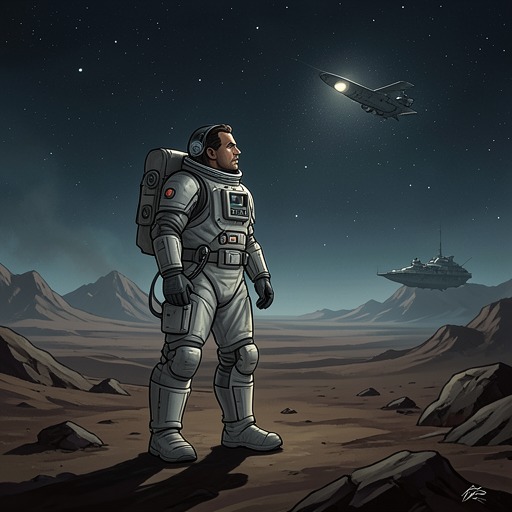
The port occupies a barren sixty-acre field containing gantry cranes, a rocket pad, three warehouses, a truck garage, and a dormitory. The dormitory is grim and unwelcoming, without gardens or children, because it is not a home but part of the quarantine. The wall does not need a gate where the roadway crosses it: there it dwindles into a line, a boundary made almost entirely of an idea. Its force lies less in its height than in the agreement and fear that make the division real.
That division changes with the observer’s position. Viewed from outside, the wall encloses the landing field, visiting ships, their crews, and the worlds beyond them, leaving Anarres outside and apparently free. Viewed from within, it encloses the whole planet, cutting its inhabitants off from other worlds and other people. The same structure can thus be read as protection against external power or as the boundary of a collective confinement. Its physical modesty sharpens rather than resolves that contradiction.
Visitors, Work, and Exchange
People come from nearby Abbenay to see the wall or watch for a spaceship. It is the only boundary wall on their world, and adolescents in particular are drawn to sit or gather beside it. Freighters arrive only eight times a year, without advance notice to the public; only syndics working at the port are informed. A ship on the pad can briefly turn an otherwise quiet stretch of field into a spectacle, but the offworld crews generally remain aboard, and the port workers eventually close down for the day. Even the rare sight of a Defense armband can add to the occasion’s appeal.
The port is also the working edge of Anarres’s relationship with Urras. Freighters bring fossil oils and petroleum products, delicate machine parts and electronic components unavailable from Anarresti manufacturing, and sometimes new fruit-tree or grain strains for testing. In return they carry away mercury, copper, aluminum, uranium, tin, and gold. The division of cargoes is a prestigious undertaking for the Urrasti Council of World Governments and a major event for the Urrasti stock market, while on Anarres the trade is debated as a humiliating accommodation with propertarian powers. The argument for continuing it is strategic: Urras finds it cheaper to obtain ores through trade than to mine them itself, while ending the agreement might invite an invasion. Seven generations of peace, the novel stresses, have not made the arrangement an expression of trust.
Shevek and the Meaning of Arrival
The port frames Shevek’s passage between worlds. As he travels back toward Abbenay from Urras, he looks down from a dirigible toward the walled field, hoping to see a ship from another world. The pad is empty. His disappointment persists even though he considers Urras despicable: the ship represents a voyage across the distance between planets, and the possibility of contact beyond Anarres’s isolation. The empty landing ground makes the separation visible at the moment he returns to it.
Earlier, arriving on Urras without money or gifts, Shevek describes himself as the Beggarman. He explains that because he cannot buy food or bring enough supplies to sustain himself, his hosts must give him what he needs; in this way, he says, he makes the Urrasti give rather than sell. At the port’s threshold, his empty hands expose the difference between Anarresti sharing and Urrasti market exchange. Later, he tells Chifoilisk that he came to bargain with the profit economy, seeking an end to his people’s exile and free exchange between the planets. For Shevek, contact is not simply commerce: it is an attempt to turn a guarded passage into human solidarity.
Rules of Access and the Possibility of Change
The terms governing the settlement restrict Urrasti visitors to the port’s boundary. When Shevek considers whether Ketho may land, he distinguishes the rule’s original wording from its later application: it bars Urrasti from going beyond the port, but Ketho is Hainish, not Urrasti. Shevek argues that extending the restriction to all foreigners was a decision made by Anarresti managers decades earlier, when Hainish people first sought contact, and that they were building more walls. The port’s boundary is thus enforced not only by stone but by interpretation, custom, and administrative choice.
The possibility of crossing remains politically charged. Before Shevek’s return, Rulag states that an Anarresti may leave if an Urrasti freighter will take him, but cannot come back. She invokes the settlement’s closure terms, which prevent anyone from leaving the freight ships beyond the port boundary. Shevek’s own return and the prospect of wider contact make that restriction more than a technical rule: it raises the question of whether separation is fixed or can be challenged by people who choose to risk crossing it.
At the end of the novel, Shevek knows that enemies and friends will be present when he lands and that the possibility of attack makes the arrival dangerous. He accepts the risk as his privilege as an Odonian, while Ketho agrees to take him down in the landing craft and to share the danger. Shevek also welcomes the prospect that Ketho might land, because treating every foreigner as an Urrasti would mean extending the old division rather than reconsidering it. The port remains a guarded threshold, but the return and the proposed landing turn it into a possible point of renewed relationship. Its wall still separates worlds; the meaning of crossing it is no longer settled.