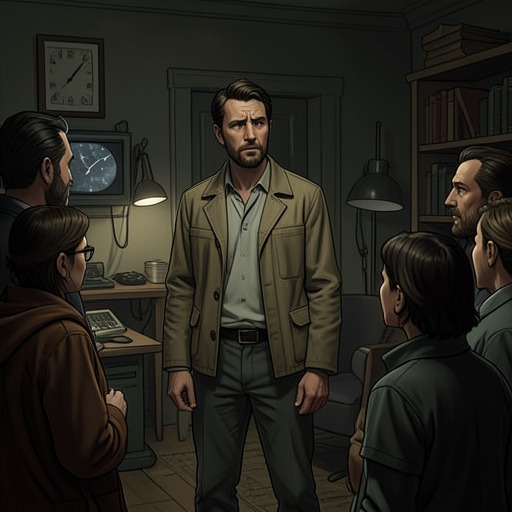
Portal Train Stranding and Hunger Incident
The DispossessedPortal Train Stranding and Hunger Incident turns Anarres’s drought from a planetary emergency into a test measured in hours without food. When Shevek’s train is delayed and a mill town will not feed its passengers, he experiences hunger for the first time and confronts the possibility that scarcity could weaken the solidarity on which his society depends. The episode’s outcome is neither simple collapse nor easy reassurance: after a sixty-hour fast, the travelers share a modest meal and leave together in renewed good spirits.
Background: scarcity and strained transport
The incident occurs after a year of drought, when Anarres’s usual transport system can no longer meet the pressure of moving provisions between threatened regions and shifting emergency workers. The transport workers’ federative makes strenuous efforts, but available vehicles and operators are insufficient. Trucks, trains, ships, ports, and yards are pressed into service, with apprentices, retired workers, volunteers, and emergency draftees helping to run them. A network effective in ordinary conditions and limited emergencies is being asked to carry more than its capacity.
The crisis has already altered everyday priorities. During the cold, dry winter, water for baths is strictly rationed because thirst and hunger take precedence over cleanliness. Food and clothing for Anarres’s twenty million people depend on holum plants, while food reserves have never been plentiful. Water is directed toward keeping the crops alive; dust from the south and west clouds the sky above Abbenay. The train’s delay therefore takes place in a society where provisioning is under genuine pressure, not against a background of abundance.
The delay and the town’s refusal
The train moves in brief bursts separated by long waits because provision trains have priority. It then stops for twenty hours after a dispatcher’s error contributes to a wreck farther along the line. The passengers are left in a small town whose economy depends on incoming food: it is a concrete- and foamstone-making mill town, built near lime deposits and a navigable river, with truck gardens but no surplus in its commons or warehouses.
The numbers make the choice stark. There are 450 people aboard the train and 160 people in the town. If the townspeople feed the passengers, they fear that their own community will go without; helping such a large group could leave them without food for days, with no certainty about when the next provisions train will arrive or how much grain it will carry. An ideal of mutual sharing would mean that everyone ate less or went hungry together, but the town gives the travelers nothing. The passengers, who have already missed breakfast, continue without food until the line is cleared and the train travels 150 miles to a station with a refectory.
Shevek’s first experience of hunger
For Shevek, the delay marks a sharp break with the ordinary security of meals. He has sometimes skipped eating while absorbed in work, but food was always available; two meals a day had seemed as dependable as sunrise and sunset. He had not understood what it meant to have to go without them. The fast lasts sixty hours, making hunger not an abstract hardship but a new limit on his experience of his own society.
As the train waits on a siding between a scarred quarry and a shut-down mill, Shevek considers what the famine may reveal about Anarres. Sharing is comparatively easy when there is enough, even if only just enough, for everyone. The harder question is what happens when there is not. He fears that scarcity may bring force and power into the place of mutual aid, with violence supported by people turning away from one another. The town’s refusal sharpens that concern: its inhabitants shelter behind the walls of their property and ignore the stranded train rather than meet the passengers’ need.
The passengers’ resentment grows bitter, and conversation beside the stopped cars circles around the same questions of need and solidarity. Someone seriously proposes raiding the town’s truck gardens; the idea is bitterly debated and might have been acted on had the train not sounded for departure. The episode does not present the passengers as untouched by the conflict: hunger brings anger and the possibility of taking by force into the same conversation as the wish to share.
A modest meal and collective recovery
When the train finally reaches a station with food, the passengers receive half a loaf of holum bread and a bowl of soup. The soup is thin, but its first taste feels worth the fast. Their mood shifts from gloom to elation, and they agree about the meal’s importance. They board again laughing and joking together, having seen one another through the ordeal.
The episode leaves both sides of its central test visible. The town’s refusal shows how scarcity can narrow mutual responsibility, while the passengers’ threatened raid shows that hunger can turn solidarity toward conflict. Yet the shared experience of fasting, followed by a meal that is small rather than plentiful, restores their sense of fellowship. The incident does not prove that Anarres will preserve solidarity through famine; it gives Shevek a concrete reason to doubt that solidarity can be taken for granted, and a concrete instance of people recovering it together.