Propertarianism and property
The DispossessedPropertarianism and property are more than an economic arrangement in the novel: they organize social status, everyday exchange, and the terms on which people relate to one another. Through Shevek’s movement between Anarres and Urras, ownership appears first as a difference in custom, then as a system that can isolate him, shape his work, and turn knowledge into a political commodity. His final insistence on giving his theory to all worlds rather than selling it makes the contrast between possession and sharing a practical political choice.
Definition and Social Logic
On Urras, property is woven into ordinary life. Money buys goods and services, but it also mediates politeness, recognition, and access. Shevek’s arrival makes the difference plain: he brings no money and explains that, because he cannot buy food, keeping him alive requires others to give it to him. Calling himself the Beggarman, he frames this dependence not as a request for charity but as a test of whether Urrasti can give rather than sell. His empty hands make visible a basic disagreement about what a guest is owed and whether need itself can establish a claim.
The vocabulary of the two societies signals this divide. In conversation with Dr. Kimoe, Shevek questions the assumed equivalence between status and class, and resists the notion that morality exists only as formal religion or law. These exchanges show how difficult it is to translate social concepts when each society treats its own arrangements as self-evident. Property is not just a set of objects that one person owns; it belongs to a wider system of categories that determines what counts as status, obligation, and legitimate exchange.
The contrast also shapes intimate relations. Pravic, the language Shevek speaks, lacks proprietary idioms for sex: its ordinary verb takes a plural subject and describes an action shared by two people, rather than something one person has or does to another. Shevek remembers that he and Beshun had each felt they possessed the other, but came to understand that neither owned the other. The language does not contain every dimension of experience, yet its grammar offers a counterpoint to the possessive assumptions he encounters on Urras. His later observation that the men around him know no relation but possession makes property appear as a habit of relating, not merely a legal rule.
Work, Money, and the Market
The system reaches into Shevek’s scientific career. On Anarres, he needs Sabul’s cooperation to publish his work and exchange ideas with Urrasti physicists. Their arrangement becomes a bargain: Shevek provides the thinking, while Sabul controls access and takes credit. Shevek recognizes the irony that his career—and, by extension, his society’s intellectual life—depends on an unacknowledged profit contract rather than mutual aid. The episode complicates any simple division between a property-based world and a sharing society: exploitative exchange can persist even where its language and ideals reject it.
On Urras, the same logic is explicit. Shevek receives an award, a government grant, a university salary, and payment for three monographs. At first the accumulation seems comic; then he recognizes its importance to the people around him. The machinery of money remains nearly unintelligible to him, but its assumptions are not neutral: the economy treats greed, laziness, and envy as ordinary motives. His income makes him uneasy because it ties scientific labor to a system he does not accept, even as the money supports his life and work there.
The market’s separation of makers from buyers sharpens this alienation. A commercial street in Nio Esseia displays vast quantities of goods, but Shevek sees no workshops, farms, factories, or workers producing them. They are elsewhere, behind walls; those visible in the shops are buyers and sellers, joined to things only by possession. The street’s abundance therefore conceals the labor and social relationships that make abundance possible. Shevek’s discomfort is not simply dislike of expensive objects: he sees a social world that hides production while making ownership conspicuous.
The price of art extends the same logic into culture. In a gallery, a painting of a nude carries a price of 4,000 International Monetary Units, which Shevek observes would keep two families alive for a year in the city. The gallery representative answers by insisting on its status as a work of art. The exchange exposes a collision between aesthetic value and market valuation: the painting is presented not only as an image but as an investment. In this system, even art appears within the language of purchase and property.
Property as Separation and Power
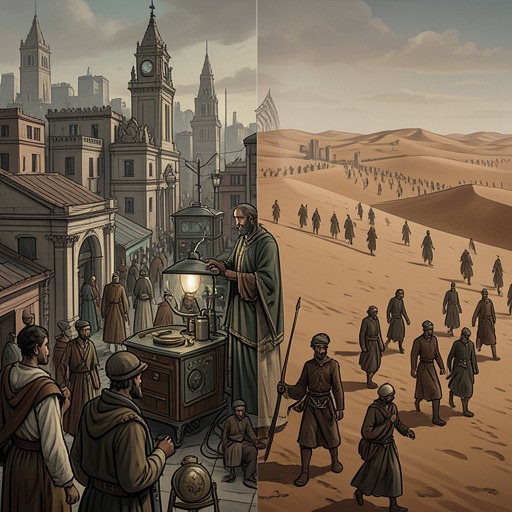
A wall frames the novel’s larger contrast. The wall around the Port of Anarres encloses a barren landing field, ships, visitors, and the worlds from which they come; viewed from the other side, it leaves Anarres outside, free. Its meaning depends on which side a person occupies. This ambiguity resonates with Shevek’s experience of property: what one side calls protection or privilege may appear to the other as confinement. The boundary between worlds is political, but it also gives concrete form to the separation between social orders.
In Nio Esseia, Shevek tests the market’s ordinary courtesies against the practices he knows from Anarres. After buying postcards and a map, he wonders whether the shopkeeper’s politeness was purchased along with them. On Anarres, a person can take what is needed from a goods depository, nod to the registrar, and leave. Shevek tells himself that in the Land of Property he must think, dress, eat, and act like a propertarian. The thought registers accommodation as a pressure to inhabit the system’s habits, not merely to use its currency.
That accommodation becomes politically troubling when Shevek finds an anonymous appeal in the pocket of a winter coat. The letter asks whether he has come to bring the Odonian hope to people suffering injustice and repression. He realizes that he has not met the poor, has accepted shelter like a propertarian, and has allowed a wall to be built around him without noticing. His protected position among the wealthy has separated him from those who might understand his presence as a promise of solidarity. Property thus works through access as well as ownership: it can shelter a visitor while keeping him apart from the people outside the protected circle.
Chifoilisk makes the political stakes explicit when he warns Shevek that the A-Io government’s hospitality is not disinterested. It provides a room, lectures, students, money, and access to institutions within a profit economy. Shevek answers that he came to bargain, but not for personal wealth. He wants the people of Anarres to come out of exile, the walls to come down, and exchange between Urras and Anarres to become free. The word bargain carries the danger of accepting the other side’s terms; Shevek’s stated aim is to use that encounter to establish solidarity rather than advantage.
Gift, Knowledge, and Political Choice
The question of whether everything must be sold reaches its clearest form in Shevek’s exchange with Keng. Shevek explains that his idea of freedom, change, and human solidarity was formed by the society he came from, and that pursuing physics while allowing propertarians to buy the truth from him would betray that inheritance. He asks whether there is an alternative to selling: whether a gift is possible. The question shifts property from material goods to knowledge, whose circulation can either be restricted for advantage or opened to common use.
Shevek says he wants to give his theory to Keng, Hain, and the countries of Urras, so that no one power can use it to dominate others, grow richer, or win more wars. His objection is not that the theory could never serve the common good; Keng suggests that truth ultimately insists on doing so. Shevek refuses to leave that outcome to the future. He has one lifetime, and will not spend it serving greed, profiteering, lies, or a master. The gift is therefore not passive generosity: it is a decision about who may control the conditions and consequences of knowledge.
The novel holds this commitment against the contradictions of both societies. Urras openly organizes labor, art, hospitality, and political influence through money and possession. Anarres rejects ownership as an ideal, yet Shevek’s dependence on Sabul exposes how informal control and unequal access can reproduce a profit-like bargain without naming it as such. Against both the visible market and its less visible equivalents, Shevek’s proposed gift insists that knowledge should circulate as a shared resource. Property matters because it determines not only who has things, but who is separated from others—and whether the truths people create can be held in common.