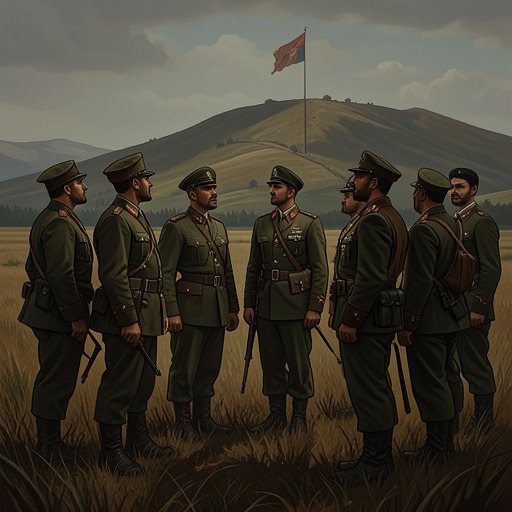
Saio Pae
The DispossessedSaio Pae is an A-Io physicist whose courteous manner and apparent intellectual openness draw Shevek into Urrasti society. He introduces him to scientific institutions, helps him navigate everyday life, and discusses physics with him; he is also a loyal, ambitious agent of the Ioti Government who reports on Shevek to the Department of National Security. The contrast between these roles makes Pae a central example of the gap between personal warmth and political control in Shevek’s Urras experience.
Identity and Introduction
Shevek first encounters Pae as a man whose name he does not know. When Shevek asks, Pae identifies himself simply as Saio Pae. Later, after Shevek has been ill and cannot initially place everyone around him, he recognizes Pae among the visitors and is introduced again to Dr. Chifoilisk, Dr. Oiie, and Dr. Atro. Pae is therefore present both as a recognizable individual and as part of the scientific company assembled around Shevek.
Pae’s manner is described as a rapid drawl matched by soft, handsome features. He can be pleased when Shevek requests a visit to the Space Research Foundation, and he responds to Shevek’s uncertainties with the ease of someone accustomed to arranging things. Yet Shevek also notices that Pae’s courtesy and charm can form a barrier: he comes to recognize the “wall” in Pae’s charm, courtesy, and indifference. The impression is not simply that Pae is unfriendly; rather, polished sociability makes it difficult to see where personal interaction ends and institutional purpose begins.
Guide to Urrasti Life and Science
During Shevek’s stay in A-Io, Pae helps him enter places that would otherwise be difficult for a foreign visitor to access. Shevek is given privileges and introductions to the Light Research Laboratories, the National Archives, the Nuclear Technology Laboratories, the National Library in Nio, the Accelerator in Meafed, and the Space Research Foundation in Drio. Pae is pleased when Shevek chooses the Foundation for a final day of sightseeing. The breadth of these visits exposes Shevek to Urras’s scientific and technical resources, while Pae acts as the efficient guide who makes that exposure possible.
Pae also takes Shevek shopping during his second week in A-Io. Shevek wants Urrasti clothes and shoes, partly because he does not want to look more foreign than necessary. His old, simple suit seems conspicuous beside Ioti clothing, and his desert boots appear unusual; Pae takes him to Saemtenevia Prospect, the elegant retail street in Nio Esseia, where a tailor and shoemaker fit him. The episode shows Pae mediating not only access to institutions but also Shevek’s adjustment to the visible conventions of Urrasti life.
Their conversations reveal a deeper cultural distance beneath the practical help. When Shevek asks about established religion, physician Kimoe struggles to explain it; Shevek’s questions expose how many assumptions Urrasti speakers take for granted. Among them is the association of “higher” with “better,” whereas an Anarresti might say “more central.” Shevek also asks whether status is the same as class, showing how he presses Pae’s society’s social vocabulary against categories familiar to him. The resulting misunderstandings are not merely gaps in information: they reveal different ways of organizing value and social relations.
Pae is also a scientific interlocutor. Shevek has read his paper on the block universe, “Paradox and Relativity,” and asks him about it. That exchange places Pae within the intellectual world Shevek hopes to join, even as their later encounters demonstrate that access to scientific discussion does not make Pae politically independent. Pae’s role combines genuine professional contact with the institutional power to direct what Shevek may see and do.
Personal Exchange and the Limits of Trust
Shevek approaches Pae through the ethic of giving that he brings from Anarres. He explains that he has no money and could not bring gifts, because Urras requires buying while Anarres does not use money. He calls himself the “Beggarman,” and tells Pae that he comes “with empty hands.” The language frames the visit as an encounter between systems of exchange: Shevek expects to receive what he needs without purchase, while Pae’s society ordinarily makes goods and services part of a market order. Pae’s assistance, including the clothing trip and institutional introductions, appears to answer Shevek’s need, but it does not establish an equal or politically transparent relationship.
That distinction becomes sharper when Shevek recognizes an impersonal hostility among Urrasti men. He interprets their relations through possession: they know no relation but possession, and are themselves possessed by the social order they inhabit. This perception provides a context for his judgment of Pae’s charm as a wall. Pae can be helpful and courteous without escaping the system that organizes people through status, authority, and control.
The conflict is clearest when Shevek learns from Chifoilisk that Pae regularly reports on him and on Chifoilisk to the Department of National Security. Chifoilisk warns that Pae is dangerous not because he is personally slippery, but because he is a loyal and ambitious agent of the Ioti Government. Shevek’s habit of treating everyone as an individual, Chifoilisk argues, prevents him from seeing the powers operating behind individual conduct. Pae’s political function thus reinterprets the hospitality and access he has provided: they occur within a relationship monitored by the state.
Restrictions, Deception, and Political Role
Pae reveals something of the constraints on foreign visitors when he describes wartime research classification, delays in publishing work officials do not understand, and limits on travel for non-nationals. Shevek is supposedly not to leave the university campus without the Chancellor’s clearance while the state of war lasts, Pae says, but he adds that he can get Shevek out without the formalities. The offer sounds like personal discretion, yet it also makes Pae a gatekeeper whose help can bypass restrictions imposed by the government he serves.
Pae’s handling of Chifoilisk’s departure reinforces the political dimension of his role. He tells Shevek that a Thuvian never knows when an order will arrive from the Presidium and must obey it without stopping for farewells; Pae then speculates about what Chifoilisk may have done wrong. His account presents state power as abrupt and unavoidable, while his own position lets him relay that power to Shevek from inside A-Io’s governing world.
The same doubleness appears in Pae’s interest in the ansible. He points Shevek toward the latest Bulletin of the Space Research Foundation, which prints Reumere’s plans for the device. Shevek replies that engineers prove causal reversibility because Reumere has his effect before Shevek has supplied the cause. After Pae leaves, Shevek calls him a profiteering liar in Pravic, clenches his hands to keep from throwing something, and recognizes that Pae’s conduct has crossed from political ambiguity into personal betrayal. The episode ties the scientific question of cause and effect to the practical question of who controls knowledge and its use.
Later Encounters and Narrative Significance
Pae remains connected to Shevek’s public image as political unrest grows in Nio Esseia. The circulated broadsheets quote the figure of the “Forerunner,” a stranger and exile arriving with empty hands and bearing the time to come. A government voice condemns the crowds’ search for a figurehead and discusses the danger of a general strike; the passage identifies Pae as the person who told Shevek about Chifoilisk’s abrupt removal, but does not establish that Pae authored the government’s words or the broadsheets. In this charged setting, Shevek’s earlier description of himself as the Beggarman resonates beyond his private encounters and becomes entangled with the public meaning assigned to an outsider.
When Shevek is in danger of being seen, Pae says, “I’ll take him home.” The brief offer places Pae once more in the role of escort and protector, but the surrounding concern is not simply for Shevek’s safety: the issue is whether he should be seen at all, amid public attention to the Forerunner and talk of a general strike. Pae’s intervention therefore retains its ambiguity, joining personal assistance to the management of a politically consequential visitor.
Pae’s character is defined less by a single revelation than by the accumulating friction between his two kinds of agency. He opens doors to laboratories, libraries, shops, and scientific conversation, yet he reports to the security apparatus, describes restrictions, and helps control Shevek’s movement. After the violent political crisis in Nio Esseia, the account returns to Shevek thinking about Pae while seated on the marble seat by the hearth in his room, a place he remembers as a gracious prison cell. That final attention does not resolve Pae into a simple friend or enemy. Instead, it leaves him as the human face of a system in which courtesy can be sincere in its form and still serve surveillance, access control, and state power.