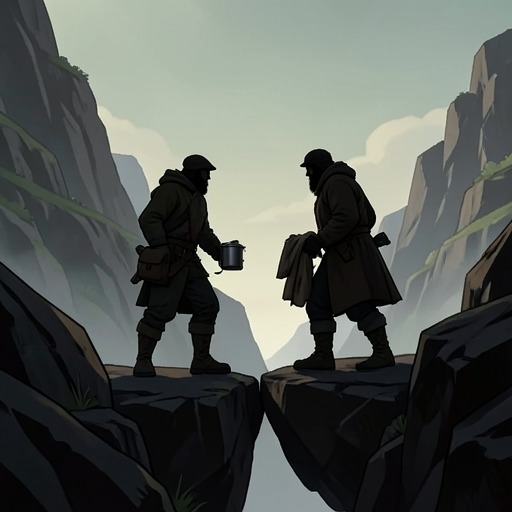
Shevek
The DispossessedShevek is an Anarresti physicist whose pursuit of a theory of time becomes inseparable from his struggle to make knowledge a shared resource rather than the property of a state, an institution, or an individual. His passage between Anarres and Urras exposes different forms of confinement: Urras makes scientific work serve political power, while Anarres can stifle an independent mind through social disapproval. He seeks contact across that division, offers his completed theory freely to other worlds, and returns to Anarres with the hope of opening a path between societies that have long ignored one another.
Identity and Intellectual Formation
Shevek is an Anarresti physicist and teacher whose work develops from questions about simultaneity and reversibility. His early experience of isolation gives his scientific problem a social dimension: he wants not only to complete a theory but to exchange ideas with people capable of understanding, challenging, and extending it. On Urras, he explains that Anarres has been cut off from the rest of humanity and that this separation left him unable to finish his work. The books, colleagues, criticism, and experimental stimulus available there help him reach a result he could not achieve in isolation.
His understanding of society is sharpened by differences in language and assumption. When a physician explains that Anarres has no religion, Shevek objects that this description confuses the absence of churches and creeds with the absence of spiritual life. He similarly questions the Urrasti equation of status with class and the division of labor by sex. Such exchanges reveal how ordinary words carry social structures with them: Shevek encounters concepts that Urrasti speakers take for granted, while his own explanations unsettle their categories.
The contrast reaches into intimate relations. Pravic, the language he speaks, does not frame sex through a proprietary verb corresponding to having a woman; its ordinary verb has a plural subject and presents the act as something people do together. Shevek recognizes that a language of non-possession does not prevent possessive feelings, but it gives those feelings no claim to ownership. His reflection on an earlier relationship with Beshun distinguishes passion and mistaken possession from the freedom to part. In his view, women do not have to learn anarchism in the same way men do, because they have less reason to accept a social order founded on possession.
Work, Anarres, and Informal Power
On Anarres, Shevek’s scientific achievement grows out of years of false starts. He works in a room beneath delicate concentric mobiles, teaching mathematics in the mornings and calculating at home as the sunlight moves across his papers. The failed attempts prove to be groundwork: he builds on them with a new confidence, and the reasoning that had seemed inaccessible becomes the structure of the Principles of Simultaneity. His concentration is so consuming that he may work six or eight hours without stopping, leaving Takver to worry about the exhaustion it causes.
Publication brings him into conflict with Sabul, who controls access to scientific channels. Shevek wants to publish his paper on reversibility and send it to Atro, whose work on causation he believes the paper might challenge. He discovers that Sabul has translated, edited, and polished a book made from Shevek’s and Atro’s ideas, while taking advantage of Shevek’s labor and claiming the standing associated with the result. Shevek recognizes that he has won a contest over the immediate paper without escaping the underlying violence of the arrangement: Sabul remains a gatekeeper, and Shevek continues to need access to Urrasti physicists and their criticism.
Bedap gives this conflict a broader political meaning. He argues that Anarres needs no formal government for power to operate: public opinion can become an unacknowledged authority, suppressing an individual mind by ignoring it and refusing change. Sabul can prevent Shevek from publishing, teaching, or working not through legal office or intellectual superiority, but through the social conformity that protects his influence. Shevek initially calls Bedap’s account crazy, even though his own experience with publication gives the argument its force. His later recognition of his own society’s pressures makes clear that the absence of law does not guarantee freedom from coercion.
The Journey to Urras and the Terms of Exchange
Shevek arrives on Urras without money or gifts. The clothes he brings are enough to make him feel like himself, but he cannot purchase food or provide the customary material offerings of a guest. He therefore calls himself the Beggarman and describes his presence as a practical challenge to a society in which necessities must be bought: if his hosts keep him alive, they must give. His empty hands are not a refusal of relationship but a test of whether hospitality can operate without turning into a sale.
He also resists being treated as an emissary of a government. Explaining the Production and Distribution Coordination network, he says it coordinates production among syndicates, federatives, and individuals rather than governing persons; it can report social opinion but cannot authorize or prevent his journey. He has acted on his own initiative, despite the disapproval of many Anarresti who fear Urras and want no dealings with the propertarians. His purpose is to begin changing that separation. He tells his hosts that Anarres and Urras have become each other’s history and possible future, and that continued ignorance between them is a wrong from which further wrong can arise.
At first Shevek believes he can bargain with Urras: he wants the walls between the worlds taken down, free exchange, and solidarity among human beings. Chifoilisk warns him that the hospitality, laboratories, lectures, and publication offered by A-Io serve political interests rather than disinterested science. Shevek admits that he came to bargain, but the terms prove unequal. After recognizing how his work is being used, he understands that the state does not negotiate with an individual as an equal; it treats his scientific contribution as something it can own and deploy. On Anarres, undertaking his chosen work had been a rebellion in the service of society. In A-Io, the same work serves the state rather than society, humanity, or truth.
Knowledge as a Gift
Shevek’s response to this realization is not to abandon physics but to reclaim its purpose. He defines the rights he came to assert as the right to work, to be maintained while working, and to share the product with anyone who wants it. His hosts have met the first two conditions, but not the third: he cannot share a result he has not yet completed. On scraps of paper in the pocket of his stylish trousers, he begins again, noticing that his private, abbreviated notes resemble Sabul’s. The difference is not merely a matter of appearance; he sees how a society organized around ownership can make secretiveness seem rational.
His work is completed through contact with Urras, even as he rejects the political appropriation of its result. Speaking with Keng, he explains that he needed the conversation, the unexpected result of an experiment in the Light Laboratory, a book on relativity from another world, and the intellectual stimulus that broke his impasse. The ideas in his head matter to him, but so does the society that formed him: he recognizes that pursuing physics while surrendering his principles would betray the idea of freedom, change, and human solidarity that made his work possible.
Shevek therefore asks whether giving can be an alternative to selling. He wants to give the theory not only to Keng but to Hain and the other worlds, and to the different countries of Urras, so that no one power can use it to dominate its rivals, enrich itself, or win wars. He will not wait for truth eventually to serve the common good; he has one lifetime and refuses to spend it serving greed, profiteering, or a master. The gift is thus both scientific and political: it denies exclusive ownership of knowledge and makes sharing the condition of its legitimate use.
Return and Narrative Significance
Shevek’s public speech to the people assembled in the Square joins personal experience to collective need. He speaks of suffering, hunger, poverty, and hope as the grounds on which people discover their dependence on one another. He presents Anarres not as a prosperous model but as a society with little to offer materially: it has no wealthy or powerful class, and its principles are mutual aid and free association. For those seeking its future, he says, the essential point is that revolution cannot be bought or made by someone else; it must be lived in the individual spirit and in relations with others.
The return voyage aboard the Davenant is quiet. During its three days travelling from Urras to Anarres, Shevek is preoccupied with the world ahead and with a hope that has been deceived and a promise that may yet be kept. On the second day he speaks by radio with Anarres, first on the PDC wavelength and then with the Syndicate of Initiative. He laughs and gestures as if the people on the other end could see him. Ketho, the first mate, observes him and asks about the news he has received; Shevek replies that the remaining matters can wait until he is home.
The return completes a circular movement without restoring an uncomplicated homecoming. Shevek has experienced isolation on both worlds: Urras tries to make his work the property of the state, while Anarres risks excluding the dissenter through convention. Yet he has also found that his theory required exchange across the very boundary he wants to undo. By returning with contact established and his work offered beyond any single owner, he makes homecoming part of a continuing effort to change his society and reopen its relation to the rest of humanity. His scientific and political journeys converge in the same claim: knowledge becomes most fully useful when it is shared.