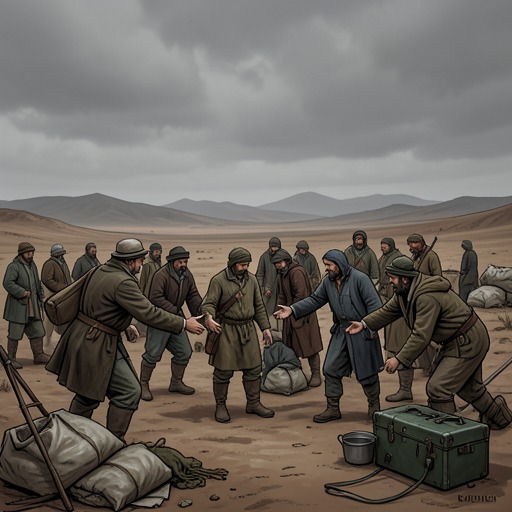
Shevek Is Removed from the Institute and Chooses Emergency Work
The DispossessedShevek’s removal from the Central Institute of the Sciences during the drought turns a dispute over the usefulness of research into a test of what voluntary social responsibility means. The Institute releases him for reposting, citing the immediate need for famine-prevention labor and a climate of suspicion around his work and conduct. He does not leave in a rage or retreat from the community: after considering the choices open to him, he asks for an urgent assignment and is sent to a phosphate mill in Elbow, in the Dust.
Background: Research under emergency conditions
Shevek has already spent six decads on a famine-prevention posting, alongside other necessary work, including a forest project, farm projects, practical training, block committees, and volunteer labor. He says he will go again when called, but maintains that he also has a trade and a right to practice it if physics remains to be done. For him, temporal physics is not a private indulgence opposed to social function: he argues that a field attempting to organize everything comprehensible to the human mind is centrally functional by definition. Sabul, by contrast, measures its worth against the immediate test of whether it puts bread into people’s mouths.
That dispute takes place against a worsening emergency. Anarres’s transport system, normally flexible and effective, is overwhelmed after a year of drought: entire regions face famine unless food is moved between them, and emergency drafts of workers must also be shifted. The transport federative has too few vehicles and too few people to run them, so apprentices, retired workers, volunteers, and emergency draftees are pressed into service. Against this background, the Institute’s turn from research to practical work is not merely a pretext; the needs are real, even as their administration exposes the strain between immediate necessity and a longer intellectual vocation.
The Institute’s decision
Sabul tells Shevek that there is no physics of the kind he does to be done at the Institute now, and that the institution must gear itself to practicality. Five people have been released for reposting, and Shevek is one of them. Sabul identifies two grounds for the decision: the abstruse and supposedly irrelevant nature of Shevek’s recent research, and a feeling among some student and teaching members that his teaching and behavior show disaffection and privatism, a failure of altruism. Sabul says that these views were discussed at a meeting and that he spoke in Shevek’s favor, but adds that he is only one syndic among many.
The formal decision is presented as a collective institutional judgment rather than a personal order from Sabul. Yet the exchange recalls the informal power Shevek’s friend Bedap has described: without laws or a government, public opinion can still limit a person’s work by refusing to publish, teach, or make room for it. Shevek has previously encountered that kind of obstruction when his letters to physicists on Urras were stopped or returned unapproved, often after Sabul refused to authorize material outside his own school of Sequency physics. In the Institute meeting, suspicion of individualism and the practical pressure of the drought converge; the result is a reassignment that is both an emergency response and a judgment on what kinds of work the community is prepared to support.
Shevek’s response and choice
Shevek asks whether Sabul recommended him for a teaching post elsewhere. Sabul replies that no one is taking on new teachers while teachers and students are working together on famine-prevention jobs around the planet. He predicts that the crisis will pass and that people will later look back with pride on their shared sacrifices. Shevek feels a strong desire to tell Sabul to go to hell, but instead says that Sabul is probably right, nods, and leaves. His controlled departure refuses both a public outburst and the claim that his research should exempt him from the emergency.
At the Division of Labor Central Posting offices, Shevek’s options are broad: he could stay in Abbenay and organize volunteer physics classes, go to the Rolny Peninsula to live with Takver even without a place at her research station, or live without taking a work posting. He recognizes that, although the choices are his, a social being does not make them alone. Asked whether he wants an urgent assignment, he answers that he has just returned from famine-prevention work and asks whether anything else needs doing. When the clerk tells him that roughly seven hundred urgent calls are posted, he asks whether any need mathematics. The question carries his professional identity into the reassignment process instead of treating it as something he must discard.
The Elbow posting and its significance
The posting sends Shevek from the Central Institute of the Sciences in Abbenay to phosphate mill number one in Elbow, in the Southwest work community. It is marked as an emergency posting of indefinite duration, with the record specifying a five-day work schedule. When told that the destination is down in the Dust, he says he has been there before and recalls that someday it will rain. The line joins a concrete decision to a longer perspective: the damaged region is not outside the world he serves, and practical labor there can be understood as part of an unfinished future.
The choice does not resolve the conflict between intellectual freedom and communal need. Shevek accepts the reassignment and does not insist on remaining at the Institute during famine, but neither does he concede that physics has no social value simply because its results are not immediate. The episode therefore makes his departure from the Institute more than an administrative change: it exposes how scarcity can turn voluntary coordination into social pressure, while showing him choosing a necessary task without renouncing the work he believes he has the right to do.