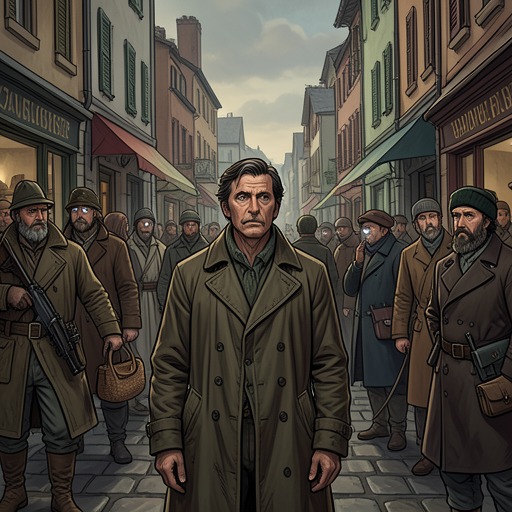
Shevek Seeks Asylum at the Terran Embassy
The DispossessedShevek Seeks Asylum at the Terran Embassy is the turning point at which Shevek escapes the violence of Nio Esseia and places himself under the protection of a government outside A-Io’s authority. At the Terran Embassy in Rodarred, he is sheltered by Ambassador Keng, then decides not to hide from the Ioti Government and renews his insistence that his scientific theory should be given freely to all worlds rather than sold for political advantage. The refuge is both immediate and political: it saves him from pursuit while creating a space in which he can reclaim the purpose of his work.
Flight to the Embassy
The embassy stands in the River Castle, a fortified building between the Nio highway and the river in Rodarred, the old capital of Avan Province. Its squat tower, moat, and walls that had withstood weapons and weather for fourteen hundred years contrast with the violence Shevek has just escaped. Although the castle houses a modern reception desk, its old defenses give the embassy a literal boundary: it is Terran soil within A-Io, protected by the diplomatic authority of the Council of World Governments.
Shevek arrives after the strike demonstration has been driven apart by police and armored cars. He has been helping a wounded demonstrator, and the man’s blood is on his coat. At the embassy, a car draws up as uniformed men in black coats enter the building. Seeing two unfamiliar visitors in the lobby, Shevek runs toward them and asks for help. One recoils, but the other recognizes the danger, takes Shevek’s arm, and ushers him into a side office before the uniformed group can reach them.
When asked whether he is one of the strikers, Shevek gives his name and identifies himself as being from Anarres. The Terran recognizes the significance of who has arrived and asks whether he is seeking asylum. Shevek cannot yet give a clear answer. The exchange registers both his exhaustion and the abruptness of his decision: he has reached safety by acting before he can explain what safety will mean.
Refuge under Terran protection
Shevek faints after reaching the embassy and wakes on a couch in a large, sunlit room, surrounded by embassy staff. They tell him that he is on Terran soil and can stay as long as he wants. He insists that he wants to see the Ambassador, but the Ambassador, Keng, first tells him to rest. When he whispers Takver’s name and admits that he does not know what to do, Keng tells him to sleep. The scene shifts from flight and confusion to care: at this moment, the embassy’s first service is to let him recover.
After two days of sleep and meals, Shevek is dressed again in his cleaned and pressed grey Ioti suit and brought to Keng’s private salon on the third floor of the tower. Keng explains that Anarres’s radio operators have been urgently asking to speak with him, while the A-Io government is embarrassed by the situation. The Ioti authorities have not been officially told that he is at the embassy, though Keng knows that embassy clerks and secretaries have made his presence known to them in practice.
Keng distinguishes the embassy’s position from A-Io’s. It is accredited to the Council of World Governments, not to the A-Io nation, and Shevek has the right to enter; the other members of the Council would require A-Io to acknowledge that right. The castle’s status as Terran soil gives that protection a formal basis, even though the embassy stands on Urras, eleven light-years from Keng’s home world. Its safety is therefore more than personal hospitality: it rests on an international boundary A-Io cannot simply treat as its own.
Choosing to be found
Keng has not yet asked whether Shevek has received a message from Anarres. She offers to arrange a broadcast on the wavelength used by his people, but explains that the Terrans had not contacted them because they had not been invited to do so. Shevek’s concern is not only whether the embassy can shelter him, but how his presence will affect the people back home and the communications between the worlds.
He asks directly whether the Ioti Government knows he is there. When Keng confirms that it does not officially, Shevek tells her that it can be informed. Keng welcomes the decision, saying that it will simplify matters and that she wanted his consent. Rather than remain a concealed guest whose location could be treated as a diplomatic secret, Shevek makes his refuge known on his own terms. The choice also places his safety, and the question of his access to Anarres, into the open.
The gift of knowledge
The embassy gives Shevek room to reconsider the bargain he has made with A-Io. He says that he came to bargain because he wanted his people to come out of exile, but now sees that pursuing physics under the arrangement has meant betraying the idea of freedom, change, and human solidarity that formed him. He recognizes that the propertarians are buying the truth from him. His refusal is not a rejection of scientific work; it is a rejection of its capture by a profit economy and by the state that hopes to turn it to its own advantage.
Shevek asks whether selling is the only alternative and whether there can be such a thing as a gift. He wants to give his theory to Keng, Hain, the other worlds, and the countries of Urras, so that no one power can use it to dominate its rivals, grow richer, or win wars. Knowledge, in his account, should be available for the common good rather than reserved as private property. Keng suggests that truth will ultimately serve the common good, but Shevek refuses to wait for that distant outcome: he has one lifetime and will not spend it serving greed, profiteering, lies, or a master.
The asylum episode thus joins physical rescue to the larger conflict over exchange and authority. At the start of his journey, Shevek had described himself as the Beggarman, arriving in Urras without money and requiring others to give him what he could not bring or buy. At the embassy, the same distinction between buying and giving becomes a deliberate political principle: he will offer his work to all rather than let a government purchase it for its own advantage. In the Terran refuge, his immediate escape from A-Io’s violence becomes inseparable from his decision to reclaim the freedom to share what he knows.