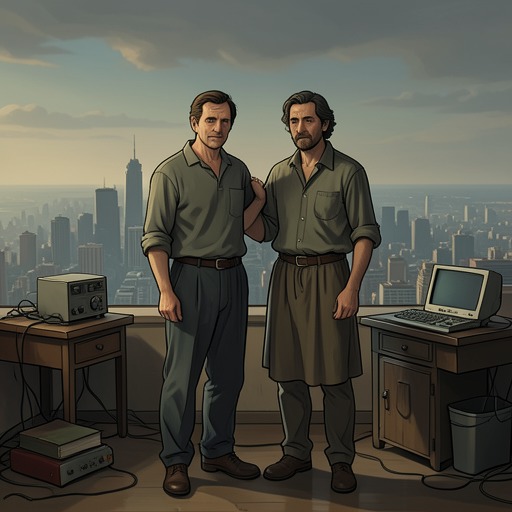
Shevek and Takver Become Lifelong Partners
The DispossessedShevek and Takver become lifelong partners through a freely chosen commitment that joins emotional equality to the practical work of making a shared life. Their relationship begins during a group hike in the Ne Theras and becomes a lasting bond; its domestic details and Shevek’s reflections on time connect intimate partnership to the novel’s larger concerns with mutuality, freedom, and continuity.
Meeting and Recognition
Shevek joins a ten-day hiking party organized by Bedap and falls into conversation with a woman he does not recognize. She knows him, while he is embarrassed to realize that he should remember her name. The encounter turns into an unexpected attraction: Shevek tells her that he has never been drawn to a woman as he is to her, though his tone is cold and almost resentful. His response is not a conventional courtship but a recognition that unsettles his solitude.
As they sit together in the mountains, Takver describes what she needs as a real bond, involving body, mind, and all the years of life. Shevek understands that this is what he needs too. When he insists that it matters, she asks whether he wants the bond for life; he answers that he wants it now and for life. Their commitment is presented as mutual and deliberate: neither partner is compelled, and Takver’s recognition of Shevek as her equal is central to her willingness to ask for a lasting relationship.
Making a Shared Home
When they return from the mountains, Shevek and Takver move into a double room in an old domicile in northern Abbenay. They register the vacant room together with the block housing manager, turning their promise into a shared living arrangement. Their move is modest but specific: Shevek brings papers, winter boots, and the orange blanket; Takver makes several trips for clothes and belongings, including the wire constructions she calls Occupations of Uninhabited Space. They also replace a broken chair through a repair shop.
These objects show how their home is made through use, care, and shared decisions rather than private accumulation. Takver considers obtaining new suits for both of them essential to beginning their partnership. Their room, with space for her suspended wire forms and a window over the city, becomes a setting for a life built together within the everyday institutions of Anarres.
Intimacy and Shared Time
Their first decads together bring emotional strain as well as joy. After long solitude, both are inexperienced and oversensitive: Shevek swings between elation and anxiety, while Takver has fits of temper. The difficulty eases as they become more attuned to one another. Their desire for closeness is renewed through daily life, and the narrative treats the partnership not as a single declaration but as a bond continually made real.
The relationship also alters Shevek’s understanding of his own history. He sees his earlier unhappy years in Abbenay as part of the happiness he has reached with Takver: what happened before has prepared what is happening now. Takver understands time more simply, as a road on which a person walks toward somewhere worth reaching. When Shevek reframes that image through memory and intention, she readily recognizes her own recent past in it. The exchange makes their different habits of thought compatible: his temporal physics and her direct account of lived experience meet in a shared understanding that the past and future take meaning through present life.
Significance
The partnership offers a personal instance of the freely chosen bonds that Shevek values in Odonian society. Its permanence does not rest on ownership or an imposed contract; it rests on the partners’ explicit choice, equality, and continuing mutual attention. The promise of a bond for life is therefore consistent with a society whose ideals depend on voluntary association rather than possession.
That ethic resonates beyond the couple’s room. In Urras, Shevek calls himself a beggarman because he arrives without money or gifts and argues that his hosts must give him what he needs rather than sell it to him. Later, he asks whether truth can be given to the worlds rather than sold for private profit, and offers his theory for common use. The relationship with Takver is not presented as the direct cause of those political choices, but it gives the novel an intimate example of exchange grounded in freely offered commitment rather than purchase. In both partnership and intellectual sharing, Shevek resists treating what matters as private property.