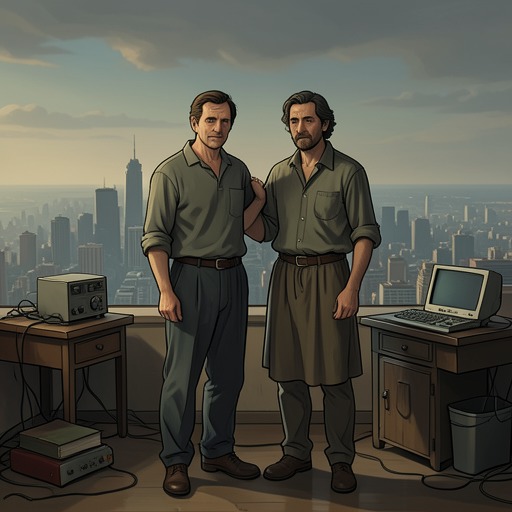
Shevek–Takver relationship through shared family life
The DispossessedShevek and Takver’s relationship gives personal form to the novel’s ideas of voluntary partnership and shared life. It is both a source of attachment and a bond that does not rest on ownership: even when separation carries Shevek away from his family, memories of Takver and their daughter Sadik remain central to how he understands his choices and his connection to Anarres.
Partnership and freedom
Shevek’s understanding of partnership is shaped by a society whose language and ethics resist treating another person as property. Reflecting on an earlier relationship, he recognizes how both partners could feel possessive without either actually owning the other; freedom, rather than possession, is what allows a person to let another go. That insight provides a contrast to the gendered and proprietary assumptions he encounters beyond Anarres, and a context for reading his bond with Takver as a chosen relationship rather than a claim of ownership.
Their relationship is also linked to Shevek’s conviction that work and social roles should follow a person’s capacities rather than sex. When asked whether men’s and women’s work is divided by gender on Anarres, he rejects the idea as a mechanical basis for assigning labor. This outlook belongs to the wider social world in which he and Takver form a life together: intimacy and work are not presented as domains in which one person has a natural right to direct another.
Shared life and separation
The relationship appears through the family memories Shevek carries into his departure. Three days before entering the small room where he will be held, he has seen Takver and the children off to Peace-and-Plenty. The ensuing rush of messages, plans, and exchanges with people on Urras leaves him feeling as if events are acting through him. He recovers the sense of his own agency by tracing the journey back to a private promise made years earlier in Chakar: he had told Takver that he would go to Abbenay and unbuild walls. His public undertaking thus has a personal history, and the separation from Takver is part of the choice that has brought him to Urras.
A small domestic memory makes the distance sharper. When Atro lends Shevek a handkerchief, Shevek remembers Sadik offering to share the one she uses. The recollection is dear to him and painful in his present circumstances. It shows how family life persists in his thoughts not as an abstract ideal, but through a remembered act of sharing between father and daughter.
Memory, home, and enduring connection
Later, looking out at night, Shevek remembers seeing the moon rise at different points in his life: in Wide Plains with Palat when he was a child, over the Dust, and above Abbenay with Takver beside him. The moon he sees from Urras is not the same moon. The sequence joins distinct places and periods without erasing their differences, and Takver’s presence in one of these remembered scenes locates their relationship within Shevek’s sense of home.
The relationship’s significance lies in this combination of attachment and freedom. Takver is part of the private history behind Shevek’s decision to cross the divide between worlds, while the memories of Takver and Sadik sustain his sense of connection when he is physically apart from them. Their shared life gives emotional weight to the values he seeks to defend publicly: bonds matter, but they are not made legitimate by possession.