Syndicate of Initiative
The DispossessedThe Syndicate of Initiative is an Anarresti group organized around communication and exchange with Urras. Its radio contact, published reports, and arguments over travel challenge the isolation imposed by the Settlement’s rules and by Anarres’s own distrust. The Syndicate’s significance lies in the tension its work exposes: solidarity cannot be sustained by coercive unanimity, but opening a society to exchange also carries real risks that its members cannot simply dismiss.
Identity and Purpose
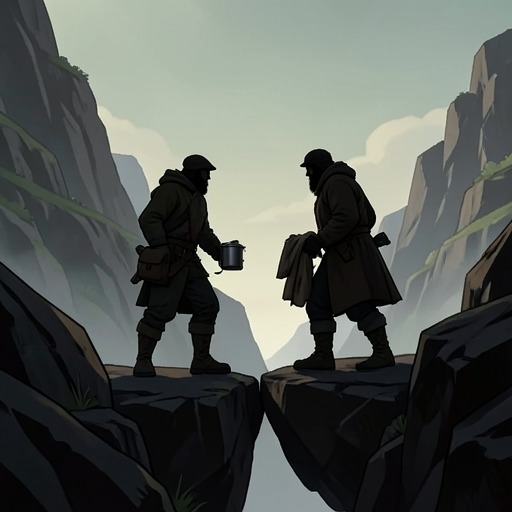
The Syndicate describes itself as a group that has been talking with Urras by radio. Shevek identifies himself as one of its syndics, but stresses that he is not an ambassador for an Anarresti authority or institution. On Anarres, the Production and Distribution Coordination network coordinates productive work; it does not govern individuals or have authority to approve or forbid Shevek’s initiative. It can, however, make public opinion legible as social conscience. Shevek says that he and his friends are mostly disapproved of, because many Anarresti fear Urras and want no dealings with its propertarians. His journey is meant to begin changing that attitude, by individual initiative rather than governmental mandate.
The group’s stated project is communication, but its work carries consequences beyond the exchange of scientific information. Shevek discovers that letters, as well as books and commodities, travel between the sundered worlds. The prospect of corresponding with people living under governments and property relations he opposes unsettles him: he questions whether such an exchange could be voluntary and equal, or whether it would become an attempt to dominate and possess. The Syndicate’s activity makes those questions practical. Contact offers a way to test mutual understanding rather than leaving each world to imagine the other from a distance.
Radio Contact and Knowledge-Sharing
The Syndicate’s exchanges include scientific knowledge, and Shevek argues that information should not be kept secret merely because it comes from Urras. He asks why he should learn Iotic but keep that knowledge to himself, and considers whether Sabul might want to treat new physics as property that gives him power over colleagues. That possibility is difficult for Shevek to accept, but it sharpens the political stakes of the Syndicate’s publishing work: knowledge can circulate as a common resource, or be withheld for advantage.
The same principle appears in a concrete medical exchange. After receiving treatments and inhalations from a government doctor for his cough, Shevek asks the doctor to describe the process and drugs over the radio to the Syndicate in Abbenay. The doctor does so willingly. Shevek sees no reason the information should not help relieve suffering caused by dust cough. This instance gives the Syndicate’s communications a practical, reciprocal purpose: a treatment learned in one society may be transmitted to another without being sold or guarded as a source of power.
The group’s dealings with Urras also prompt Shevek to examine what he is doing there. Chifoilisk warns him that the Ioti welcome and support may serve a profit economy rather than scientific fellowship. Shevek answers that he came to bargain for the end of his people’s exile, for solidarity, and for free exchange between Anarres and Urras. He distinguishes his work on Urras from what he did at home: there he acted, while here he bargains. The Syndicate’s communication is therefore not a neutral technical channel. It is one part of a political effort to break isolation while resisting the conversion of exchange into ownership or state advantage.
Publishing and Political Opposition
Radio communication becomes public through the Syndicate’s reports. By the time Bedap discusses a new message at a PDC meeting, the group has already established contact and printed accounts of its exchanges. The message comes on the wavelength used by Ioti contacts, but outside a scheduled transmission; it is weak and appears to originate in Benbili rather than A-Io. Its sender identifies itself as the Odonian Society, a group of post-Settlement Odonians existing within Urras’s legal and governmental loopholes, and addresses the Anarresti as brothers. It asks whether it may send people to Anarres as settlers.
That request forces the Syndicate’s broader project into a direct dispute over entry and security. Rulag accuses the group of building a transmitter, broadcasting, and publishing communications against the advice of most of the PDC and the increasing protests of the Brotherhood. She argues that the broadcasts disclose Anarres’s weakness to a powerful enemy and that allowing settlers could lead from a small group of supposed Odonians to profiteers and, ultimately, an armed occupation. Her case rests on the Settlement’s prohibition against Urrasti leaving their ships, a rule that has protected Anarres from contact for generations. Bedap counters that inviting a few people would test whether the worlds could meet as equals, but does not treat the danger as imaginary.
The dispute is not resolved by a formal vote. Once it is clear that almost everyone present favors the Settlement’s restrictions, Bedap accepts that no Urrasti will be brought ashore from the freighters Kuieo Fort or Mindful. He says the Syndicate’s aims must yield to the opinion of society as a whole on that question. The decision limits the organization’s immediate program, but it does not settle whether an Anarresti may travel to Urras. Shevek argues that leaving would not harm anyone on Anarres and that the Settlement’s terms do not forbid it; treating the journey as forbidden would give the PDC authority to abridge individual initiative. Rulag replies that a traveler may leave but cannot return under the closure terms. The disagreement reveals how an association committed to openness must confront boundaries its community regards as necessary protection.
Initiative, Conformity, and the Cost of Dissent
Shevek’s defense of individual action gives the Syndicate’s dispute a wider significance. He argues that Anarres was founded for freedom, not safety, and that if people must always agree and work together, society becomes like a machine. When a person cannot act in solidarity with others, he says, that person must have the duty and right to work alone. For Shevek, the right to initiate is inseparable from responsibility: a society founded on revolution must keep changing rather than turn majority opinion into another form of rule. His argument does not erase the risk Rulag identifies; instead, it asks whether protection from risk has become a reason to deny the very freedom the settlement was meant to preserve.
The Syndicate’s members experience opposition not only in meetings but in daily life. Bedap explains that he, Shevek, Skovan, Gezach, and others spend much of their time at the printing shop or radio tower and consequently see relatively little of people outside the group. At the PDC, Bedap expects resistance because his role there puts him in opposition. Takver describes a more intimate cost: people are hostile to her, her project director no longer speaks to her, and a woman on her block sanitation committee refuses even to let her enter a room, denouncing her and the others as traitors and intellectuals. Takver says the encounter frightened her, despite her humor at its grotesqueness. Bedap observes that customary disapproval can be harder to escape than a law: it is woven into everyday relations, leaving social approval as the only security. The group’s challenge to isolation thus exposes it to informal punishment, even where no formal authority has ordered reprisals.
Sharing as an Alternative to Ownership
The Syndicate’s politics culminate in a dispute over whether knowledge must be sold. Before leaving Anarres, Shevek had refused Sabul’s offer of reconciliation and recognition in return for the opportunity to print his equations and share the credit. Yet he had not given the work to the Syndicate’s press either: his reasoning remained unfinished, and the night before departure he burned every paper he had on the General Temporal Theory. Later, as he recognizes that the Ioti want the theory for spaceflight and prestige, he confronts the possibility that pursuing physics within their system is allowing propertarians to buy truth from him.
Against that arrangement, Shevek asks whether there can be a gift rather than a sale. He wants to give his theory to the people of Urras, Hain, and other worlds, so that no one country can use it to dominate rivals, enrich itself, or win wars. His proposal extends the Syndicate’s practice of communication into a demand for genuinely public knowledge: not merely an exchange between organizations, but a refusal to reserve the truth for private profit. Across the group’s radio work, its printed reports, and its contested invitation to exchange people as well as ideas, the same unresolved test recurs: whether openness can become solidarity without ignoring danger, and whether a society that fears domination can preserve freedom without making fear itself a rule.