Urras
The DispossessedUrras is the inhabited world from which the settlers of Anarres departed, and the destination of Shevek’s journey beyond the isolation between the two planets. It is at once a world of immense natural and civic beauty and a society organized by ownership, money, and state power. Through Shevek’s changing experience of it, the planet becomes more than a contrasting setting: it is the beautiful world enclosed by a social wall, and the place where the possibility and limits of solidarity are made urgently visible.
Definition and First Impressions
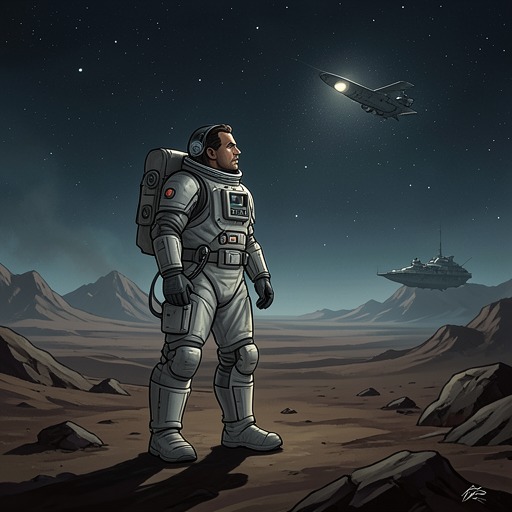
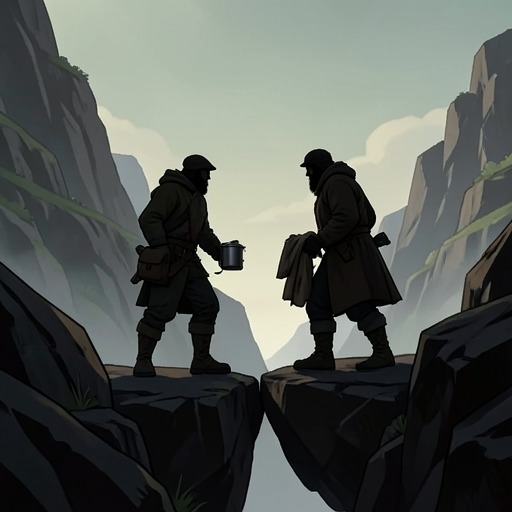
At the Port of Anarres, Urras is present first as the world on the other side of a boundary. The rough wall around the landing field encloses ships arriving from space, their crews, and the worlds they come from; from one perspective it leaves Anarres outside, free. From the opposite perspective, the wall encloses Anarres itself, making the planet a prison cut off from other people and worlds. The novel gives no simple answer about which side is inside: the wall’s meaning changes with the observer, and Urras is initially both the excluded outside and the source of the exclusion.
For Shevek, stepping onto Urras brings the boundary into intimate focus. After the disorientation of landing, he stumbles from the covered ramp onto new ground and recognizes the cool, damp, many-scented air as the air of his race’s ancestral world. The recognition is neither uncomplicated delight nor mere foreignness; grief and recognition show together on his face as photographers record the arrival of the first man from the Moon. Urras feels like home because of its air, gravity, and living abundance, but that homecoming occurs under floodlights, among dignitaries, professors, and security agents, with journalists held back by police.
Landscape, Cities, and Material Abundance
Urras’s abundance is not an abstraction to Shevek. The summer valley, its birds, trees, and sunlight, and the heavier pull of the planet’s gravity make the world sensuously present. During his first days, he listens to birds he has learned to identify from books and watches them move from tree to tree. Their song sharpens his memory of Anarres, where no birds sing and the silence belongs to barren lands. The contrast makes Urras’s ecological richness seem like a birthright, while also reminding him that the two worlds have formed different habits of perception and life.
The city of Nio Esseia gives that abundance an imposing civic scale. A train approaches across the green marshes of the Estuary, where the city’s towers appear at first like mist and sunlight, then rise into solidity before the train plunges through an underground approach. Passengers emerge into a vast central station beneath an ivory-and-azure dome described as the largest raised by human hands on any world. The polished marble and monumental architecture proclaim collective technical achievement, yet the crowds moving through the station seem anxious and separate. Shevek wonders whether insecurity about money, or guilt over those with less, marks their faces; the grandeur of the setting does not dissolve the social distrust he senses within it.
Urras also impresses through its contrasts. Its beauty is lavish beside the dusty, dry hills and scarcity of Anarres, but Shevek gradually sees that abundance is distributed within a society of rich and poor rather than held in common. In a conversation about the planets, he describes Anarres as meager and hard, without palaces or plentiful goods, while Urras has enough air, rain, food, music, buildings, machines, books, and clothes. He contrasts the jewels visible on Urras with the faces that matter to him on Anarres: in his account, people who possess little are free to depend on one another, while possessors are themselves possessed by what they own. The speech makes the visual contrast between the worlds an argument about social relations, not simply about landscape.
Institutions, Property, and the Wall
The early promise of Urras does not survive unchanged. Shevek hopes to settle down and work at Ieu Eun University after his period as a tourist, and he chooses to teach as well as conduct research. Students ask him to give an open lecture course; administrators object, but the students and Shevek hold firm, and the university’s rectors yield to avoid unpleasant publicity. His first lecture draws two thousand people, after which attendance declines, though several hundred continue to come. Some are curious about the visitor from Anarres; others respond to his personality, his libertarian implications, or both the philosophy and the advanced mathematics. This episode shows that Urras contains people capable of curiosity and independent initiative, even within its formal institutions.
Yet Shevek’s scientific work becomes entangled with the state and the economy. At first, the world’s generosity seems to offer him room to work. Over time, Urras grows less real to him: the vital, magnificent world he saw from his window seems to slip away, replaced by something like waste paper and wrappings. The papers he writes bring salary and payment from the university press; his existing awards and government grant add to money held in a National Bank account. He tries to understand the economics that give these sums meaning but finds the operations of capitalism alien and frightening. The money that first seemed amusing becomes a sign that his work is entering a system whose assumptions he cannot accept.
The political meaning of that entanglement becomes explicit when Shevek explains why he came. He wants his people to come out of exile and the walls between Urras and Anarres to fall. He believes the people of Thu fear a revived revolution, while the rulers of A-Io have forgotten the revolutionary demand for justice and imagine that possession can reconcile people to confinement. He hopes for free exchange and human solidarity, and says that on Anarres he acted as he could, while on Urras he bargains. But his later reckoning reverses that confidence: as a physicist in A-Io, he has not been serving society, humankind, or truth, but the State. He recognizes that he cannot bargain with it as an equal; the state owns him, and power is the only currency it recognizes.
The wall therefore returns in altered form. It is no longer only the physical boundary of the landing field or the isolation between planets. For Shevek, it names the social enclosure created by property and mistrust. At Nio Esseia’s central station, strangers hurry past one another, apparently unwilling to spend time on idle conversation; outside the protected world of his guides, he feels frightened in a society whose moral premise seems to be mutual aggression rather than mutual aid. When he later reaches Old Town, the contrast becomes material and immediate: rain falls on dark streets without working streetlights; shopfronts are shuttered, one burned-out storefront remains black and broken, and a woman he mistakes for old is not yet thirty. The city’s splendor and its neglected streets belong to the same world.
Encounter with Poverty and Political Violence
Shevek’s attempt to encounter Urras beyond its scholarly and wealthy circles brings him into contact with the costs hidden by its polished surfaces. In Nio Esseia he had hoped to talk with members of the working classes, but the hurried people he sees appear intent on business and protective of their time. In Old Town, the shut doors and refuse-strewn pavement make exclusion tangible. Later, during the demonstration and its violent suppression, he helps an injured man who can no longer keep up with the crowd. With the streets blocked and the army driving people away from Capitol Square, Shevek breaks the hasp and padlock of a warehouse basement and takes the wounded man inside. The act is deliberate but not furtive or vindictive: he treats the locked door as an obstacle to care, while the injured demonstrator’s shattered hand gives the political violence a bodily consequence.
The episode makes the contradiction in Urras’s order impossible for Shevek to keep at a distance. He had been brought to live among scholars and the rich, shielded from the poor and from anything ugly, so that he could work and eventually hand over his theory. The Terran ambassador sees the uprising in a related light: the demonstrators are not merely seeking higher wages or protesting conscription, but resisting power in a tradition connected to Anarres and Odo’s writings. Shevek’s presence in A-Io, intended to keep him away from the populace, has instead brought the danger of that living tradition into view. The planet’s political conflict thus links its social divisions to the very exchange across worlds that his visit was meant to control.
A Contested Home and the Novel’s Final Image
Shevek’s judgment of Urras shifts from recognition to disillusionment, but the novel does not reduce the planet to a single verdict. In his most severe account, Urras is a beautiful package concealing a black cellar: a world where profit, fear of loss, and the desire for power enter ordinary dealings, and where people manipulate, command, obey, or trick one another instead of meeting as brothers. The wounded man in the cellar gives that indictment its concrete image. Yet the Terran ambassador contests Shevek’s conclusion. She describes Urras as the kindliest, most various, and most beautiful inhabited world she knows, full of injustice and waste but also vitality, achievement, and hope. Her view preserves the distinction between condemning the world’s social order and denying the life and beauty within it.
At the novel’s close, Urras is again seen from outside. Before the ship breaks orbit, its viewports are filled with the cloudy turquoise planet; then the vessel turns and the stars come into sight, with Anarres among them, a bright round rock in motion and apparent stillness. The closing image restores the spatial distance between the worlds without resolving the argument over which is home or which is prison. Urras remains beautiful, politically compromised, and bound to Anarres by a history of departure and renewed contact. Its significance lies in that unresolved double vision: the wall separates worlds, but the act of crossing it makes their differences and their possible connections newly visible.