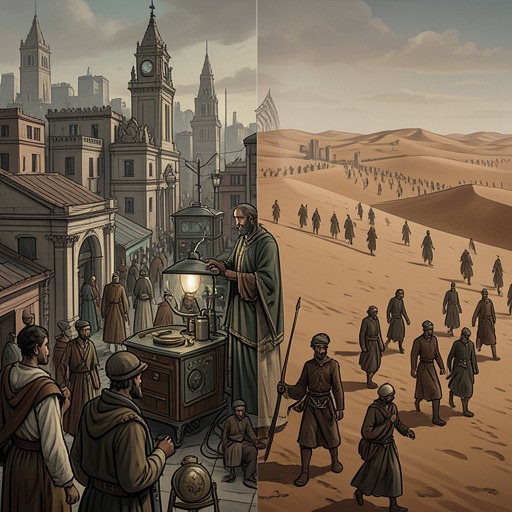
Urras’s propertarian society and social order
The DispossessedUrras’s propertarian society and social order makes ownership and exchange the organizing terms of social life, linking material comfort to class, state power, and the pursuit of profit. Shevek encounters its assumptions in ordinary acts of hospitality as well as in the political control of knowledge; his eventual decision to offer his theory as a gift exposes the alternative his society represents and the limits of treating truth as private property.
Material Exchange and Hospitality
For Shevek, the difference between Anarres and Urras first appears in the problem of how a visitor is kept alive. Arriving without money, gifts, or luggage, he observes that he cannot buy food and cannot bring enough to provide for himself. The people of Urras must therefore give him what he needs, though the very fact of receiving care makes him feel like a beggar. He describes himself as making the Urrasti behave as Anarresti do: giving rather than selling. His predicament turns hospitality into a small social experiment, revealing that what counts as ordinary provision in one society appears as an exceptional favor in another.
On the Mindful, Shevek likewise explains that he came with empty hands because Anarres uses no money and has nothing to give that Urras lacks. Atro and Pae assure him that no payment is expected and that hosting him is their privilege; Chifoilisk adds that the Ioti Government is paying the bill. The exchange is thus never simply outside institutions: personal generosity exists alongside public expenditure and an unspoken political context. Shevek’s repeated insistence on arriving empty-handed makes the contrast between a gift and a transaction visible even when his hosts consider the matter settled.
Profit, Class, and Political Power
Shevek understands that the welcome he receives is shaped by the profit economy. Chifoilisk warns that the lectures, students, money, tours, and comfortable laboratories are not offered out of disinterested scientific affection. Shevek answers that he came to bargain with that system, but defines his intended return not as personal gain: he wants his people to come out of exile, the walls between Urras and Anarres to fall, and human solidarity and free exchange to become possible. In his view, A-Io may be more receptive than Thu because its people have forgotten the revolution and suppose that possessions can make confinement acceptable.
The order also reaches into the production and circulation of knowledge. On Anarres, Shevek’s letters to physicists and mathematicians on Urras are blocked or delayed: Port of Abbenay managers suspect technical correspondence might be code, while Sabul refuses to approve work outside his own preferred field. The restrictions do not arise from a formal law against communication, but from institutional discretion, professional gatekeeping, and distrust of an ideological enemy. In a different form, A-Io imposes wartime classification on research and limits the travel of non-nationals, requiring clearance to leave the campus. Across both worlds, access to ideas and movement is shaped by authorities that claim to coordinate or protect society.
A Gift Against Private Profit
The decisive challenge comes when Shevek recognizes that pursuing his physics while allowing the propertarians to buy the truth would betray the idea of freedom, change, and human solidarity that formed him. He asks whether selling is the only possible relation and whether a gift can exist. He wants to give his theory to Keng, Hain, and the countries of Urras alike, so that no one state can use it to dominate others, grow richer, or win wars. His offer rejects exclusive ownership not by withholding the discovery, but by making it available to all.
Shevek refuses to wait for truth eventually to serve the common good. He has one lifetime and will not spend it serving greed, profiteering, and lies or any master. The gift is therefore both a means of distributing knowledge and a political act: it contests the assumption that a discovery must become an asset controlled by whoever can purchase or command it. The contrast with the empty hands of his arrival comes full circle. At first, he depends on others to give him necessities; by the end, he chooses to give what he has made rather than let it become private power.
Beauty and the Limits of Shevek’s Judgment
Shevek’s confrontation with Keng also shows that his condemnation of Urras is not the novel’s only account of the planet. He calls it a box whose beautiful surface conceals states, weapons, rich people’s lies, and poor people’s misery; even ordinary greetings, he argues, are burdened by judgments of superiority. He describes a world where one cannot act without profit, fear of loss, or the wish for power, and where people manipulate, command, obey, or trick one another instead of meeting as brothers. His image of the cellar and the dead man gives his alienation a political focus: he has seen the violence done to someone who reached out to others.
Keng answers from another position of estrangement. As a Terran, she too is an alien on Urras, yet she sees it as the kindliest, most varied, and most beautiful inhabited world she knows: a place approaching paradise, alive with achievement, vitality, and hope despite injustice, greed, folly, and waste. She asks Shevek to imagine how her world must appear to him. Their disagreement prevents either abundance or suffering from becoming the whole definition of Urras. The propertarian order is not merely a landscape of possessions; it is a social arrangement whose beauty and vitality coexist with the inequalities and coercions Shevek cannot accept.