Vea Doem Oiie
The DispossessedVea Doem Oiie is an Ioti woman whose encounter with Shevek brings the gender hierarchy and polished abundance of Urras into intimate focus. Introduced as Demaere Oiie’s beautiful sister and the wife of a powerful industrialist, she becomes Shevek’s companion in his effort to see beyond the carefully managed surfaces of Nio Esseia. Their connection is charged by attraction and mutual curiosity, but also by a sharp difference in what each takes for granted about women, men, and intimacy.
Identity and Social Position
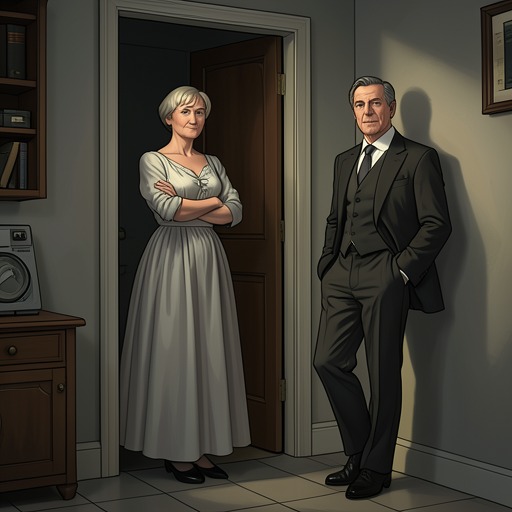
Vea is Demaere Oiie’s sister; her full name, Vea Doem Oiie, follows the Ioti naming mode. Her husband, Doem, heads a large industrial combine and spends half of each year abroad representing the government in business. That position places Vea within the privileged social world that surrounds Shevek during his visit, even as the conventions governing women’s lives become a subject of direct disagreement between them.
She first meets Shevek at Demaere’s home. He arrives from the snow, stamping it from himself and extending a large, cold hand; when he recognizes her as Demaere’s sister and says she resembles him, Vea is unexpectedly pleased. The remark matters to her because it comes from a man she regards as strikingly masculine and different from those around her. She spends the afternoon wondering what makes him seem so unlike other men, while he studies her appearance and registers her softness as part of the comfort and luxury of Urras.
Becoming Shevek’s Guide
Vea is due to return to Nio Esseia by train after dinner, having come out only for the day. When Demaere asks Shevek to walk her to the station, she playfully mocks the idea that she needs protection, joking about wolves, raiders, and a melodramatic rescue. Her lively self-parody and laughter unsettle Shevek: their force briefly overwhelms the words around them, and he is drawn to her without recognizing how far his interest has taken hold.
Their conversation soon gives Vea a role beyond that of an alluring guest. Shevek tells her he has seen many places in Urras, but that they all seem alike; he has seen only Nio Esseia’s exterior, the wrapping around the package. His image arises from the layers of paper, plastic, cardboard, and foil in which Urrasti goods arrive, and from his growing sense that he, too, has been packaged. Vea recognizes the official itinerary he means—the historical museum, the Dobunnae Monument, and a speech in the Senate—and promises to show him the real city. She thus offers access to a life beyond the formal tours arranged for a celebrated visitor.
Gender and Intimacy
Shevek confronts Vea with his perception that men control Ioti industry, art, management, government, and public decisions. He also points to women’s use of their fathers’ and husbands’ names, their exclusion from schooling, and men’s predominance among teachers, judges, police, and officials. Vea rejects his conclusion that women are simply controlled: she insists that women do as they like, without needing to dirty their hands or occupy the visible positions Shevek identifies as power. His reply—asking what women actually do—leaves their disagreement unresolved, exposing the gap between his structural account of male authority and her account of female freedom within it.
That divide also shapes a more intimate exchange. Before a party at Vea’s luxurious, all-white rooms overlooking Nio Esseia, Shevek falls asleep in a large armchair while she changes. She returns in formal Ioti dress, a pleated skirt leaving her torso bare, with a jewel at her navel. She sits near him and asks how relations between men and women work on Anarres. Shevek is startled by the context: servants are present, she knows he has a partner, and he knows she has one, yet her clothes, movements, and tone strike him as an invitation. He answers that a man and a woman have between them what each wants, individually and together. The scene brings his attraction into collision with the sexual freedom and privacy he associates with Anarres, while showing how readily he reads Vea’s conduct through his own assumptions.
Narrative Significance
Vea functions as both a personal presence and a point of contrast. Her promise to reveal the real Nio Esseia answers Shevek’s frustration with a city presented to him as a sequence of official sights and polished surfaces. Yet the closeness she offers does not erase the political difference between their worlds: her insistence that women act freely sits beside Shevek’s observation that men occupy the institutions that govern public life.
The encounter also helps make Shevek’s position as a guest feel precarious. Earlier, he describes himself as arriving in Urras empty-handed: without money or gifts, he must depend on others to keep him alive, and he hopes to make his hosts give rather than sell. In Vea’s company, the problem of exchange takes a personal form. Her attention and promised access offer intimacy and hospitality, but Shevek cannot easily separate welcome from the seductive abundance that surrounds him. Vea is not reduced to that abundance: she speaks back to his assumptions and directs him toward the city he wants to know. The tension between her social privilege, her claim to female independence, and Shevek’s attraction gives their brief connection its force.