Collapse of the Mannix Group and bankruptcy of Master Insurance
The Door into SummerThe collapse of the Mannix Group and the bankruptcy of Master Insurance destroy the apparent financial security Dan Davis expected to find after waking in the future. The disclosure does more than wipe out his stocks: it exposes how thoroughly a company can be emptied before its wrongdoing comes to light, and leaves Dan unable to establish what became of Hired Girl or whether Ricky was harmed by the same collapse.
Background and Disclosure
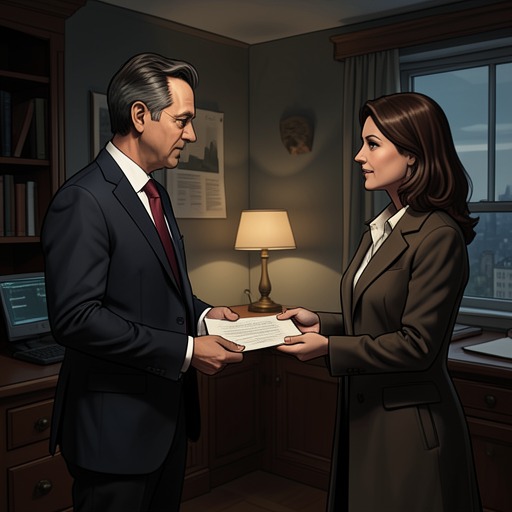
At a meeting with Mr. Doughty, Dan arrives believing that some of his investments must still be valuable. He points to his morning copy of the Times as evidence. Mr. Doughty tells him instead that he owns no stocks: Master Insurance has gone broke. The news abruptly overturns Dan’s expectation that the investments survived the passage of time.
Dan asks whether the Panic caused the failure. Mr. Doughty distinguishes the Panic from what followed, explaining that Master Insurance’s collapse belonged to the wider disintegration of the Mannix Group. The Panic may have set events in motion, but it was not, by itself, the explanation for the insurer’s ruin.
How Master Insurance Was Emptied
Mr. Doughty describes Master Insurance as having been systematically looted. By the time the scheme was discovered, the company was an empty shell, and the men responsible had put themselves beyond extradition. An ordinary receivership might have preserved something for those with claims; here, there was effectively nothing left to salvage.
The timing matters to Dan. He has awakened into a world in which the consequences of decisions made decades earlier have already been settled, while the people who could have been held responsible are beyond reach. Mr. Doughty offers reassurance that such a scheme could not happen under present laws, but Dan finds this no comfort. His own distrust of complicated law, learned from his father’s warning that legal complexity gives scoundrels opportunities, makes the assurance ring hollow.
The Lost Investment and Limited Remedies
The failure of Master Insurance is not merely a general corporate disaster for Dan. It means he cannot recover value from the stocks he thought he still owned. He recognizes that he cannot turn to Mutual Assurance Company: he had never completed his contract with the firm, despite asking how it had fared. Mutual Assurance survived the Panic, but its survival does not give Dan a policy or a claim.
Nor does a lawsuit against Master Insurance offer a remedy. The company is bankrupt, and Dan regards suing its hollow remains as pointless. He considers whether he could sue Belle and Miles, but acknowledges that he has no proof and does not know whether they are even still around. His anger at Belle remains vivid, including his wish to mark her as null and void, but anger cannot substitute for evidence or restore the lost assets.
Hired Girl and Ricky’s Exposure
The collapse also brings Dan back to the earlier corporate conflict. He remembers that Miles and Belle had been preparing to sell Hired Girl, Inc., to the Mannix interests when they expelled him. He therefore asks whether Mannix owned Hired Girl and whether any assets remain. Mr. Doughty recognizes the company as a domestic autoappliance firm but says the Mannix empire no longer exists as such; he knows of no substantial connection between it and Hired Girl.
That answer leaves the ownership question unresolved rather than proving that Hired Girl escaped the collapse. Dan accepts the matter for the moment, but his response is divided. If Miles and Belle were caught in Mannix’s failure, he would welcome their misfortune; if Mannix had owned and looted Hired Girl, however, Ricky could have suffered too. Dan’s concern for her outweighs the satisfaction he might take in his former adversaries’ losses.
Consequences and Narrative Significance
The episode turns a financial inquiry into an account of institutional failure. A newspaper listing cannot protect Dan from the difference between apparent value and legal ownership; a surviving insurer cannot help when no contract was executed; and a nominally available lawsuit cannot produce recovery from a bankrupt company or against opponents for whom there is no proof. Each possible route to restitution closes for a different reason.
The Mannix collapse thus sharpens the novel’s concern with the uneven reach of responsibility across time. The people who looted Master Insurance are beyond extradition, while Dan, newly returned to a future he did not choose, must reckon with the consequences. Yet the scene does not settle Hired Girl’s fate or Ricky’s exposure. Its ending preserves that uncertainty: Dan can accept the collapse of his own assets more readily than the possibility that the same machinery has injured Ricky.