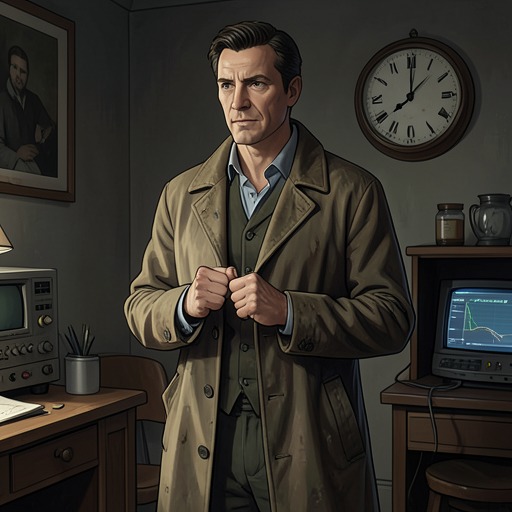
Dan Davis's involuntary cold sleep
The Door into SummerDan Davis’s involuntary cold sleep is the central reversal in his attempt to escape the danger posed by Miles Gentry and Belle Gentry: after Dan has decided against sleeping, Belle drugs him and directs him into the very procedure he meant to refuse. The episode preserves his awareness while stripping him of the ability to think or resist, then separates the continuity of his living body from the security of the legal and financial arrangements meant to protect it. He wakes thirty years later with the memory of the betrayal intact but his assets gone.
Consent, custody, and the abandoned plan
Dan’s cold-sleep arrangements had been carefully formalized. Because a client in cold sleep was legally in chancery—alive but helpless—court consent was required, as well as a physical examination. The paperwork was processed with striking speed: the insurance agent prepared four original copies of nineteen documents, Dan signed until his fingers cramped, and a messenger hurried them away while Dan went for his examination. The procedure was not merely a medical decision; it placed his body and affairs under a system of legal custody.
Yet Dan later decided not to go through with it. When Belle questioned him under the drug’s influence, he explained the whole plan from the beginning, including that he had changed his mind. His account included his decision in a drive-in, his trip to confront Miles and Belle, and the arrangements he had made for his Hired Girl stock. The difference between what Dan could say and what he could choose becomes the scene’s governing contradiction: he can recount his refusal, but Belle turns that account into a prompt for reversing it.
The drug and the loss of agency
Belle’s weapon is the “zombie” drug, which Dan identifies afterward as a government-developed answer to brainwashing. He describes it as illegal and exceptionally effective; in his understanding, even a psychiatrist would require a court order to use it. The needle leaves him conscious but passive. He can hear and see, and can answer questions, yet he cannot think freely or initiate action. The drug therefore does not simply knock him out: it makes his capacity to respond available to Belle while removing his capacity to direct himself.
Belle exploits that narrow opening by asking him to explain the sleep arrangements and his change of mind. Dan answers because her questions are structured so that he can respond. Once his account confirms that he had decided against sleeping, she tells him that he has changed his mind again, that he wants the cold sleep, and that he will take it. Dan repeats the instructed decision and begins to sway after standing motionless for what he estimates may have been more than an hour. His body’s gradual collapse makes visible what the drug has already done to his will.
The coercion is sharpened by Dan’s trust in Belle. When he feels the needle, his first reaction is astonishment that she would do this to him; he still trusted her at the moment she betrayed him. That remembered shock distinguishes the event from a simple capture by an enemy. Belle’s familiarity gives the drugged command its force, while Dan’s later account makes clear that awareness survived even where meaningful consent did not.
The journey to the sanctuary
The decision to proceed is put into practice at the Consolidated Sanctuary at Sawtelle, a facility used by smaller insurance companies that did not operate their own sanctuaries. Belle and Miles take Dan there; he sleeps during the drive, then wakes when Belle speaks to him. Miles remains in his car while Belle accompanies Dan inside and presents herself as his sister. The institutional setting makes the contrast between formal custody and personal coercion especially pointed: Dan arrives under the appearance of an orderly, insured procedure, but the decision to bring him there has been imposed through the drug.
The sanctuary’s custody contract with Master Insurance Company of California is separate from the contract managing Dan’s estate. The sanctuary representative explains that the hypothermia, custody, and revivification fee has been paid in advance and placed in escrow with the superior court’s chancery division, then released quarterly as earned. This arrangement is explicitly described as protection for a client who is helpless. It secures the provision of care, but it does not secure Dan’s control over the decision that brought him into care or guarantee that his estate will survive the decades of his absence.
Awakening and belated memory
Thirty years later, Dan wakes in a hospital bed. His return to consciousness follows a disorienting interval: he recalls heat and a forest fire on a mountain, being urged to wake, a vibrating table, lights, equipment, and people around him. Once fully awake, he feels physically well aside from a listless, floating sensation. Nurses prevent him from asking questions and give him something to take by mouth; he is also massaged. When he finally feels fine, he gets out of bed, recognizes who he is, and understands that the intervening images were dreams.
He also recognizes who put him there. Any instructions Belle may have given him while he was drugged to forget her actions either failed or lost their hypnotic effect during the thirty years of cold sleep. His memory of being shanghaied remains, though some details are blurred. Recognition returns before anger does: he says he is not especially angry, even though the events feel like “yesterday” in the sequence of his life. His recollection is close and vivid, but his emotional response belongs to something remote. Cold sleep thus divides memory from feeling rather than erasing either one.
Dan intends to find Belle and Miles and take revenge, but sees no need to hurry; he is more eager to look at the year 2000. The shift in priority does not undo the remembered betrayal. Instead, the thirty-year interval has altered its emotional distance and placed his immediate curiosity about the new era ahead of retaliation. The episode ends its first reversal not with a confrontation, but with Dan awake, physically restored, and newly oriented toward a future he did not choose to enter.
Legal protection and financial ruin
The sanctuary’s escrow system and Dan’s estate arrangements illustrate two different outcomes of institutional protection. The money paid in advance for his care is held and disbursed under chancery supervision, but the assets Dan expected to retain have not endured. When he asks how much he owns, he is told that he has no assets. He protests that the stocks he invested in are doing well and points to a copy of the Times, only to learn that he owns none of them: Master Insurance has gone broke.
The sanctuary representative distinguishes the company’s collapse from the Panic itself. Master Insurance failed as part of the collapse of the Mannix Group, after the Panic, and was systematically looted until it was an empty shell; those responsible were beyond extradition by the time the fraud was discovered. Dan’s body has survived the sleep, and the sanctuary has performed its custodial function, but the separate company entrusted with his estate has disappeared. The consequence is a sharp split between biological survival and economic continuity: Dan returns as the same person who signed the documents, yet the property he expected to find waiting for him is gone.