Long Sleep cold-sleep technology
The Door into SummerLong Sleep cold-sleep technology makes time itself a form of travel: a person can pass across decades by surrendering consciousness and relying on others to preserve and revive the body. Its promise is inseparable from vulnerability. A sleeper remains legally alive but unable to act, so court supervision, custody contracts, and secured funds become part of the technology’s practical meaning. Dan Davis’s experiences expose the gap between bodily continuity and economic security, while his later decision to sleep again turns the procedure into a means of keeping a promise to Ricky and returning to a future he has already seen.
Definition and Legal Status
Cold sleep is not treated as death. When Dan considers entering it, he understands that a client in cold sleep is legally in chancery: alive, but helpless and therefore subject to legal oversight. Consent from a court and a physical examination are required. The law’s classification preserves the sleeper’s personhood, but also recognizes that an unconscious client cannot manage his own affairs.
The distinction between the sleeper’s body and his legal and financial interests is consequential. Dan assumes the formalities may make his plan slow, yet the paperwork is prepared in quadruplicate across nineteen separate documents, and a messenger carries it off while Dan attends the examination. He never sees the judge. The procedure’s administration thus appears efficient, but that efficiency does not mean the sleeper can protect himself once he is unconscious.
Custody and Financial Safeguards
A sanctuary’s custodial contract is separate from the insurance company’s agreement to manage a client’s estate. The sanctuary explains to Dan that its contract with Master Insurance Company of California covers hypothermia, custody, and revivification, with the full fee paid in advance. The funds are held in escrow by the superior-court division handling chancery matters and released to the sanctuary quarterly as earned. This arrangement is intended to protect someone who cannot protect himself: advance payment is paired with court-supervised disbursement rather than handed over all at once.
The separation of contracts matters because care of the body and management of the estate are different obligations. The sanctuary can fulfill its custodial role only while the resources and institutions supporting it remain intact; it does not thereby guarantee that the sleeper’s other assets will survive. Cold sleep therefore depends not only on a medical process but on a chain of legal and financial arrangements extending through the sleeper’s absence.
The Collapse of Financial Continuity
When Dan awakens and asks what assets he still has, he is told that he owns none. He remembers having had little personal property before his sleep: his car’s fate is unknown, he closed his Mojave checking account, and the cash he carried was only thirty or forty dollars. He nevertheless believes the stocks he invested in remain valuable, pointing to a copy of the Times. The answer is that he owns no stocks because Master Insurance has failed.
The failure is connected to the collapse of the Mannix Group, which followed the Panic. Master Insurance was systematically looted, leaving a hollow shell before the perpetrators were beyond extradition. Dan’s case makes the limits of the safeguards visible: the sanctuary’s custodial contract and escrow provisions addressed his helplessness during care, but his property was entrusted to a distinct financial arrangement that did not endure. The body can be preserved across decades even as the economic identity attached to it is erased.
Time Displacement and the Possibility of Return
Cold sleep also serves as a way back from time displacement. Dan points out that a traveler sent into the past could return by entering cold sleep and waking in a later period. Chuck accepts that this would be possible only if the traveler went back a short enough distance to reach a time when cold sleep existed—no farther back than the war. The method offers no route to a remote historical age: the imagined opportunity to witness the Crucifixion is dismissed as impossible, both because a traveler could not return and because the globe lacked sufficient power. The conversation also establishes that time displacement consumes costly equipment and power, including power taken from the Arco reactors.
This return mechanism links two different forms of temporal passage. Time displacement can cast someone into the past or future without control over the direction, while cold sleep can carry a person forward through a chosen interval of unconsciousness. It does not make time travel freely reversible, but it supplies a limited bridge home when the past still has the technology needed to preserve and revive the traveler.
Dan, Pete, and the Second Sleep
Later, Dan tells eleven-year-old Ricky that he cannot stay with her and that he must take the Long Sleep. He cannot explain the true reason in a way she would believe, and refuses to substitute a lie. Ricky understands what cold sleep means and fears that she will never see him again. Dan reassures her that she will: Pete will go with him, and both will sleep until their reunion is possible. Ricky would rather have Dan and Pete come to Brawley and live with her and her grandmother, but Dan holds to his plan.
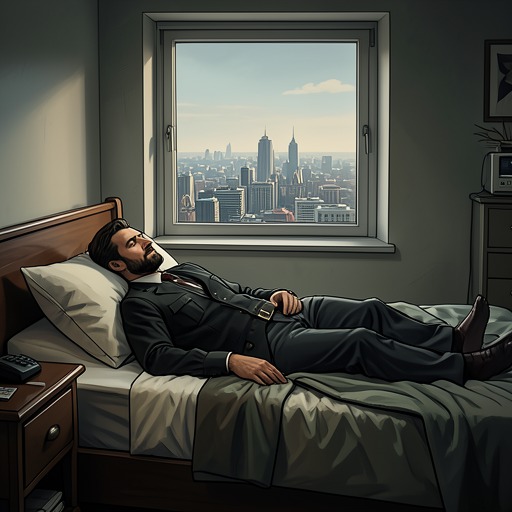
Before the second procedure, Dan comforts Pete as the cat receives the first sedative, then lies back for his own treatment. He could have waited another day, but is urgently eager to return to 2001. Around four in the afternoon, with Pete’s flat head resting on his chest, he falls asleep. When he wakes, he is untroubled by disorientation and wants breakfast and the Great Los Angeles Times rather than conversation. He does not explain that this is his second passage through cold sleep, knowing the doctor would not believe him. The procedure’s recurrence gives it a personal meaning beyond preservation: Dan and Pete use it together to cross the interval separating him from the future in which he expects to find Ricky again.